

If you’ve ever watched a Brazilian Jiu Jitsu class, you’ve noticed the rainbow of belts on the mat. The BJJ grading system is one of the most respected ranking structures in martial arts — and one of the slowest. Unlike disciplines where a black belt can be earned in three to four years, BJJ demands a decade or more of consistent training. Each belt represents real, tested skill. At Global Martial Arts USA in Gallatin, TN, our IBJJF-certified instructors guide students through every stage of this journey, from their first day as a white belt to the mastery that comes with years on the mat.
This guide breaks down every belt in the BJJ ranking system — what each color means, how long promotions typically take, what the IBJJF requirements are, and how stripes and degrees work at the advanced levels.
How the BJJ Grading System Works
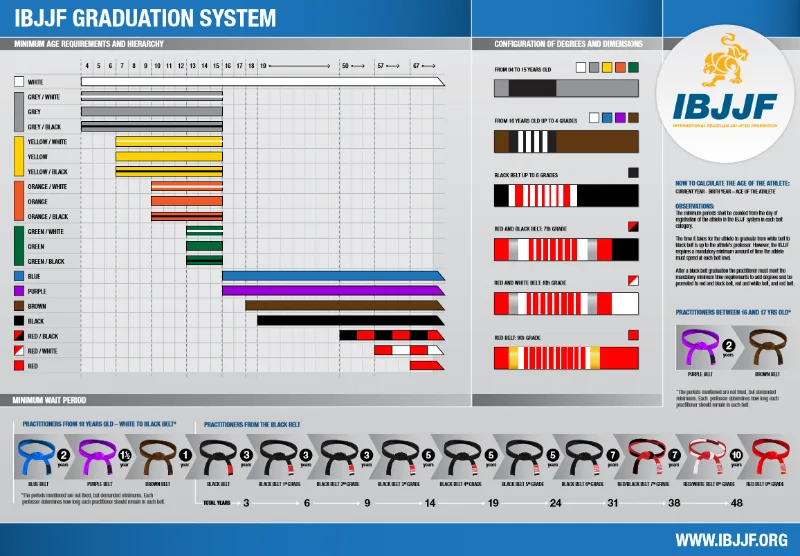
The BJJ belt system follows standards set by the International Brazilian Jiu-Jitsu Federation (IBJJF), the sport’s primary governing body. Unlike many traditional martial arts that use formal testing with set techniques, BJJ promotions are largely at the professor’s discretion. Your instructor evaluates your technical knowledge, sparring ability, competition results, time on the mat, and overall development as a practitioner.
Each belt below black belt can carry up to four stripes — small strips of tape wrapped around the belt’s black bar. Stripes mark incremental progress within a rank and give students visible milestones between promotions. Not every school uses stripes the same way, but the four-stripe system is the IBJJF standard.
At GMA, our BJJ program follows the Gracie lineage and IBJJF guidelines. Promotions are earned through consistent training, demonstrated skill, and character development — there are no pay-to-promote shortcuts.
White Belt: Where Every BJJ Journey Begins
The white belt is your starting point. There are no prerequisites, no minimum age for kids programs, and no experience required. Every world champion, every coral belt, every legend in the sport started right here.
As a white belt, you’ll focus on fundamental positions, basic submissions, escapes, and the core principles of leverage and body mechanics that make BJJ effective regardless of size or strength. You’ll learn to survive, then to defend, then to attack. The IBJJF has no minimum time requirement at white belt — promotion to blue belt depends entirely on your professor’s assessment of your readiness.
Most students spend one to two years at white belt. The biggest challenge at this stage isn’t physical — it’s mental. Learning to be comfortable in uncomfortable positions, accepting that higher belts will submit you regularly, and showing up consistently despite the steep learning curve are what separate white belts who earn their blue from those who quit.
Blue Belt: Building Your Game
Blue belt is where your personal style starts to take shape. You’ve survived the fundamentals and now you’re developing go-to techniques, chaining movements together, and starting to control the pace of rolls with less experienced partners.
The IBJJF requires that practitioners be at least 16 years old to receive a blue belt and must remain at blue belt for a minimum of two years before promotion to purple. In practice, many students spend two to four years at blue. This is also where the highest dropout rate in BJJ occurs — the initial excitement has faded, the belt feels like a plateau, and the road ahead looks long. The students who push through this phase develop the discipline and resilience that define the art.
Blue belts at GMA train alongside our upper belts and begin developing the problem-solving mindset that separates BJJ from other martial arts. You’re no longer just learning techniques — you’re learning when and why to use them.
Purple Belt: The Transition to Advanced Jiu Jitsu
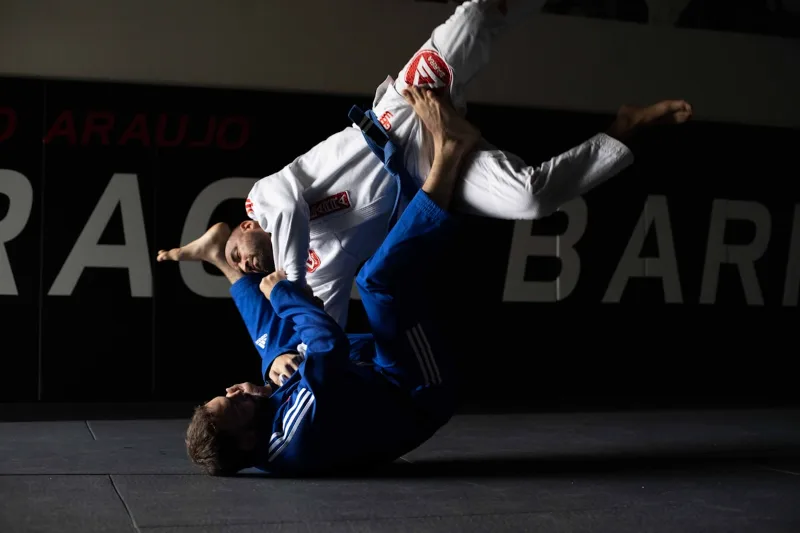
Purple belt is the bridge between intermediate and advanced. At this level, you’ve accumulated thousands of hours on the mat and your technique library is deep. You can handle most situations from most positions, and you’ve started developing a game that plays to your body type and strengths.
The IBJJF requires purple belts to be at least 16 years old and to have spent a minimum of 18 months at purple before being eligible for brown belt. Most purple belts train at this rank for two to three years. Many purple belts also begin helping instruct lower-ranked students — teaching solidifies your own understanding and is considered part of the growth process in BJJ culture.
Purple belt is where people start to take notice. Your rolls with higher belts become competitive, your submissions are precise, and your defense is strong enough that even brown and black belts have to work for their positions.
Brown Belt: Refining Mastery
Brown belt is the final step before black. The technical gap between a skilled purple belt and a brown belt might not look dramatic to an outside observer, but the difference is in the details — timing, pressure, transitions, and the ability to impose your game on anyone at any level.
The IBJJF requires a minimum of one year at brown belt before promotion to black, with a minimum age of 18. Most practitioners spend one to two years at brown belt. At this stage, the focus shifts from learning new techniques to refining everything you know and eliminating gaps in your game.
Brown belts are often described as “black belts in training.” The knowledge is there — the remaining work is polish, consistency, and the kind of deep understanding that only comes from years of repetition under pressure.
Black Belt and Beyond: Degrees, Coral Belts, and Red Belts
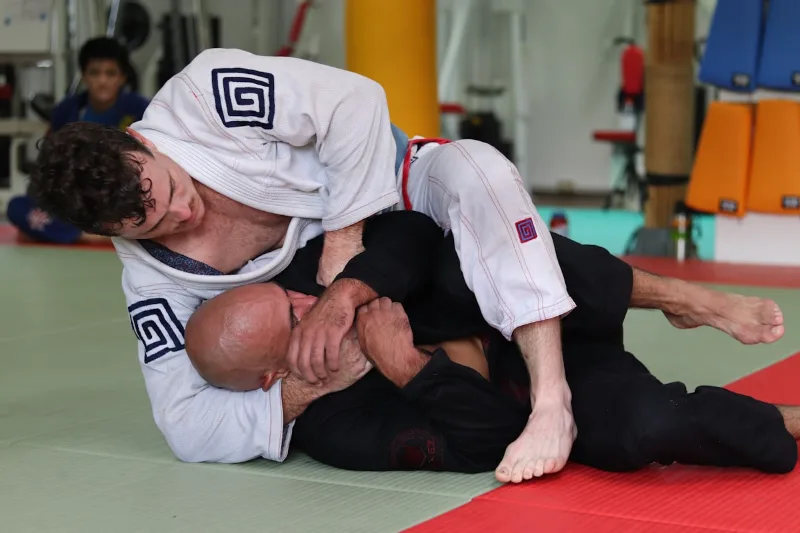
Earning a BJJ black belt is a milestone that takes most practitioners eight to twelve years of consistent training. The IBJJF requires candidates to be at least 19 years old. But the black belt isn’t the finish line — it’s widely considered the beginning of a deeper understanding of the art.
After black belt, practitioners earn degrees rather than stripes. The IBJJF awards the first three degrees at three-year intervals, degrees four through six at five-year intervals, and degree seven requires seven additional years. At seventh degree, the belt itself changes — the traditional black belt becomes a coral belt with alternating red and black bars, recognizing a lifetime of contribution to the art. Eighth degree is also a coral belt. The ninth and tenth degrees carry a red belt, reserved for the pioneers and grandmasters who shaped BJJ into what it is today.
At GMA, our BJJ program operates under IBJJF-certified instruction with direct Gracie lineage. That means every promotion our students earn carries the credibility of the sport’s highest governing body — the same organization that oversees world championships. Our head instructor holds an IBJJF BJJ Black Belt, bringing competition-tested knowledge to every class. For students ready to dive deeper into competition-level training, explore our dedicated BJJ program at GMA Team.
Youth Belt Rankings: The Kids BJJ System
Children under 16 follow a separate ranking system with more belt colors and smaller increments of progression. The youth system moves through white, then grey (starting at age 4), yellow (age 7), orange (age 10), and green (age 13). Each color group includes three variations — a color-white belt, solid color, and color-black belt — giving young students frequent milestones to work toward.
When a practitioner turns 16, they transition into the adult system. A green belt with strong skills might receive a blue or purple belt upon transition, depending on their professor’s evaluation. Our kids martial arts program at GMA uses this structured progression to keep young grapplers motivated while building the fundamentals they’ll carry into the adult ranks.
What Makes BJJ Belt Promotions Different
The BJJ grading system stands apart from most martial arts for one key reason: there are no formal tests at most schools. You don’t memorize a set of techniques and demonstrate them on command. Instead, your professor watches you train — day after day, month after month — and promotes you when your overall game, attitude, and mat time reflect the next level.
This approach keeps the belts honest. A BJJ blue belt from any reputable school can defend themselves on the ground against most untrained opponents. A purple belt can handle most martial artists who don’t train grappling. A black belt has spent a decade or more pressure-testing every technique against resisting partners. There’s no shortcut, and that’s the point.
If you’re considering starting BJJ in Gallatin, TN, know that the journey is long but the rewards compound at every stage. The confidence, problem-solving ability, physical fitness, and community you build along the way are worth far more than the color around your waist. And if you’re interested in how belt systems work across other martial arts, our guide to the martial arts belt ranking system covers TaeKwonDo, HapKiDo, and more.
Ready to Get Started?
Your first class is free. Whether you’re a complete beginner or an experienced martial artist, we’d love to welcome you to the GMA family.
Call us at (731) 324-3847 or book your free trial online.
Frequently Asked Questions
How long does it take to get a black belt in BJJ?
Most practitioners earn their BJJ black belt in eight to twelve years of consistent training. The IBJJF sets minimum time requirements at each belt — two years at blue, 18 months at purple, and one year at brown — but actual promotion timelines depend on training frequency, skill development, and your professor’s assessment. There are no shortcuts in a legitimate BJJ program.
What are the stripes on a BJJ belt?
Stripes are small pieces of tape wrapped around the black bar of your belt. Each belt from white through brown can carry up to four stripes, marking incremental progress within that rank. They give students visible milestones between belt promotions, though not all schools use stripes the same way. After black belt, the markings are called degrees and follow IBJJF time-in-rank requirements.
Is the BJJ belt system the same at every school?
The belt colors and general progression are standardized by the IBJJF, but individual schools may vary in how strictly they follow minimum time requirements and how they evaluate readiness for promotion. Schools affiliated with the IBJJF or with direct lineage to the Gracie family tend to follow the most consistent standards. At GMA, our IBJJF-certified instruction ensures promotions carry recognized credibility.