
One of the first questions every new martial arts student asks is: what do the belt colors mean? The martial arts belt ranking system is more than just a visual marker — each color represents a stage of growth, knowledge, and commitment on your journey from beginner to black belt.
At Global Martial Arts USA, our belt system follows the traditional Korean TaeKwonDo ranking structure. This guide breaks down every belt color, what it symbolizes, and what’s expected at each level — from your very first white belt all the way through 9th Dan Black Belt.
How the Belt Ranking System Works
Korean martial arts use two ranking categories. Gup (also spelled Kup) ranks are the color belt levels — these are the ranks you progress through as a beginner and intermediate student. Dan ranks are the black belt degree levels, starting at 1st Dan and going up to 9th Dan.
The Gup system counts down — a 10th Gup (white belt) is the most junior, and a 1st Gup (black stripe belt) is the most senior color belt. Once you earn your black belt, the Dan system counts up — 1st Dan, 2nd Dan, and so on.
Belt promotions aren’t automatic. Students must demonstrate proficiency in forms (poomse), techniques, sparring, and knowledge of Korean terminology before advancing. Your instructors evaluate your progress and determine when you’re ready to test. The minimum time at each Gup level is 3 months, but curriculum and class time requirements must also be completed.
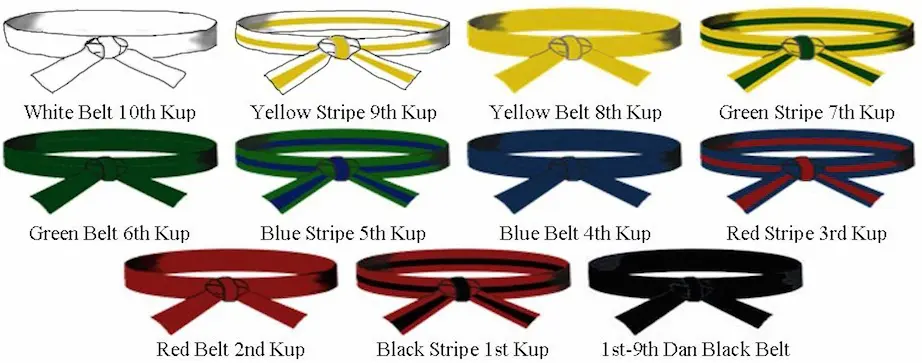
Color Belt Ranks (Gup Levels)
Each belt color in TaeKwonDo carries symbolic meaning rooted in nature and the student’s growth. Here’s every rank from your first day to the doorstep of black belt.
White Belt — 10th Gup
The white belt represents a blank slate — purity and the beginning of your martial arts journey. Every student starts here, regardless of age or athletic background. At this level, you’ll learn basic stances, your first kicks, and the foundational etiquette of the dojang (training hall).
Yellow Tag Belt — 9th Gup
A white belt with a yellow stripe. This is your first promotion and signals that the seed has been planted. You’ve demonstrated the basics and shown the discipline to continue training.
Yellow Belt — 8th Gup
The yellow belt symbolizes the earth where the seed takes root. You’re building a solid foundation of basic techniques, learning your first forms, and developing coordination and balance.
Green Tag Belt — 7th Gup
A yellow belt with a green stripe. You’re transitioning from basic fundamentals to more complex techniques. The green tag signals that your skills are beginning to sprout.
Green Belt — 6th Gup
The green belt represents the plant beginning to grow. Your techniques are becoming sharper, your forms more precise, and you’re starting to understand the deeper principles behind each movement.
Blue Tag Belt — 5th Gup
A green belt with a blue stripe. You’re reaching toward the sky — your training is becoming more advanced and your understanding of martial arts philosophy is deepening.
Blue Belt — 4th Gup
The blue belt represents the sky that the plant grows toward. At this level, you’re an intermediate student with solid fundamentals. Your kicks are higher, your forms are cleaner, and you’re beginning to develop your own style within the structure of the art.
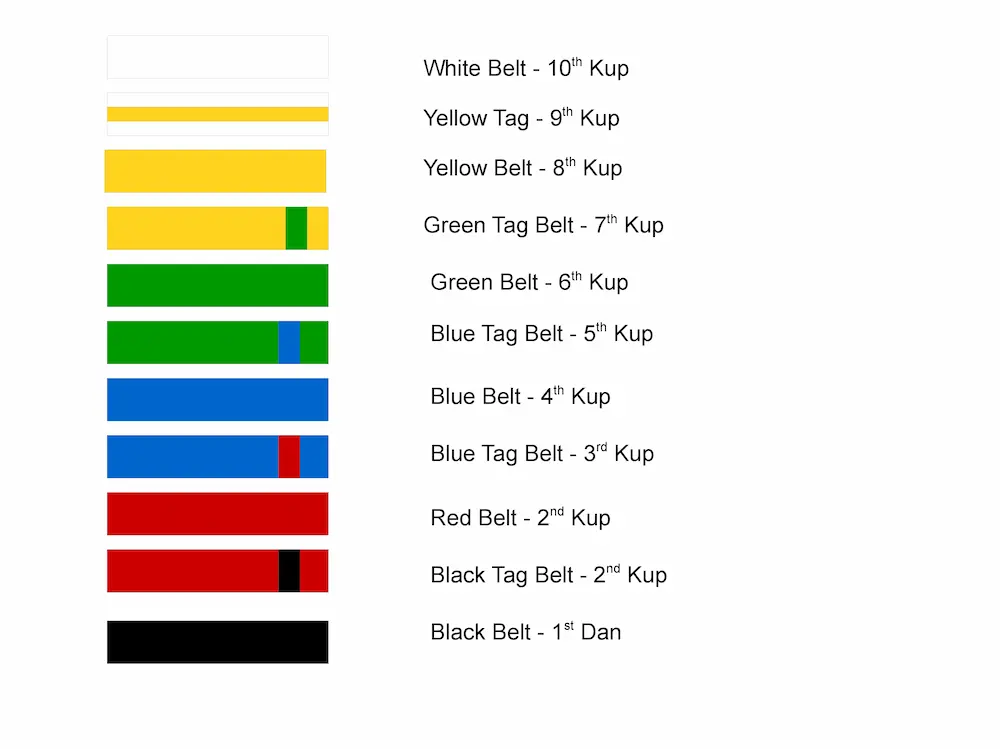
Blue Tag Belt (Red Stripe) — 3rd Gup
A blue belt with a red stripe. You’re approaching the advanced color belt ranks. At this level, students at GMA can begin leadership training and assist with younger students’ classes.
Red Belt — 2nd Gup
The red belt symbolizes danger — both the power the student now possesses and the caution needed to use it wisely. Red belt students demonstrate strong technique, advanced forms, and competitive sparring ability.
Black Tag Belt — 1st Gup
A red belt with a black stripe — the final step before black belt. This is the most senior color belt rank. Students at this level are refining every aspect of their martial arts: precision, power, mental discipline, and readiness for the Dan examination.
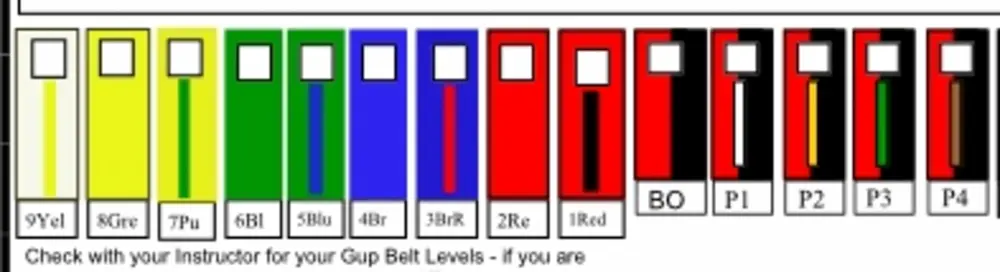
Black Belt Ranks (Dan Levels)
Earning a black belt is not the end of the journey — it’s the beginning of a deeper one. The Dan ranking system has nine degrees, each requiring progressively more years of training, teaching, and contribution to the art.
1st Dan — Training Instructor
Minimum 3.5 to 4 years of total training. A 1st Dan black belt can serve as a Training Instructor at GMA, assisting certified instructors in classes. For juniors (ages 10-15), this rank is called 1st Poom (Junior Black Belt).
2nd Dan — Certified Instructor
Minimum 3 years at 1st Dan, with 6 to 8 years of total training. A 2nd Dan holder can become a Certified Instructor — qualified to lead classes independently. Must be at least 18 years old and pass a background check, SafeSport exam, and coaching certification.
3rd Dan — Certified Instructor
Minimum 3 years at 2nd Dan, with 7 to 10 years of total training. Continued deepening of expertise, teaching ability, and contribution to the school community.
4th Dan — Certified Senior Instructor
Minimum 4 years at 3rd Dan, with 15 to 17 years of total training. Minimum age 25. A 4th Dan or higher must test in front of several internationally certified Grandmaster-level examiners. If a student earned Poom (Junior Black Belt) at a young age, they can potentially reach 4th Dan by age 20.
5th Dan — Master Level Instructor
Minimum 5 years at 4th Dan, with 18 to 20 years of total training. Minimum age 30. Only Master-level instructors (5th Dan and above) can test black belt candidates. This is the threshold of true mastery in the art.
6th Dan — Master Level Instructor
Minimum 6 years at 5th Dan, with 23 to 25 years of total training.
7th Dan — Master Level Instructor
Minimum 7 years at 6th Dan, with 28 to 32 years of total training. At this level, the title changes from Master to Grandmaster (KwanJangNim in Korean).
8th Dan — Grandmaster
Minimum 8 to 10 years at 7th Dan, with 40 years of total training. Minimum age 52.
9th Dan — Grandmaster
Minimum 8 to 10 years at 8th Dan, with 50 years of total training. Minimum age 60. The highest achievable rank in TaeKwonDo. At GMA, our founder KwanJangNim Spillmann holds a 9th Degree Black Belt — representing over 50 years of dedication to the martial arts.

GMA Instructor Certification Standards
At Global Martial Arts USA, we hold our instructors to the highest standards. Only Certified Instructors (2nd Dan Black Belt or higher) can lead classes — all uncertified individuals can only assist under the direction of a certified instructor.
To become a GMA Certified Instructor, you must pass a background check, complete a yearly SafeSport exam, pass a coaching exam, attend rules seminars, and participate in monthly instructor training classes to maintain your teaching credentials. These standards ensure that every student at GMA learns from qualified, vetted, and continuously improving instructors.
How Long Does It Take to Get a Black Belt?
At GMA, the minimum time from white belt to 1st Dan black belt is approximately 3.5 to 4 years for adults. For children who begin as Junior Black Belts (Poom), the timeline can be 3.5 to 8 years depending on age and dedication.
There are no shortcuts. Each Gup level requires a minimum of 3 months in rank, plus completion of curriculum requirements and class attendance. Your instructors at GMA will work with you individually to ensure you’re prepared for each promotion — the goal isn’t speed, it’s genuine skill development.
If you’re interested in exploring other martial arts styles alongside TaeKwonDo, GMA offers HapKiDo, Brazilian Jiu Jitsu, Tai Chi, Wing Chun, and self defense classes — each with their own ranking systems and progression paths.
Ready to Get Started?
Your first class is free. Whether you’re a complete beginner eyeing that white belt or an experienced martial artist looking to continue your journey, we’d love to welcome you to the GMA family.
Call us at (731) 324-3847 or book your free trial online.
Frequently Asked Questions
How long does it take to get a black belt in TaeKwonDo?
At GMA, the minimum time from white belt to 1st Dan black belt is approximately 3.5 to 4 years for adults. Each Gup (color belt) level requires a minimum of 3 months plus completion of curriculum and class time requirements. The actual timeline depends on your dedication, attendance, and individual progress.
Can kids earn a black belt?
Yes. Children ages 10-15 can earn a Poom (Junior Black Belt), which is equivalent to a Dan rank but designated for younger students. Junior black belts can serve as assistant instructors for younger children’s classes. The minimum training time for a 1st Poom is 3.5 to 8 years depending on the student’s age and when they begin.
What does each belt color mean?
Each color represents a stage of growth inspired by nature. White represents a blank beginning, yellow is the earth where the seed roots, green is the growing plant, blue is the sky the plant reaches toward, red represents danger and power, and black symbolizes maturity and mastery. Stripe belts (tags) mark the transition between each solid color rank.