

Every roll in Brazilian Jiu Jitsu ends one of two ways: the clock runs out, or somebody taps. The BJJ moves that produce that tap — the submissions — are what draw most people to the art in the first place. There are hundreds of them, and the beginner who tries to collect techniques instead of building a small, reliable set usually ends up with neither.
This guide covers the submissions that actually matter in your first year on the mat: what separates a choke from a joint lock, which finishes have the highest success rates when it counts, what the rules let you attack at white and blue belt, and how to drill all of it without hurting the training partners you’ll need next week.
What Counts as a Submission in BJJ?
Strip away the names and every submission in jiu jitsu falls into one of two categories. Chokes (more accurately, strangles) restrict blood flow through the carotid arteries or, less often, air through the windpipe. Joint locks take a joint past its normal range of motion — the elbow, shoulder, knee, or ankle. That’s the whole menu. The hundreds of techniques you’ll eventually see are variations on those two ideas, applied from different positions.
Which brings up the rule that governs all of it: position before submission. A finish applied from a position you can’t hold is a finish your opponent escapes. Beginners who chase the tap from unstable positions spend their first year getting swept and passed; the ones who learn to hold side control and back control first find that the submissions start appearing on their own. If you’re still building that base, our guide to the basic BJJ techniques every beginner should master covers the positions and escapes that come first.
The Highest-Percentage BJJ Moves in Competition
You don’t have to guess which submissions work. Competition data has been tracked for years, and it points in a consistent direction. Roughly 40% of professional-level BJJ matches end in a submission rather than on points — and a small handful of techniques account for most of those finishes.
The rear naked choke sits at the top by a wide margin, accounting for around 45% of all submissions at the 2023 IBJJF World Championships. Beyond it, five techniques — the armbar, rear naked choke, triangle choke, guillotine, and kimura — together produce more than half of all recorded finishes. Collar chokes, available any time you’re training in the gi, post some of the highest completion rates of any attack in the sport.
The practical takeaway for a white belt is unglamorous and worth taking seriously: the submissions that win world titles are the same ones taught in your first month. Depth beats breadth. Ten techniques you can hit on a resisting partner are worth more than fifty you’ve watched on video.
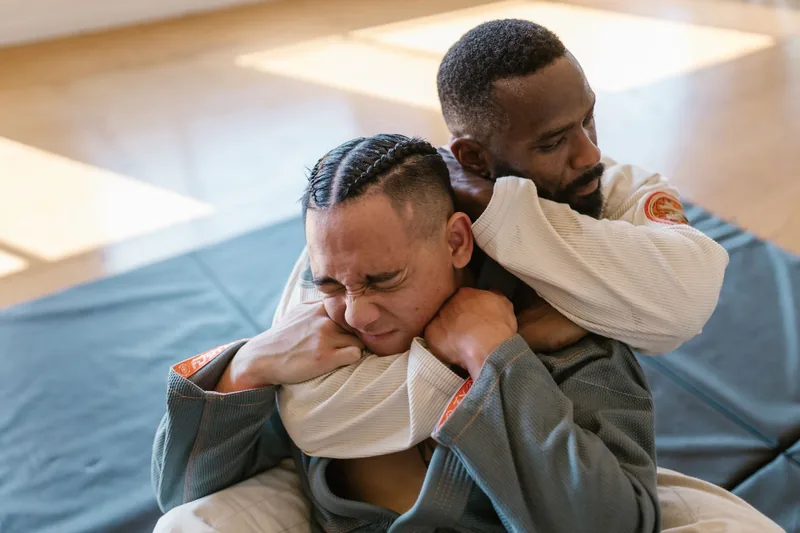
Chokes: The Fastest Way to End a Roll
A well-applied strangle doesn’t require strength and doesn’t care how tough your opponent is. Blood chokes work by compressing the carotid arteries on both sides of the neck, and they finish in seconds whether or not the person on the receiving end wants to continue. That’s precisely why they’re both the most effective and, when trained properly, among the safest submissions in the art.
The rear naked choke. Taken from back control with your arm under the chin and your hands joined, it’s the finish every other choke is measured against. Because back control is the most dominant position in BJJ, the choke that lives there is also the hardest to defend.
Collar chokes. Using your opponent’s own lapel as the tool, the cross collar choke and its cousins are available from guard, mount, and back control. They’re the reason gi training builds such precise grips.
The triangle choke. Your legs encircle the neck and one arm from the guard, turning a bottom position into an attacking one. The guillotine catches the head and neck from the front, most often when an opponent shoots in poorly or postures down in your guard.
One point of technique that matters more than any detail of the grip: chokes finish on the arteries, not the throat. If a training partner is coughing and grabbing their windpipe, the mechanics were wrong.
Joint Locks and Leg Locks: What You’re Allowed to Attack
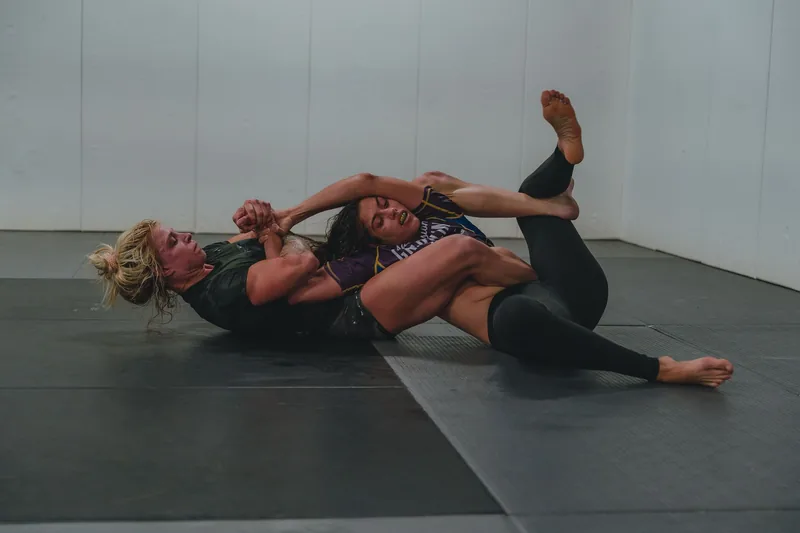
Joint locks give you a second category of threat, and the arm attacks are where every beginner starts. The armbar isolates the arm between your legs and extends the elbow — it can be hit from mount, guard, and side control, which makes it the most versatile submission in the beginner toolkit. The kimura and americana attack the shoulder from opposite directions using a figure-four grip, and both are reliable from side control. Every one of these has a distinct point where the joint reaches its limit, and part of learning them is learning to feel that point in your partner before you pass it.
Leg attacks are a different conversation, because the rules change with your belt. Under IBJJF competition rules, white belts (and the youth ranks below) may not apply leg locks at all. Blue and purple belts are limited to the straight ankle lock. Toe holds, kneebars, and calf slicers open up at brown and black belt, and heel hooks — the most dangerous of the group — remain illegal in gi competition at every belt, becoming legal only for adult brown and black belts in no-gi. Those restrictions exist because knee ligaments give very little warning before they tear. Respect them in the gym as well as at a tournament, and understand where your current rank sits within the BJJ belt ranking system before you start hunting legs.
Learning BJJ Submissions Safely in Gallatin, TN
Submissions are the only techniques in martial arts that let two people train at full intensity and walk away unharmed — but that depends entirely on the culture of the room. Tap early and tap often. A tap costs you thirty seconds; an ego costs you three months in a knee brace. On the applying end, take the finish slowly enough that your partner has time to respond, and release the instant they signal.
The other half is structure. Drilling a submission on a compliant partner teaches the shape of it; hitting it in live rolling teaches the timing, the setup, and the reaction you need to read. You need both, in that order, which is why a real curriculum sequences them deliberately instead of leaving you to figure it out.
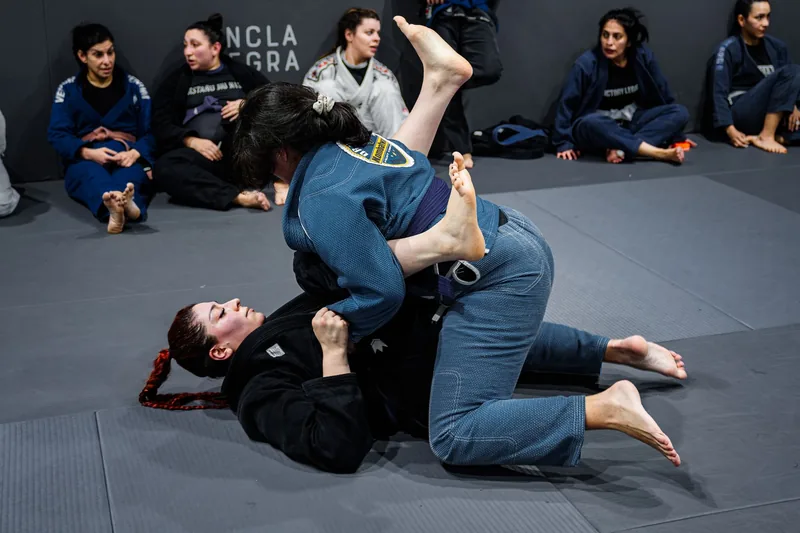
Our Brazilian Jiu Jitsu classes in Gallatin are taught under an authentic Gracie lineage by IBJJF-certified black belt instruction, backed by the 50+ years of martial arts experience behind Global Martial Arts USA. Beginners work a structured fundamentals track — positions and escapes first, then the high-percentage finishes above — before rolling in open mat. Competitors who want to take it further train through our dedicated program at GMA Team. And if BJJ is one of several things you’re weighing, explore our full class lineup — we teach eight disciplines under one roof in Sumner County.
Ready to Get Started?
Your first class is free. Whether you’re a complete beginner or an experienced martial artist, we’d love to welcome you to the GMA family.
Call us at (731) 324-3847 or book your free trial online.
Frequently Asked Questions
What is the most common submission in BJJ?
The rear naked choke, by a wide margin. It accounted for roughly 45% of all submissions at the 2023 IBJJF World Championships and is also the most-used finish in professional mixed martial arts. It’s applied from back control, which is the most dominant position in jiu jitsu.
How many BJJ moves should a beginner learn?
Far fewer than most people expect. A working set of five or six submissions — rear naked choke, armbar, triangle, kimura, americana, and a collar choke — will carry you through your entire white belt and most of blue. Competition data shows a small group of techniques produces the majority of finishes at every level.
Are BJJ submissions dangerous to train?
Trained correctly, they’re remarkably safe, because the tap gives both people a way to end the exchange before any damage occurs. Injuries in jiu jitsu almost always trace back to someone applying a technique explosively or refusing to tap. Leg locks carry the most risk, which is why competition rules restrict them by belt level.