
Nobody warns you that the hardest part of Brazilian Jiu Jitsu is the first six months. Not the conditioning, not the technique — the stretch where you get submitted by people half your size and have no framework yet for why. Most of the BJJ white belt tips floating around focus on moves. The ones that actually keep people training are about how you show up, what you pay attention to, and what you let yourself be bad at.
This is the survival guide we’d hand a new student on day one: what your first month really looks like, the habits that separate the people who make blue belt from the people who don’t, the mat rules nobody says out loud, and an honest timeline for your stripes.
Why Most White Belts Quit — and How Not To
There’s no rigorous study on BJJ retention, but every estimate from gym owners and community surveys lands in the same uncomfortable range: somewhere between 70% and 90% of white belts never make blue belt. Treat the exact number with suspicion — but every instructor who has run a beginner program for a decade will tell you the shape of it is real.
The reason isn’t difficulty. It’s the gap between effort and visible progress. In most sports, a beginner who trains hard sees improvement within weeks. In jiu jitsu, you can train hard for three months and still get tapped by everyone in the room, because everyone in the room has been solving these problems longer than you have. That feels like failure — and feelings are what make people stop coming.
The fix is to change what you measure. Stop scoring rounds by whether you got submitted. Score them by whether you survived a position that used to be hopeless, or hit a sweep you drilled Tuesday. Those move every week. Tap count doesn’t move for a long time.
What Your First Month Actually Looks Like
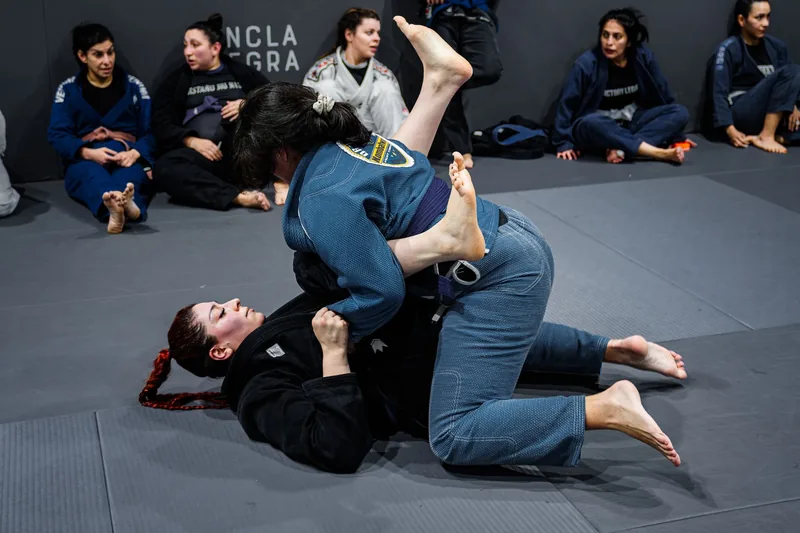
Week one, you will be exhausted in a way that has nothing to do with your fitness level. Grappling uses muscles you don’t train and teaches you to hold your breath under pressure. Everyone gasses; it passes in about three weeks.
Practical logistics: wear a gi if the class is gi, a rash guard and shorts with no pockets or zippers if it’s no-gi. Trim your fingernails and toenails — a safety issue, not a courtesy one. Wash your gi after every session, don’t walk off the mat barefoot, and bring more water than you think you need.
Expect most of your first month to be positional, not flashy: shrimping, bridging, breaking posture, technical stand-up, and learning to recognize mount from side control from knee-on-belly. Our guide to the basic BJJ techniques every beginner should master covers the short list, and what Brazilian Jiu Jitsu is gives you the wider context.
You will also tap a lot. Tapping is not losing — it’s the mechanism that lets two people train dangerous techniques at full speed for decades without injury. Tap early, tap often, tap to pressure and not just to pain.
BJJ White Belt Tips That Actually Speed You Up
Learn to defend before you learn to attack. Escapes from mount, side control, and back control are worth more in your first year than any submission. You cannot attack from underneath a purple belt, but you can learn to get out, and getting out is what buys you the time to build a game.
Pick three positions and go deep. The white belt instinct is to collect techniques — a new sweep every week, none of them retained. Pick a guard, one escape, one submission, and hunt them in every round for two months. Depth compounds; breadth evaporates.
Ask one question per class. Not ten. One specific question about the exact moment a technique failed — “when he posted his hand here, what was I supposed to do?” Specific questions get far better answers, and you’ll remember them.
Roll with the people who beat you. Higher belts are the safest partners in the room — they have the control to let you work and the awareness to stop before something breaks. The people to be careful with are other new white belts with something to prove.
Use your strength less. Muscling out of a bad position works against people your size and fails against everyone better. Every time you force something, you skip the lesson.
Show up twice a week, forever. This is the one that outweighs the other five combined. Two classes a week for a year beats five a week for two months, every single time. Consistency is the entire skill.
Mat Etiquette and the Unwritten Rules
Every gym has norms that nobody announces because everyone already knows them. The short version:
Show up on time. Bow or shake hands before and after every round. Don’t coach your partner mid-roll unless you’re the higher belt and they’ve asked. Don’t slam, don’t crank submissions, and release the moment you feel a tap, hear a tap, or see a tap.
Tell your partner about injuries before you start, not after they’ve grabbed the bad shoulder. If you’re sick, stay home — skin infections spread fast in a room full of people pressed together. And if you’re rolling with someone newer than you, your job is to give them a hard problem, not to prove you can beat a beginner.
These rules exist because jiu jitsu is unusually dangerous to practice carelessly and unusually safe to practice well. Our own mat is built around that, and the same standards run through the dedicated program at GMA Team Brazilian Jiu Jitsu.
Stripes, Blue Belt, and the Honest Timeline
White belt carries four stripes before blue. Under IBJJF rules there’s no minimum time-in-grade required to go from white to blue — that one is entirely instructor discretion — though every belt after it has a required minimum, starting with two years at blue before purple. The one hard rule at this level is age: you must be at least 16 to hold an adult blue belt.
In practice, blue belt at a school with real standards takes around two years of consistent training. Plenty take longer, usually the ones training twice a week around a job and kids — which is most people, and is fine. The full progression is laid out in our BJJ belt ranking system guide.
Stripes are not a schedule. They’re an instructor’s read on your technique, your live rolling, and your understanding of position. If four months pass without one, that’s information about what to work on, not a verdict — ask, and most instructors will tell you exactly what they’re waiting to see.
Somewhere around the one-year mark, you’ll notice the change that makes all of this worth it: you stop reacting and start recognizing. You see the pass coming. You feel the weight shift before the sweep. That’s when jiu jitsu turns from a beating into a puzzle — and the submissions every beginner should know stop being techniques you copy and start being answers you choose.
Starting as a White Belt in Gallatin, TN
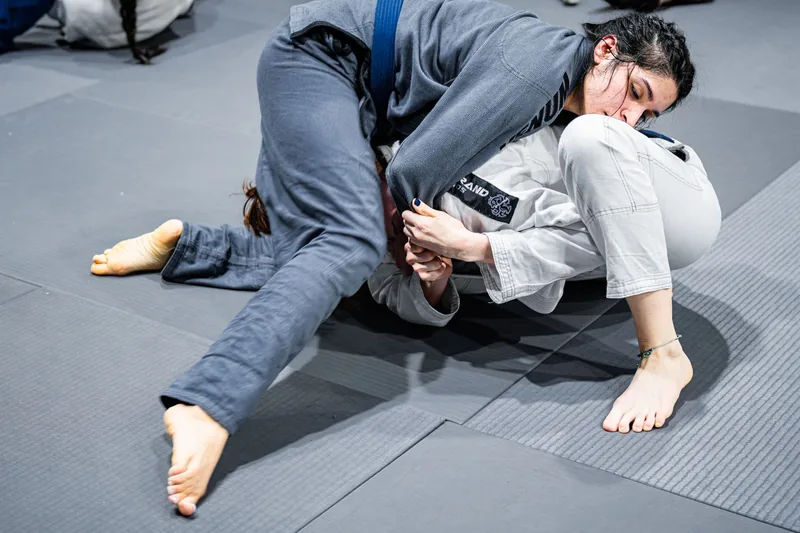
Our Brazilian Jiu Jitsu classes in Gallatin, TN run a structured fundamentals track, so new students aren’t dropped into an advanced room and left to survive. Grandmaster K.O. Spillmann earned his black belt directly under Professor Rocian Gracie Jr. and holds IBJJF and USBJJF Level 3 certification — part of the 50+ years behind Global Martial Arts USA and the reason we’ve been voted a top school in Sumner County.
Gi and no-gi both run weekly, adults and kids train separate programs, and you can check the class schedule for a beginner-friendly time. Nobody starts as anything other than a white belt.
Ready to Get Started?
Your first class is free. Whether you’re a complete beginner or an experienced martial artist, we’d love to welcome you to the GMA family.
Call us at (731) 324-3847 or book your free trial online.
Frequently Asked Questions
How often should a BJJ white belt train?
Two to three classes a week is the sweet spot for most beginners. It’s frequent enough that skills stick between sessions and sustainable enough to keep up for years. Training five or six days a week as a brand-new white belt usually leads to burnout or injury before it leads to a blue belt.
Is it normal to get tapped every round as a white belt?
Yes, and it continues longer than you’d like. Everyone in the room has more time on the mat than you do, and jiu jitsu rewards experience more heavily than almost any other sport. Judge your progress by how long you survive and which positions you escape, not by tap count.
What should I bring to my first BJJ class?
Water, a rash guard or fitted t-shirt, and athletic shorts with no pockets or zippers. Most schools will loan or rent you a gi for a trial class, so don’t buy one before you’ve trained. Trim your nails, remove jewelry, and arrive about ten minutes early to meet the instructor.