
TaeKwonDo and karate are two of the most recognized martial arts in the world, and they get compared constantly. Both are stand-up striking arts, both use belt ranking systems, and both have produced elite competitors at the Olympic level. But beneath those surface similarities, they are fundamentally different martial arts — different origins, different techniques, and different philosophies. If you’ve ever wondered how taekwondo vs karate really stack up, this guide cuts through the noise and breaks it all down.
Whether you’re shopping for martial arts classes or simply curious how these two arts relate, here’s what you actually need to know.
Different Origins: Korea vs. Okinawa
Karate originated in Okinawa, Japan, as a fusion of native fighting traditions and Chinese martial arts brought by traders and diplomats. Weapons were periodically banned in Okinawa for political reasons, which pushed skilled fighters to develop devastating unarmed combat systems. When Japan absorbed Okinawa in the late 1800s, the art spread to mainland Japan and was shaped deeply by Japanese martial philosophy — discipline, stillness, controlled aggression. Today’s major karate styles (Shotokan, Goju-Ryu, Kyokushin) all carry those roots.
TaeKwonDo has a more intentional origin story. When Japan’s occupation of Korea ended in 1945, Korean martial artists — many of whom had trained in karate and Chinese arts during the occupation — began building something distinctly Korean. In 1955, a group of kwan (school) masters formally unified their different approaches under a single name: TaeKwonDo, meaning “the way of the foot and fist.” The art drew heavily from Korea’s own ancient kicking tradition called Taekkyeon, which emphasized fluid, high, and spinning kicks as the primary weapon. TaeKwonDo went on to become an Olympic demonstration sport in 1988 and earned full medal status in 2000.
At Global Martial Arts USA, our TaeKwonDo program carries this Korean tradition forward under KwanJangNim K.O. Spillmann — a 9th Degree Black Belt with over 50 years of experience who studied under masters in the Jidokwon lineage.
Kicking vs. Balanced Striking
The most visible difference between TaeKwonDo and karate is how they divide their technique sets.
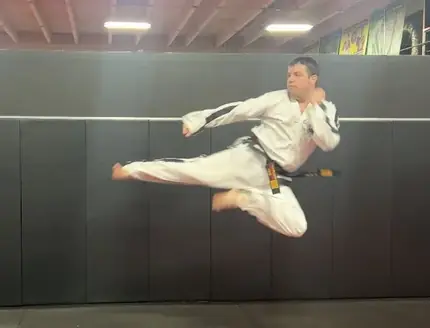
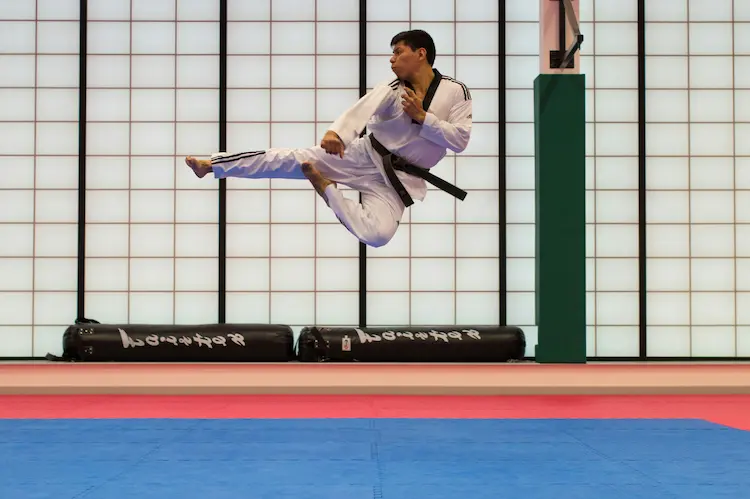
In TaeKwonDo, kicks are the primary weapon. Roughly 70–80% of scoring techniques in Olympic competition come from kicks — and many of those target the head. Spinning heel kicks, jumping roundhouses, axe kicks, sidekicks, and back kicks are staples. Hand techniques exist in the system, but the kicking repertoire is unmatched in any other striking art. TaeKwonDo practitioners train obsessively for leg flexibility, speed, and timing — which is why the art’s competition fighters tend to be among the fastest kickers in the world.
Karate trains a much more even balance. Punches, palm strikes, elbow techniques, and knife-hand strikes are trained just as seriously as kicks. Karate’s foundational stances are lower and more rooted, emphasizing grounded power and explosive close-range delivery. A trained karateka develops knockout force through hand technique — something TaeKwonDo competitors spend far less time on.
Neither distribution is superior. They develop different tools for different ranges. A TaeKwonDo practitioner becomes exceptionally dangerous from mid-to-long range with their legs. A karateka builds powerful, versatile striking from all distances. Students who cross-train both — as many GMA students do — end up with a complete striking game that covers every gap.
Forms, Philosophy, and Competition
Both arts use forms — choreographed sequences of techniques — as a central training method. In TaeKwonDo, these are called poomsae. In karate, they’re kata. Both encode the principles of the art into muscle memory and serve as moving meditation, drilling power generation and precise technique without a partner.
Philosophically, karate reflects Japanese Zen influence — stillness, deliberate action, and controlled aggression. The Japanese concept of mushin (empty mind) runs through every technique. TaeKwonDo’s official tenets — courtesy, integrity, perseverance, self-control, and indomitable spirit — reflect a more dynamic and expressive Korean martial philosophy, well matched to the art’s acrobatic, explosive character.
In competition, Olympic TaeKwonDo (governed by World Taekwondo) rewards head-height kicks and spinning techniques with bonus scoring, making it a high-intensity athletic sport. Karate made its long-awaited Olympic debut at the Tokyo 2020 Games. Both sports produce serious athletes with years of dedicated training — but they reward different skills and test different attributes.
Understanding where these arts come from also means understanding how they fit together with other disciplines. GMA’s martial arts belt ranking system guide covers how rank progression works across Korean arts, which gives useful context if you’re comparing training paths across styles.
Which One Should You Learn?
If your goal is to develop fast, powerful kicks — or you want to compete in a sport with Olympic-level prestige — TaeKwonDo is an outstanding choice. The kicking curriculum at GMA runs from fundamental front kicks all the way through advanced jumping and spinning combinations. Students build flexibility, explosiveness, footwork, and timing that transfers across every other martial art they ever train.
If you want a more balanced striking art that trains hands and feet equally, with a methodical, power-focused approach — traditional karate may be your preference. GMA doesn’t offer a standalone karate program, but our self-defense classes and HapKiDo program both develop practical striking alongside joint locks and grappling — in many respects a more complete combat system than either sport art alone.
Worth noting: the serious martial artists at GMA rarely train just one art. TaeKwonDo builds the legs and footwork. HapKiDo develops joint control and close-range defense. BJJ handles the ground. Combined, they produce genuinely well-rounded martial artists — which has been KwanJangNim Spillmann’s approach to teaching in Gallatin, TN for over 50 years.
Ready to Get Started?
Your first class is free. Whether you’re a complete beginner or an experienced martial artist, we’d love to welcome you to the GMA family.
Call us at (731) 324-3847 or book your free trial online.
Frequently Asked Questions
What’s the main difference between TaeKwonDo and karate?
TaeKwonDo is a Korean martial art that emphasizes high, fast, and spinning kicks — roughly 70–80% of competition scoring comes from kicks, many targeting the head. Karate is Japanese/Okinawan in origin and trains a more balanced mix of hand strikes and kicks, with powerful close-range technique. Both use belt ranking systems and forms training, but their core technique sets reflect very different priorities.
Is TaeKwonDo harder to learn than karate?
Neither is inherently harder — they’re just different. TaeKwonDo requires developing significant leg flexibility and kicking speed, which takes time for beginners. Karate emphasizes powerful, rooted hand technique and stable stances. Most beginners adapt to TaeKwonDo’s dynamic movement style within a few months of consistent training. The real variable isn’t the art — it’s showing up.
Does GMA teach karate?
Global Martial Arts USA doesn’t offer a standalone karate program, but our TaeKwonDo curriculum covers many of the same foundational striking principles. We also offer HapKiDo, Brazilian Jiu Jitsu, Tai Chi, Wing Chun, and self-defense — making GMA a complete martial arts education for students who want to go deeper than any single discipline.