
Walk into your first Brazilian Jiu Jitsu class and the sheer volume of moves can feel overwhelming — there are thousands of techniques, variations, and counters. But every black belt started by drilling the same short list of fundamentals. The basic BJJ techniques you learn in your first few months are the foundation everything else is built on, and mastering them matters far more than memorizing flashy submissions you saw online.
At Global Martial Arts USA in Gallatin, TN, we’ve guided hundreds of beginners through their first steps on the mat. This guide breaks down the core positions, escapes, submissions, and sweeps every white belt should focus on — and why getting these right early sets the pace for everything to come.
What Are the Basic BJJ Techniques Every Beginner Should Learn?
The basic BJJ techniques fall into four buckets: positions (where you want to be), escapes (how to get out of bad spots), submissions (how to finish), and sweeps (how to reverse a bad position into a good one). Beginners who spend their first six months building a real foundation in these four areas progress far faster than those who chase advanced moves before they can hold a stable position.
Here’s the principle that makes it all work: in BJJ, position comes before submission. You establish control first, then hunt the finish. Rushing a choke or armbar from a weak spot is the single most common beginner mistake — and learning to be patient is itself one of the most important skills you’ll develop. If you’re brand new to the art entirely, our guide on what Brazilian Jiu Jitsu is covers the bigger picture before you dive into the moves below.
Fundamental Positions: Guard, Mount, Side Control, and Back Control
Before you can submit anyone, you have to understand the positional hierarchy. These four positions are the map of every roll:
The guard. Fighting off your back is the cornerstone of BJJ, and it’s what most sets the art apart. From closed guard — legs wrapped around your opponent’s waist — you can control a bigger opponent, defend, and attack, all while underneath them. Learning to be dangerous from your back is a beginner’s first real breakthrough.
The mount. Sitting on your opponent’s chest is a dominant top position that opens up submissions and strikes while giving them very little to work with. Side control puts you perpendicular across their torso, pinning their upper body and setting up transitions to mount or submissions. And back control — chest to their back with your heels hooked inside their thighs — is the single most dominant position in BJJ, because they can’t see what you’re doing and the rear naked choke is waiting.
The Two Movements That Unlock Everything: Shrimping and Bridging
Ask any experienced coach and they’ll tell you the same thing: the two most valuable movements for a beginner aren’t submissions at all. They’re escapes — and they underpin nearly everything else you’ll do.
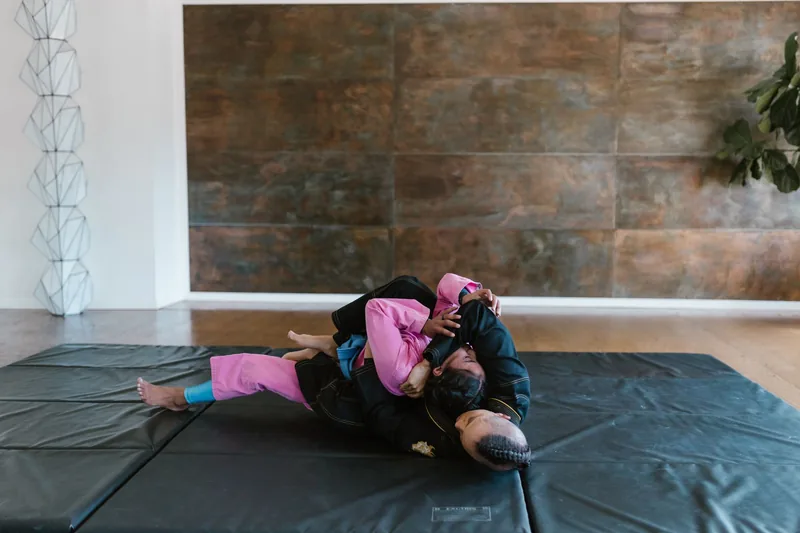
The hip escape (shrimping). This is the most important movement in BJJ. By planting a foot and pushing your hips out to create space between you and your opponent, you recover guard, escape pins, and defend submissions. Almost every escape and guard retention technique is built on top of shrimping, which is why most schools drill it in the warm-up of every single class.
The bridge and roll (upa). The classic escape from under the mount: trap your opponent’s arm, plant your feet close to your hips, bridge explosively upward, and roll them over your shoulder to end up in their guard. Together, shrimping and bridging give you a way out of the two worst positions a beginner ends up in — and the confidence that comes from knowing you can escape is what lets you relax and actually learn.
Beginner Submissions: Your First Finishes
Once you can hold position and escape trouble, you earn the right to finish. These are the highest-percentage submissions for beginners because they’re mechanically simple and work at every level:
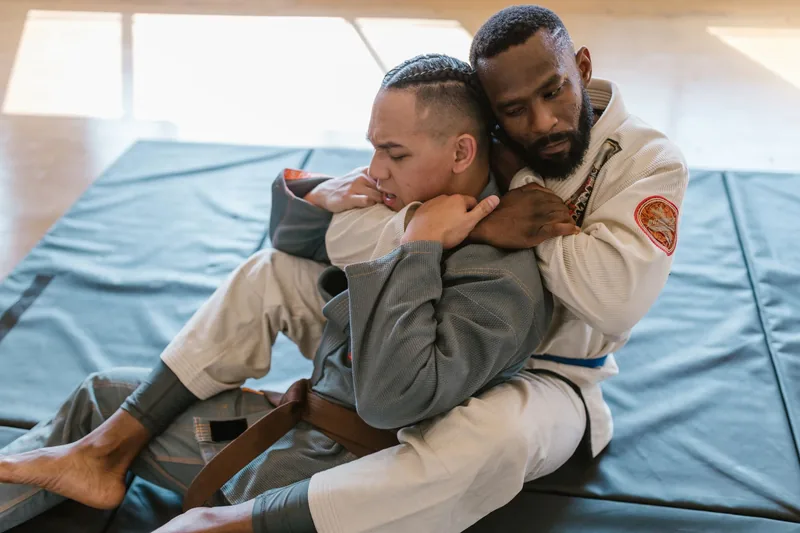
Rear naked choke. Applied from back control, you slide one arm under the chin, grip your own bicep, and squeeze. It attacks the arteries, not the windpipe, so it’s both safe to train and devastatingly effective — it’s the most reliable finish in all of BJJ.
The armbar. Hyperextending the elbow by trapping the arm between your legs, the armbar can be hit from mount, guard, and side control — making it one of the most versatile submissions to learn early.
The triangle choke and shoulder locks. The triangle uses your legs to encircle your opponent’s neck and one arm from the guard. The kimura and americana — two shoulder locks — can be applied from guard, mount, and side control, rounding out a beginner’s core arsenal. In training you’ll “tap” the moment a submission is locked in; tapping is how everyone stays healthy enough to train for decades, not a mark of failure.
Sweeps: Turning a Bad Position into a Good One
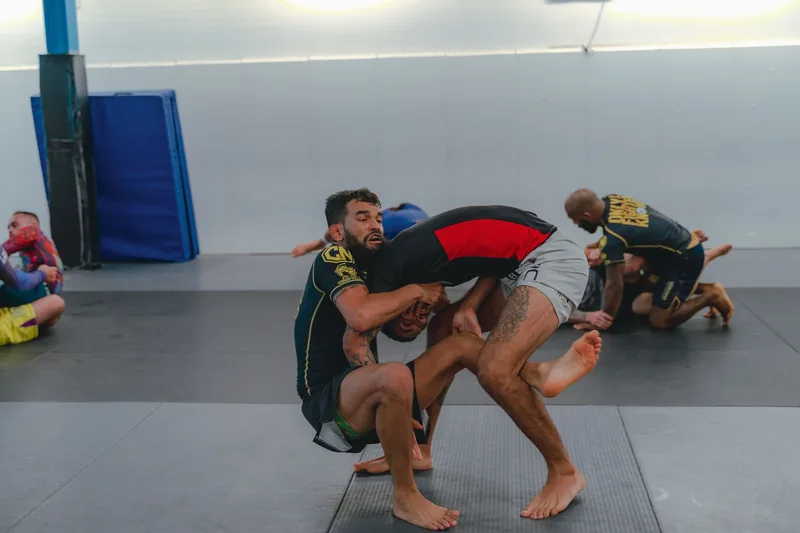
A sweep reverses the situation — you go from being underneath to being on top. For beginners, the scissor sweep is the classic starting point. From closed guard, you control a collar and sleeve, place one shin across your opponent’s belly, and scissor your legs while pulling them forward to roll them over and come up into mount.
Sweeps teach a lesson that defines good jiu jitsu: being on the bottom isn’t the same as losing. A skilled guard player is constantly threatening to reverse the position, and that threat is what makes the guard such a powerful equalizer for smaller practitioners. Mastering a few reliable sweeps is what turns your guard from a place you survive into a place you attack from — and it’s a major milestone on the road through the BJJ belt ranking system.
Learning Basic BJJ Techniques at Global Martial Arts USA in Gallatin
Techniques on a screen only get you so far. What accelerates a beginner is structured, progressive instruction from coaches who know how to build skills in the right order — and a training environment where you can drill safely with partners at your level.
Our Brazilian Jiu Jitsu classes in Gallatin carry a direct Gracie lineage and are taught by IBJJF-certified black belt instructors, backed by 50+ years of martial arts experience at GMA. Beginners start with a structured fundamentals curriculum — the exact positions, escapes, and submissions covered above — before rolling in open mat, so you’re never thrown in the deep end.
Students who catch the competition bug can pursue that path through our dedicated program at GMA Team, where serious competitors train under structured preparation. And if you’re still deciding where to start, explore our full class lineup — BJJ is one of eight disciplines we teach under one roof in Gallatin.
Ready to Get Started?
Your first class is free. Whether you’re a complete beginner or an experienced martial artist, we’d love to welcome you to the GMA family.
Call us at (731) 324-3847 or book your free trial online.
Frequently Asked Questions
What is the first BJJ technique a beginner should learn?
The hip escape, or “shrimping,” is usually the very first thing you’ll drill — often in the warm-up of every class. It’s the foundational movement behind nearly every escape and guard recovery in BJJ, which is why coaches prioritize it before any submission.
How long does it take to learn the basic BJJ techniques?
Most students gain a working grasp of the fundamental positions, escapes, and a handful of submissions within their first three to six months of consistent training. True comfort comes with mat time — but you’ll be able to survive and defend yourself on the ground long before you earn your blue belt.
Do I need to be in shape to start learning BJJ?
No. Most beginners are winded after the first warm-up, and that’s completely normal. BJJ itself builds your conditioning over time. Show up as you are, focus on technique over strength, and the fitness follows naturally.