
Most people met him through a movie. Donnie Yen’s 2008 film turned a quiet Foshan gentleman into a global action icon — but the real Grandmaster Ip Man never threw a punch on screen. He did something more lasting: he took a closely guarded village art and taught it openly. The Ip Man technique that survives him isn’t a single move. It’s a way of thinking about structure, economy, and the centerline that still defines Wing Chun in every school teaching his lineage today.
This guide covers who Ip Man actually was, what made his approach to Wing Chun distinct, how the Hong Kong years turned a regional style into a worldwide system, and why his most famous student changed martial arts a second time. It’s the history behind what students train in our Wing Chun program at Global Martial Arts USA in Gallatin, TN.
Who Was Ip Man? From Foshan to Hong Kong
Ip Man was born Ip Kai-man on October 1, 1893, in Foshan, Guangdong — a wealthy family in a city known for its martial arts culture. He began studying Wing Chun as a boy under Chan Wah-shun, becoming Chan’s sixteenth and final student. It was a short apprenticeship. Chan suffered a stroke in 1909 and retired to his village, leaving Ip with a foundation but not a finished art.
The second half of his education came by accident. As a teenager, Ip moved to Hong Kong for school and encountered Leung Bik — the eldest son of Leung Jan, the legendary Foshan master who had taught Chan Wah-shun. Ip trained under Leung Bik until Leung’s death, and the experience reshaped what he thought he knew — he had learned the art from Leung Jan’s student, and was now learning it from Leung Jan’s son. The refinements from those years became the backbone of the system he would eventually teach.
He returned to Foshan around 1916 and served as a police officer under the Nationalist government, teaching subordinates, friends, and relatives but never opening a formal school. For three decades, Ip Man was simply a skilled man who happened to know Wing Chun. That changed in 1949, when the Communist victory in the civil war sent him to Hong Kong at fifty-six years old, with almost nothing.
Ip Man Technique: What Made His Wing Chun Different
Ip Man didn’t invent Wing Chun, and he never claimed to. What he did was strip it down and explain it — and that explanation is the real inheritance.
The centerline as an organizing idea. Wing Chun’s core geometry says the shortest distance between you and your opponent is a straight line down the middle, and whoever controls that line controls the exchange. Ip Man taught it as a principle rather than a collection of techniques. Once a student understands the centerline, the individual hand shapes stop being separate things to memorize and become obvious answers to specific problems.
Economy over force. Ip Man was not a large man, and his Wing Chun reflects it. Every movement in the system is measured against a simple test: does this do the job with less? Simultaneous attack and defense — one hand deflecting while the other strikes — exists because two actions in the time of one is the cheapest possible exchange. Power comes from structure and alignment, not from muscling through.
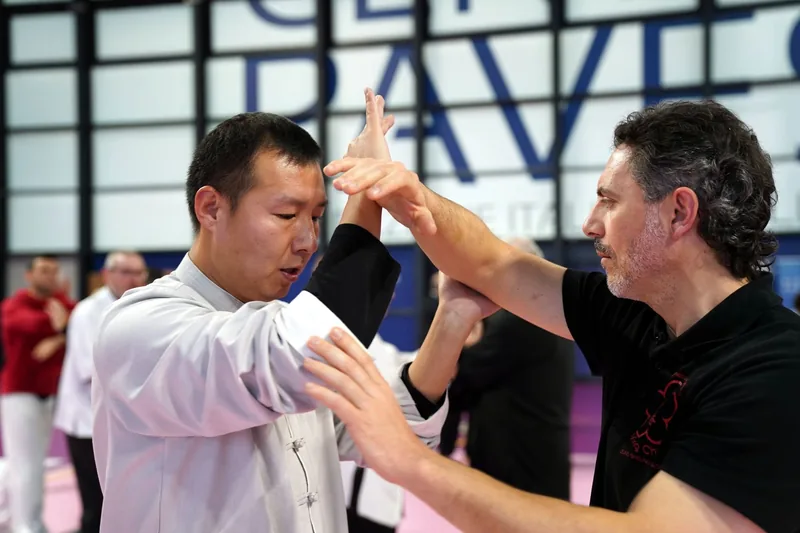
Sensitivity instead of speed. The most distinctive part of the Ip Man technique is what happens on contact. Chi Sao — “sticky hands” — trains the arms to read pressure and respond before the eyes can process what happened. Reacting to what you see is always late. Reacting to what you feel is not. That tactile reflex is why Wing Chun works at conversational range, where most real confrontations happen.
Teaching plainly. The quiet revolution was pedagogical. Traditional kung fu passed down through secrecy and ritual; Ip Man explained his art in ordinary language to ordinary people, and he explained why — the reasoning behind a movement, not just its shape. That’s the single reason Wing Chun spread while other village systems faded.
The Hong Kong Years: Teaching Wing Chun in the Open
Ip Man began teaching in 1950 out of the Hong Kong Restaurant Workers’ Association union hall in Kowloon. His first students weren’t martial arts royalty — they were working men. Leung Sheung, Lok Yiu, Chu Shong-tin. He taught on a rooftop and in borrowed rooms, and he taught for money because he needed it.
That ordinariness turned out to be the point. Because Ip Man taught anyone who showed up, Wing Chun escaped the closed-door lineage model that kept other systems small. By the 1960s his reputation had grown well past the union hall, drawing better-educated students who pressed him on the theory underneath the movements — and got real answers.
In 1967, Ip Man and seven senior students founded the Ving Tsun Athletic Association, formalizing the art so it could be taught collectively rather than resting on one aging man. He died on December 2, 1972, of laryngeal cancer, in his flat on Tung Choi Street. Shortly before his death he filmed himself performing the forms — a last act of teaching, aimed at students he would never meet.
Bruce Lee and the Ip Man Legacy
A teenage Bruce Lee joined Ip Man’s classes in the mid-1950s, and Wing Chun became the foundation of everything he built afterward. Jeet Kune Do’s directness, its economy of motion, its insistence on stripping away what doesn’t work — that’s Ip Man’s thinking, carried forward and pushed further by a student who refused to stop questioning.
Lee died seven months after his teacher, in 1973. The pairing is the most consequential teacher-student relationship in modern martial arts, and it cuts both ways: Lee made Wing Chun famous, but Wing Chun made Lee possible.
Ip Man’s other students seeded the art worldwide — Wong Shun-leung built his reputation in Hong Kong’s rooftop challenge matches, and Ip’s sons Ip Chun and Ip Ching carried the family line forward. Every legitimate Wing Chun school today traces back through one of them to a man teaching restaurant workers in a borrowed room.
Training the Ip Man Lineage at GMA
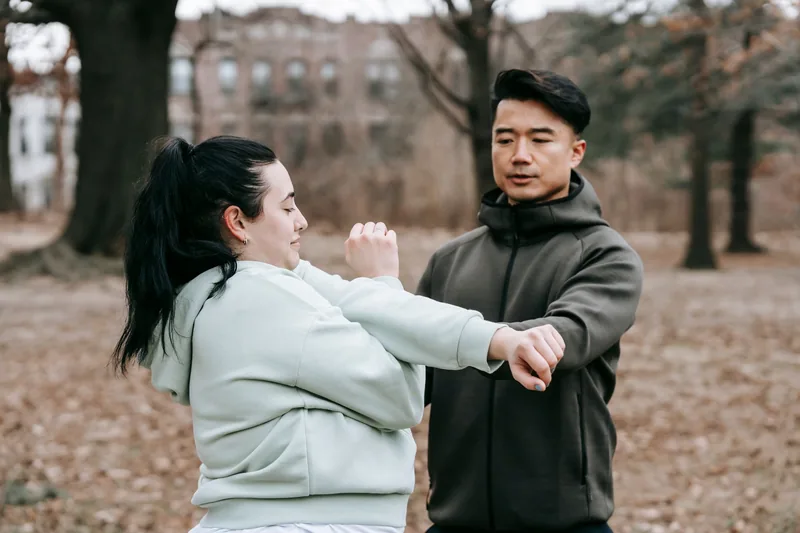
Wing Chun at Global Martial Arts USA is taught under the Ip Man lineage system by Grandmaster W. Vardeman, as part of the Golden Talon Kung Fu curriculum. That lineage claim matters for a practical reason, not a romantic one: it means the material arrives with its reasoning attached. Students learn why the elbow stays down, why the stance turns instead of steps back, why the strike travels the line it does.
The progression follows the system as Ip Man organized it — the three empty-hand forms (Sil Lum Tao, Chum Kiu, Biu Jee) building structure and power, Chi Sao developing the tactile reflex, and the Wing Chun wooden dummy integrating everything into applied sequences. Nothing gets skipped, because each stage is what makes the next one work.
For students in Gallatin and across Sumner County, that history isn’t decoration. Wing Chun’s close-range focus makes it directly applicable to real self-defense situations, and it remains the only major martial art founded by a woman — Ng Mui, the Shaolin nun whose system Ip Man spent his life clarifying. After 50+ years teaching martial arts here, GMA teaches Wing Chun the way Ip Man intended: openly, with the reasons included. Read more about our instructors and lineage, or come see a class for yourself.
Ready to Get Started?
Your first class is free. Whether you’re a complete beginner or an experienced martial artist, we’d love to welcome you to the GMA family.
Call us at (731) 324-3847 or book your free trial online.
Frequently Asked Questions
Was Ip Man really as skilled as the movies show?
The Donnie Yen films are action dramas, not biography — the fight scenes and much of the plot are invented. The real Ip Man was genuinely respected as a Wing Chun master, but his historical importance comes from teaching, not fighting. He was the first to teach Wing Chun openly, explaining the reasoning behind the art rather than passing it down as secret ritual. That decision, not any duel, is why Wing Chun exists worldwide today.
What is the most important Ip Man technique to learn first?
Structure comes before any specific technique. The first form, Sil Lum Tao (“Little Idea”), teaches a stationary stance and the fundamental hand positions — beginners often find it frustrating because it looks like nothing is happening. That’s the lesson. Ip Man’s system builds alignment and the centerline concept first, because every strike, deflection, and trap that follows depends on them.
Did Bruce Lee complete the Wing Chun system under Ip Man?
No. Bruce Lee trained under Ip Man as a teenager in Hong Kong for several years but left for the United States before completing the full curriculum, including the wooden dummy form. He developed his Wing Chun foundation independently from there, eventually building Jeet Kune Do from it. Lee’s art was a departure from traditional Wing Chun — but its principles of directness and economy of motion came straight from Ip Man.