

HapKiDo is one of the most complete self-defense systems in the martial arts world — a Korean art that blends dynamic kicks, close-range strikes, standing joint locks, and bone-breaking throws into a single, practical fighting system. If you want to understand the core HapKiDo techniques and how the belt ranking system tracks your progress from white belt to black, this guide breaks down exactly what you’ll learn and how you advance.
At Global Martial Arts USA in Gallatin, TN, HapKiDo is taught as a real-world combat system — not a sport. Below, we cover the three guiding principles that make HapKiDo work, the essential techniques every student develops, and how the Gup and Dan belt structure maps your journey.
The Three Core Principles of HapKiDo
Every HapKiDo technique is built on three foundational principles. Understanding them is what separates memorizing moves from actually understanding the art.
Hwa (harmony, or non-resistance): Rather than meeting force with force, a HapKiDo practitioner blends with an incoming attack and redirects it. This is why the art works regardless of size or strength — you’re never trying to overpower a larger opponent, only to control their momentum.
Won (the circular principle): HapKiDo redirects and neutralizes attacks with circular, flowing motion instead of linear blocks. Circular movement lets you turn an opponent’s energy back against them while keeping your own balance and options open.
Yu (the water principle): Like water, the HapKiDo student flows around resistance and conserves energy until the decisive moment. Soft where an attacker is hard, firm where they are weak — adapting continuously rather than committing to a single fixed response.
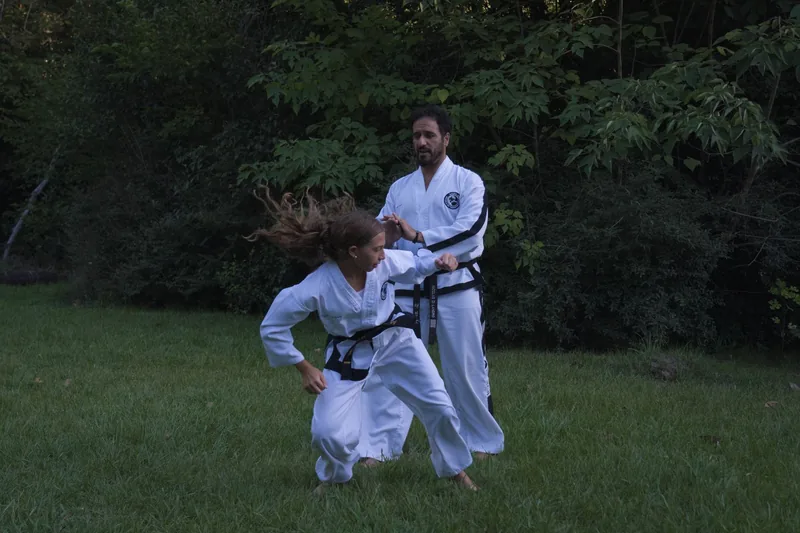
Essential HapKiDo Techniques
HapKiDo is often described as covering every range of combat, and its curriculum reflects that. Where a striking art like TaeKwonDo focuses on kicks and punches, HapKiDo layers grappling, joint manipulation, and weapon defense on top of a strong striking base. These are the technique categories you’ll develop:
Kicks and strikes: HapKiDo shares Korea’s love of dynamic kicking, adding spinning and jumping kicks at long range, then transitioning to elbows, knees, and hand strikes when the distance closes.
Joint locks and pressure points: Wrist locks, arm bars, and pressure-point control are the signature of the art. These techniques let a smaller person control or immobilize a larger attacker by attacking the mechanical limits of a joint.
Throws and takedowns: Using leverage and an opponent’s own balance, HapKiDo throws put an attacker on the ground while keeping you standing and in control — never a strength-against-strength contest.
Weapon defense and training: Students learn to defend against knives, clubs, and firearms, and to train with traditional weapons such as the cane, short stick, bo staff, and sword. GMA’s program also drills disarming and weapon-removal techniques.
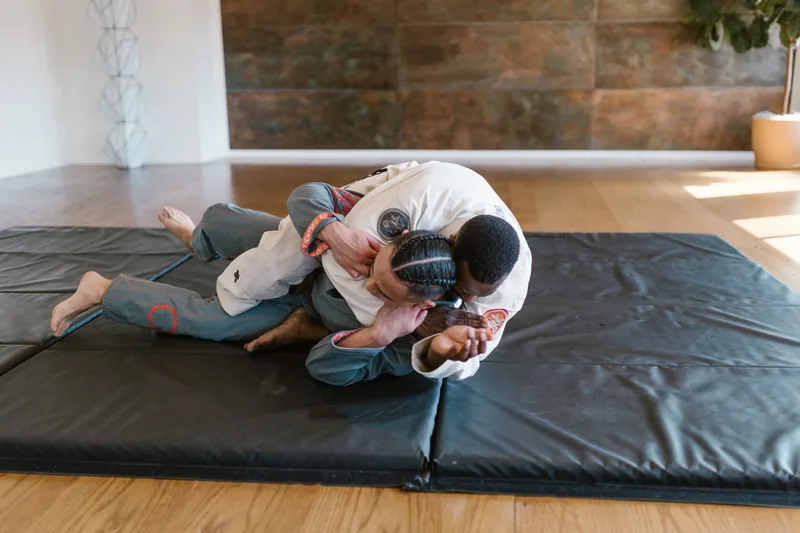
Ground defense: Because real fights end up on the floor, GMA integrates foundational Gracie Brazilian Jiu-Jitsu so you’re never helpless if a confrontation goes to the ground. This multi-range coverage is exactly why HapKiDo consistently ranks among the best martial arts for self defense.
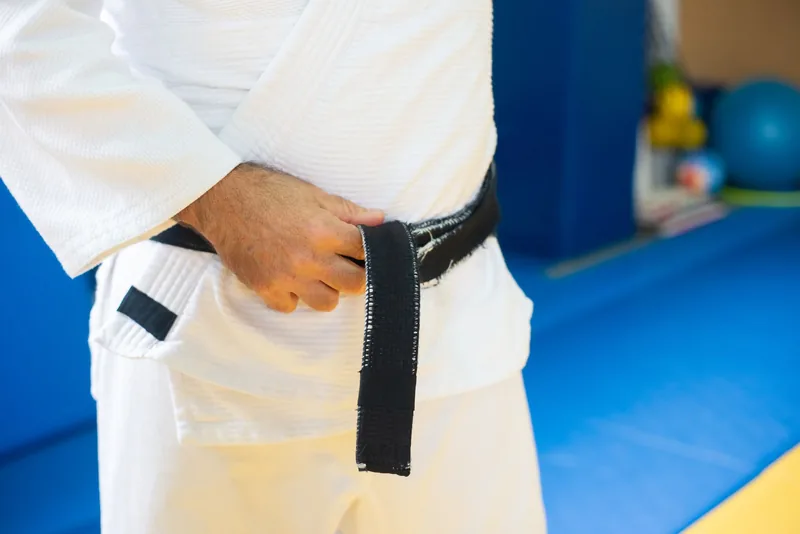
The HapKiDo Belt System: Gup and Dan Ranks
Like other Korean martial arts, HapKiDo uses a two-part ranking structure that mirrors the traditional system we use across all our Korean programs. If you’ve read our full guide to the martial arts belt ranking system, the framework will look familiar.
Gup ranks (color belts): Beginners start at 10th Gup — the white belt — and count down toward 1st Gup, the most senior color belt. A typical progression runs white, through yellow, blue, and red belt stages, with each level adding new joint locks, throws, and self-defense combinations to your curriculum.
Dan ranks (black belts): Once you earn your black belt, you enter the Dan system, which counts up — 1st Dan, 2nd Dan, and beyond. Each degree requires progressively more years of training, teaching, and refinement. The most senior Dan ranks are reserved for masters and grandmasters who have devoted decades to the art.
Promotions are never automatic. Students test in front of qualified instructors and must demonstrate the techniques, self-defense applications, and understanding of Korean martial arts terminology required for each rank before advancing.
How Long Does It Take to Earn a HapKiDo Black Belt?
For a dedicated adult training consistently, reaching 1st Dan (black belt) in HapKiDo typically takes around three and a half to four years. There are no shortcuts — each Gup level carries a minimum time in rank plus curriculum and attendance requirements, and your instructors decide when you’re genuinely ready to test.
That timeline reflects the depth of the art. By black belt, a HapKiDo student is fluent across striking, joint locks, throws, weapon defense, and ground control — a complete self-defense skill set rather than a single specialty.
HapKiDo Training at GMA in Gallatin
Global Martial Arts USA has taught Korean martial arts in Sumner County for over 50 years. Our HapKiDo program is a non-sport, commando-style combat system led by Master A. Davis and certified through top international HapKiDo organizations including the GHF, KHF, KKAHMA, and WCHF. Classes are open to students ages 12 and up, from complete beginners to experienced martial artists adding joint locks and weapon defense to their skill set.
Because GMA teaches multiple disciplines under one roof, HapKiDo students can cross-train with TaeKwonDo, self defense, and BJJ to build a truly well-rounded game. You can view our class schedule to see when HapKiDo meets, and learn more about our instructors’ credentials and 50+ year history on our about page.
Ready to Get Started?
Your first class is free. Whether you’re a complete beginner or an experienced martial artist, we’d love to welcome you to the GMA family.
Call us at (731) 324-3847 or book your free trial online.
Frequently Asked Questions
Is HapKiDo effective for real self-defense?
Yes. HapKiDo was designed as a practical combat system rather than a sport, covering every range of a confrontation — long-range kicks, close-range strikes, standing joint locks and throws, weapon defense, and ground control. Because it relies on redirecting an attacker’s force rather than overpowering them, it works regardless of your size or strength.
What’s the difference between HapKiDo and TaeKwonDo?
TaeKwonDo is primarily a striking art focused on kicks and punches, with a strong sport and competition element. HapKiDo is a combat self-defense system that adds joint locks, throws, pressure points, and weapon defense. Many students at GMA train both, since the two arts complement each other well.
How many belts are there in HapKiDo?
HapKiDo uses the Korean Gup and Dan structure. Students progress through the color-belt Gup ranks — beginning at 10th Gup (white belt) and counting down to 1st Gup — before earning their 1st Dan black belt. From there, the Dan degrees count up as students continue advancing over many years of training.