
Ask ten martial artists what is Wing Chun and you’ll get ten answers — the Bruce Lee art, the Ip Man art, the one with the wooden dummy. All true, all incomplete. Wing Chun is a southern Chinese martial art built around one practical problem: what do you do when a bigger, stronger person is already inside arm’s reach and swinging?
Its answer is unusual. Instead of backing up to create distance, Wing Chun steps in, takes the center, and attacks and defends in the same motion. This guide covers where the art came from, the principles holding it together, what the curriculum looks like, and what it honestly does and doesn’t do.
What Is Wing Chun? A Close-Range Combat System
Wing Chun is a concept-based Chinese martial art specializing in close-range combat. That phrase — concept-based — is doing real work. Most striking systems hand you a catalog of techniques and drill you until the right one comes out. Wing Chun hands you a small set of rules about structure, distance, and pressure, and the techniques fall out of those rules.
The practical range is conversation distance — close enough to put a hand on the other person’s chest. Most confrontations start there, not at kicking range, which is why the system spends almost no time on the long game and keeps its kicks low, aimed at knees and shins.
Two things set it apart: it was engineered for a smaller person to beat a larger one, using structure and angles instead of mass and reach, and it is the only major martial arts system credited to a woman — less a marketing footnote than a design constraint that shaped every technique in it.
Where Wing Chun Came From: Ng Mui, the Red Boats, and Foshan
The traditional origin story runs like this: after the destruction of the southern Shaolin temple, a Buddhist nun named Ng Mui escaped and built a streamlined fighting method that didn’t depend on size or decades of conditioning. She taught it to a young woman, Yim Wing Chun, who used it to fend off a warlord pressing her to marry him. The art carries her name.
It’s a good story, and it encodes something true about the system’s design intent. Historians are careful with it, though — no contemporary documentation survives to confirm the events, and researchers treat the temple narrative as tradition rather than record.
The trail becomes solid in 19th-century Guangdong, where Wing Chun traces reliably to practitioners connected with the Cantonese Red Boat Opera troupes — traveling performers whose constant movement between towns made them plausible carriers of a compact fighting system. From there the line runs through Foshan: Leung Jan, who taught Chan Wah-shun, who took on a young Ip Man as his final student.
Ip Man is why anyone outside a few Foshan streets has heard of the art. He fled to Hong Kong in 1949 and taught openly, to anyone who paid — a break from the closed-door model that kept most village systems small and eventually killed them. Our history of Ip Man and the Wing Chun legacy covers those years in full.
The Core Principles: Centerline, Economy, and Simultaneous Attack
The centerline. Draw a vertical line down the middle of your body, through the targets that end fights — throat, solar plexus, groin. Wing Chun’s geometry says the shortest path to your opponent runs down that line, and whoever occupies it controls the exchange. Every guard, step, and strike is measured against whether it takes the center or gives it away.
Economy of motion. No wind-up, no wide arcs, no movement that doesn’t earn its cost. The famous chain punch — rapid straight vertical-fist strikes down the centerline — exists because a short punch that arrives beats a powerful one still traveling. Power comes from alignment and elbow position, not muscle.
Simultaneous attack and defense. Rather than block, then counter, one hand deflects while the other strikes, in the same beat. Two actions in the time of one is the whole argument of the system.
Sensitivity over speed. Once arms are in contact, reacting to what you see is too slow. Wing Chun trains the arms to read pressure and respond by feel, which skips a processing step. That tactile reflex is what Chi Sao exists to build.
What You Actually Train: Forms, Chi Sao, and the Wooden Dummy
The curriculum is famously compact — three empty-hand forms rather than the dozens some systems carry.
Sil Lum Tao (Little Idea) comes first and frustrates almost everyone. You stand in one place and move your arms — no footwork, no partner, nothing that looks like fighting. What it builds is the stance, the centerline habit, elbow power, and the three foundational hand shapes: Tan Sao, Bong Sao, and Fook Sao.
Chum Kiu (Seeking the Bridge) adds the body — turning, stepping, closing distance, the first kicks and elbows, and the harder problem of holding structure while in motion. Most students find it the toughest of the three.
Biu Jee (Thrusting Fingers) is the emergency form: what to do when position is lost and you need the centerline back. It’s traditionally taught last, and guarded.
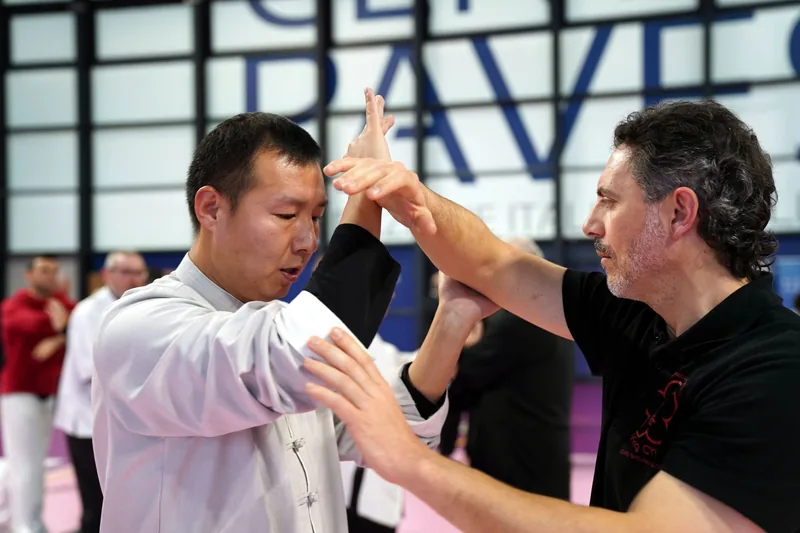
Alongside the forms, Chi Sao — “sticky hands” — converts theory into reflex. Two practitioners maintain arm contact and trade pressure, learning to feel an opening and fill it before the eyes catch up. The wooden dummy, or Mook Jong, integrates everything into applied sequences against a structure that never tires and never lets a sloppy angle slide. Advanced students add the butterfly swords and the long pole.
Timelines vary, but expect one to two years to get comfortable with the first form and basic drills, and three to five years before the concepts hold up under pressure.
Is Wing Chun Effective? An Honest Answer
Wing Chun is very good at a specific job: someone already close, standing, and committed. The trapping range, the sensitivity work, the refusal to give ground — that answers how most street confrontations begin, and it’s why the art keeps its place in practical self defense training.
It is not a complete answer to every situation, and no honest instructor claims otherwise — it doesn’t address a fight that hits the ground. That gap is exactly why GMA teaches multiple disciplines rather than selling one art as the whole solution; students who want the grappling half can also explore our dedicated BJJ program at GMA Team. If you’re weighing styles, our comparison of the best martial art for self defense lays out the trade-offs discipline by discipline.
Training Wing Chun in Gallatin, TN
At Global Martial Arts USA in Gallatin, TN, Wing Chun is taught under the Golden Talon Kung Fu system founded by Grandmaster W. Vardeman — a curriculum blending Wing Chun with Tai Chi, Bagua Zhang, and Kung Fu material from northern and southern Chinese traditions. The Wing Chun core stays intact; the surrounding system covers what a single village art was never designed to.
Students train the forms, the sensitivity drills, and the self-defense applications side by side, so theory never drifts far from something usable. Because GMA has taught martial arts in Sumner County for over 50 years — and has been voted the county’s top school — students here also have direct access to instructors in seven other disciplines under one roof.
See current class times on our schedule, or read more about our Wing Chun program. The most useful thing, though, is to stand across from someone and feel what the centerline does — no article gets you there.
Ready to Get Started?
Your first class is free. Whether you’re a complete beginner or an experienced martial artist, we’d love to welcome you to the GMA family.
Call us at (731) 324-3847 or book your free trial online.
Frequently Asked Questions
Is Wing Chun good for beginners with no martial arts experience?
Yes — arguably better than most. The system was built so a smaller, untrained person could develop usable skill without years of conditioning first. The first form is stationary and needs no flexibility or strength baseline, and the principles are taught as reasoning rather than memorization. Beginners are typically drilling practical close-range responses within their first few classes.
What’s the difference between Wing Chun, Ving Tsun, and Wing Tsun?
They’re spellings of the same Cantonese name, not different arts. Ip Man’s family and the Ving Tsun Athletic Association favored “Ving Tsun”; other lineages standardized on “Wing Tsun” or “Wing Chun” as they spread internationally. Differences between schools come from lineage and teaching emphasis, not the spelling on the sign.
Do I need to be in shape before starting Wing Chun classes?
No. Wing Chun avoids the high kicks and flexibility demands of some striking arts, and its power comes from structure rather than raw strength. Conditioning is a result of training, not a prerequisite. Students in their forties, fifties, and beyond train the system regularly.