
Ask ten martial artists whether BJJ self defense holds up outside a gym and you’ll get ten confident answers pointing in different directions. The honest version is more useful: Brazilian Jiu Jitsu solves one specific problem better than anything else in martial arts — what to do when a fight has already closed to grabbing range and hit the floor — and it does almost nothing for several other problems you also need to solve.
Here’s what BJJ actually gives you in a real confrontation, what the law enforcement data shows, where the art genuinely falls short, and how to train it so it works when it isn’t a sport.
Why BJJ Works for Self Defense
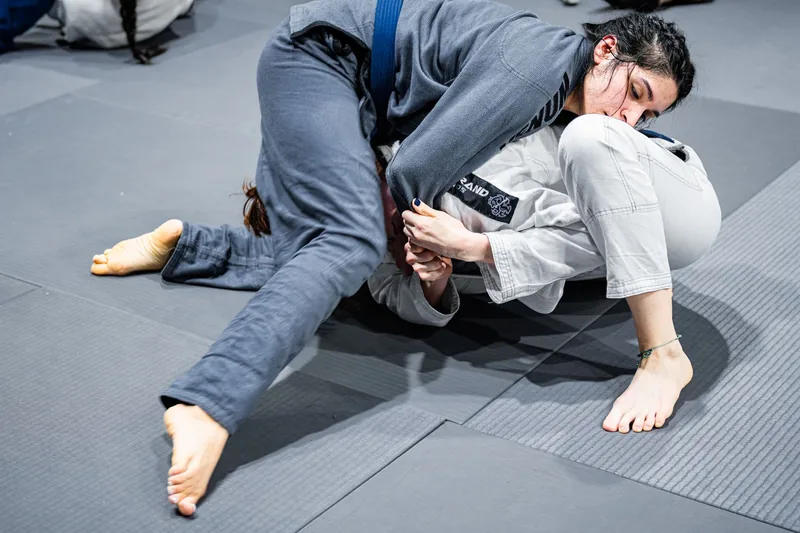
Most untrained violence follows a predictable shape. Someone closes distance, grabs, and both people end up tangled — against a wall, over a table, or on the ground. That’s the exact range where striking gets unreliable and where a grappler is most dangerous.
BJJ trains three things that matter enormously there. The first is position before submission: getting to a place where the other person can’t effectively hit you, before you try to end anything. The second is leverage over strength — chokes and joint locks that function regardless of whether you’re the bigger person, which is the entire reason a 180-pound Royce Gracie beat a 196-pound boxer, a 220-pound shoot wrestler, and a 216-pound karate black belt in one night at UFC 1 in 1993, finishing all three in a combined 4:59.
The third is the one people underrate: BJJ is trained at full resistance every session. You aren’t rehearsing a technique against a compliant partner and hoping. You’re applying it against someone the same size who knows what’s coming and is actively stopping you. That live pressure-testing is why grapplers tend to stay calm when a confrontation gets physical — the sensation of someone’s weight on your chest is Tuesday night, not a crisis.
What the Data Actually Says About Fights Going to the Ground
You’ve heard the claim that 90% of fights end up on the ground. It’s overstated, and repeating it damages the credibility of a real argument.
The number comes from a study by Sergeant Greg Dossey of the LAPD, who reviewed all 5,617 use-of-force reports the department filed in 1988. In 62% of those incidents, the officer and the subject ended up grappling on the ground. That’s a striking figure — but it describes police officers attempting arrests, not two strangers in a parking lot, and later analysis put the share where both parties intentionally continued fighting on the ground closer to 32%.
So: not 90%. But somewhere between a third and two-thirds of physical altercations involve the ground, which is more than enough to make being helpless there a serious problem.
The stronger modern evidence comes from law enforcement adopting BJJ directly. The Marietta, Georgia Police Department made jiu jitsu training a requirement for new recruits in 2019 and tracked the outcomes. Compared with officers who didn’t train, BJJ-trained officers saw a 48% reduction in injuries to themselves and a 53% reduction in injuries to the people they arrested. Suspects required hospitalization in 31% of arrests involving BJJ-trained officers versus 65% for non-trained officers. Taser use dropped 23%, and overall use of force fell 59%.
That last set of numbers is the real self-defense argument. Grappling skill doesn’t just help you win — it gives you options between doing nothing and hurting someone badly. GMA has taught that same control-based approach to officers and first responders through our law enforcement self defense programs for years.
Where BJJ Self Defense Falls Short
Any honest look at jiu jitsu for self defense has to name the gaps, because a false sense of capability is its own hazard.
Multiple attackers. BJJ’s core strategy — commit to controlling one person at close range — is close to the worst possible plan when a second person is free to kick you. Going to the ground with one attacker while another stands over you is a losing position no technique fixes.
Weapons. Grappling at contact range with someone who has a knife is extremely dangerous, and standard sport training spends no time on it. Weapon defense is a separate skill set — it’s a big part of why HapKiDo training and dedicated self defense curricula exist alongside a grappling program.
Environment. Mats are flat, clean, and forgiving. Asphalt, curbs, stairwells, and furniture are none of those. Techniques that trade position for a submission look very different when the fall is onto concrete.
Sport drift. Competition rules quietly shape habits. Pulling guard scores fine in a tournament and is a terrible idea in a parking lot. Turtling to avoid points exposes your head to punches that don’t exist in a match. A purely sport-focused school can build reflexes that are actively wrong outside the ruleset.
None of this makes BJJ a poor choice. It makes it an incomplete one — which is why we’d point anyone weighing options toward our comparison of the best martial art for self defense rather than a single answer.
Sport BJJ vs Self-Defense BJJ: What to Actually Train
The distinction isn’t about different techniques so much as different priorities. Self-defense-minded jiu jitsu emphasizes a specific short list.
Escapes come first — mount escapes, side control escapes, and standing up in base — because the realistic bad scenario is you already underneath someone. Closing and controlling the distance matters more than guard intricacy, since wrestling-style takedown and clinch skills decide whether you choose where the fight goes. Strike-aware positioning changes which positions you accept: closed guard with an opponent posting to punch is a different problem than closed guard in a match.
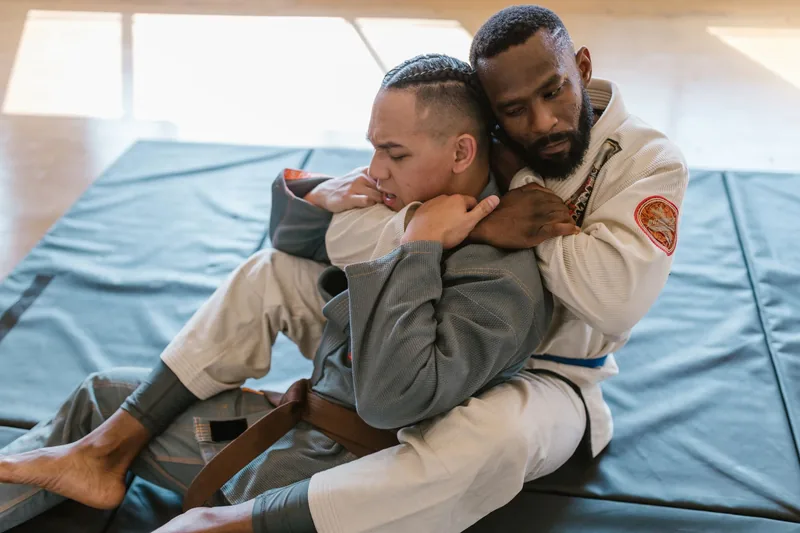
Control is prioritized over finishing. Holding someone in side control or a body-triangle back position until they stop or help arrives is frequently the best available outcome, legally and practically. When finishing is warranted, the reliable options are the ones that don’t depend on clothing or fine positioning — the core BJJ submissions every beginner should know, chokes above all.
Training no-gi periodically helps too: nobody on the street is wearing a lapel, and grips that vanish when fabric does are worth knowing about in advance. If you’re new to the art entirely, our guide to what Brazilian Jiu Jitsu is covers the foundation this all sits on.
Training BJJ for Self Defense at GMA in Gallatin, TN
Our Brazilian Jiu Jitsu program in Gallatin, TN runs gi and no-gi on separate nights, with fundamentals built around escapes and positional control before anything flashy. Grandmaster K.O. Spillmann earned his black belt directly under Professor Rocian Gracie Jr. and holds IBJJF and USBJJF Level 3 certification.
Because Global Martial Arts USA teaches eight-plus disciplines under one roof, students don’t have to accept BJJ’s blind spots. Our self defense classes cover awareness, de-escalation, striking, and weapon defense — the parts grappling doesn’t reach. That multi-discipline approach is a large part of why we’ve been voted a top school in Sumner County across 50+ years of teaching families here. Students training specifically for personal safety often pair jiu jitsu with our self defense track; women starting from scratch may want to read self defense for women first.
Competitors and students who want to go deeper into pure grappling can train at GMA Team Brazilian Jiu Jitsu, our dedicated BJJ academy. Either way, check the class schedule and come see a session before you decide.
Ready to Get Started?
Your first class is free. Whether you’re a complete beginner or an experienced martial artist, we’d love to welcome you to the GMA family.
Call us at (731) 324-3847 or book your free trial online.
Frequently Asked Questions
Is BJJ enough for self defense on its own?
For the close-range, one-on-one, already-grabbed scenario, it’s the strongest single answer available. It won’t cover weapons, multiple attackers, or the awareness and de-escalation skills that prevent most confrontations from starting. Most people are best served pairing jiu jitsu with a dedicated self defense curriculum.
How long does BJJ take to be useful in a real situation?
Basic escapes from mount and side control start working within a few months of consistent training, and those are the techniques that matter most in a bad spot. Meaningful control over a resisting person of similar size usually takes a year or more. Progress is measured in how rarely you panic, not in belt color.
Is BJJ or striking better for self defense?
They solve different ranges. Striking keeps distance and creates a chance to escape, which is the preferred outcome. Grappling handles what happens after distance is gone, which is where a lot of real altercations go. Training at least some of both closes the obvious gaps in either one.