
Most martial arts hand you a catalog. Wing Chun hands you six forms — three empty-hand, one wooden dummy, two weapons — and expects them to carry an entire fighting system. That compactness is deliberate, and it’s the reason the Wing Chun forms confuse newcomers more than any other part of the curriculum. There’s no long list to memorize. There’s a short list to understand.
Each form solves one problem the previous form left open. Miss that logic and the sequence looks arbitrary; see it and the whole system snaps into focus. Here’s what each form is for, what it builds, and roughly when you’ll meet it.
The Six Wing Chun Forms, in Order
The curriculum runs in a fixed sequence, and the order is the argument:
1. Sil Lum Tao (Little Idea) — structure, standing still.
2. Chum Kiu (Seeking the Bridge) — structure, in motion.
3. Biu Jee (Thrusting Fingers) — what to do when structure fails.
4. Muk Yan Jong (Wooden Dummy) — all of it, applied against resistance.
5. Luk Dim Boon Kwan (Six-and-a-Half-Point Pole) — power at the far end of a long weapon.
6. Baat Cham Dao (Eight Cutting Knives) — the same principles at maximum precision.
Six forms against the dozens carried by many Chinese systems isn’t a gap in the curriculum. Wing Chun was built to produce a functional fighter fast, and every form that didn’t earn its place got cut. If you’re new to the art entirely, our guide to what Wing Chun is covers the principles these forms are built to install.
The Three Empty-Hand Wing Chun Forms
Sil Lum Tao — The Little Idea
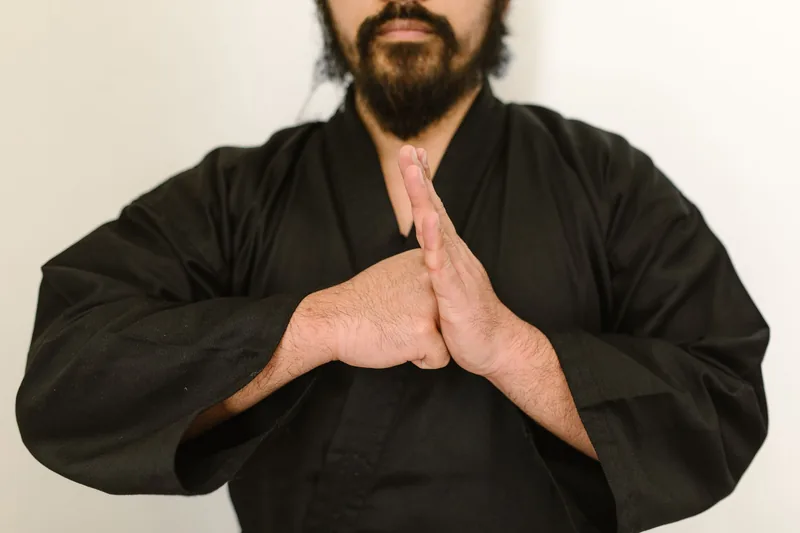
The first form frustrates almost everyone who starts it. You plant your feet, you don’t move them, and you work your arms through a slow sequence for ten or fifteen minutes. Nothing about it looks like fighting.
What it’s actually doing: setting the stance, drilling the centerline habit until it’s automatic, and teaching power that comes from elbow position and alignment rather than shoulder muscle. It introduces the three hand shapes the rest of the system runs on — Tan Sao, Bong Sao, and Fook Sao — and it trains something harder to name, the relaxed-but-loaded state Wing Chun calls on under pressure. Breathing, concentration, and stillness are part of the content, not a warm-up for it.
The name translates as “little idea,” and it’s honest. One small idea, drilled until it stops being an idea and becomes how you stand.
Chum Kiu — Seeking the Bridge
The second form adds everything the first one withheld: turning, stepping, kicking, elbows, and the considerably harder job of keeping your structure intact while your feet are moving. Most students find Chum Kiu the toughest of the three, because standing still with good structure turns out to be a much easier trick than walking with it.
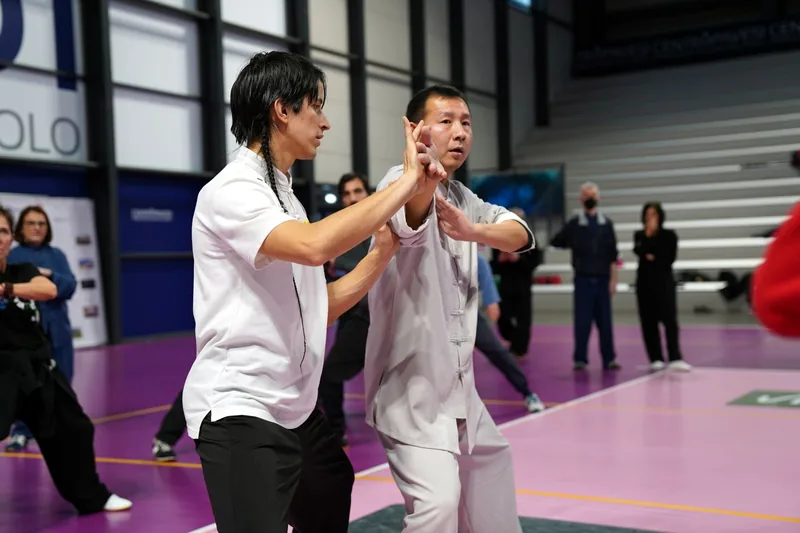
The “bridge” is the point of arm-to-arm contact with an opponent. Seeking it means closing the gap and establishing that contact on your terms — which is where Wing Chun wants the fight. Chum Kiu also teaches force generated along multiple vectors at once: the turn of the waist, the step of the foot, and the arm technique firing together rather than in sequence. That combination is what makes a small person’s strike difficult to absorb.
Biu Jee — Thrusting Fingers
Biu Jee is the emergency form. Everything before it assumes you have your structure and the centerline; this one assumes you’ve lost both and need them back immediately. It brings in finger strikes, driving elbows, and recovery techniques for positions the first two forms would call a failure.
It’s traditionally taught last and, in older lineages, guarded closely — the old saying was that Biu Jee doesn’t leave the door. Modern schools are less secretive, but the sequencing logic holds: emergency tools are dangerous in the hands of someone who hasn’t built the structure they’re meant to rescue.
Muk Yan Jong: The Wooden Dummy Form
The dummy form is where the empty-hand material stops being three separate sequences and becomes one integrated system. In the Ip Man lineage it runs to 116 techniques, chaining the hand shapes, angles, footwork, and kicks from all three forms into applied sequences against a fixed structure.
The dummy’s value is that it doesn’t cooperate. It never tires, never flinches, and never lets a sloppy angle pass — if your elbow is out of position, the wood tells you immediately and without diplomacy. Students typically reach it after several years of empty-hand work. Our wooden dummy training guide breaks down how the Mook Jong is built, what each section develops, and how students progress through it.
The Weapons Forms: Pole and Butterfly Swords
Wing Chun’s two weapons forms come last, and neither is really about the weapon.
Luk Dim Boon Kwan, the six-and-a-half-point pole, is normally taught first. Tradition credits it to Leung Yee Tai, who is said to have learned it from the monk Chi Shin and traded Wing Chun for it — tradition rather than documented record, like most origin tales in the art. The pole is long and heavy, and holding structure at the end of it exposes every weakness in your stance and elbow position that an empty hand lets you hide.
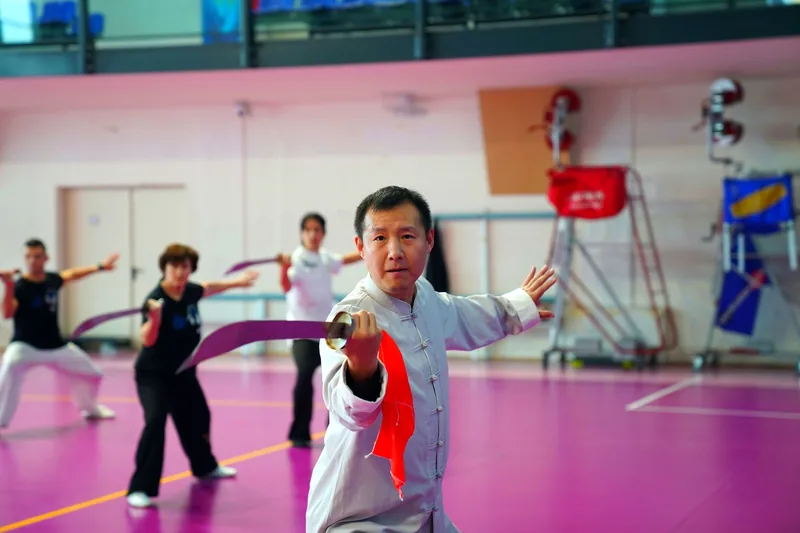
Baat Cham Dao, the eight cutting knives — the butterfly swords — is the final form in the system. The blades are short and paired, so the footwork, angles, and close-range efficiency are the same ones from the empty-hand curriculum, executed with no margin for error.
What the Forms Build — and What They Don’t
Forms are a delivery system for attributes, not a fight simulator. Practiced alone, they build structure, sensitivity, and reflexes that show up under pressure later. Practiced instead of partner work, they build a person who moves beautifully and can’t apply any of it.
Wing Chun schools that produce capable students pair the forms with Chi Sao and live application from early on, so the solo practice always has something to answer to. That’s also the honest limit of the curriculum: the forms cover close-range standing exchange thoroughly and don’t address a fight that hits the ground. Nobody teaching the art seriously claims otherwise. Students who want the grappling half of the equation can explore our dedicated BJJ program at GMA Team.
Realistic timelines: one to two years to be comfortable with Sil Lum Tao and basic drills, three to five before the concepts hold up when someone is genuinely trying to hit you. The dummy and weapons forms sit further out than that. Anyone promising a faster route is selling something.
Learning the Wing Chun Forms in Gallatin, TN
At Global Martial Arts USA in Gallatin, TN, Wing Chun is taught within the Golden Talon Kung Fu system founded by Grandmaster W. Vardeman — a curriculum that blends Wing Chun with Tai Chi, Bagua Zhang, and material from both Northern and Southern Chinese traditions. The Wing Chun forms are taught intact, in the traditional order, alongside the sensitivity drills and self-defense applications that keep them connected to something usable.
Students work the empty-hand forms, Chi Sao, and weapons training as one progression rather than separate tracks. GMA has taught martial arts in Sumner County for over 50 years and has been voted the county’s top school, and students train alongside instructors in seven other disciplines under one roof. Our piece on Ip Man and the Wing Chun legacy covers how these forms reached the West at all.
Class times are on our schedule, and you can read more about our Wing Chun program — though the fastest way to understand what Sil Lum Tao is doing is to stand in it for ten minutes with someone correcting your elbow.
Ready to Get Started?
Your first class is free. Whether you’re a complete beginner or an experienced martial artist, we’d love to welcome you to the GMA family.
Call us at (731) 324-3847 or book your free trial online.
Frequently Asked Questions
How many forms are there in Wing Chun?
Six in the standard curriculum: three empty-hand forms (Sil Lum Tao, Chum Kiu, Biu Jee), the wooden dummy form (Muk Yan Jong), and two weapons forms — the six-and-a-half-point pole and the butterfly swords. Some lineages count or subdivide them slightly differently, but the core sequence is consistent across Ip Man-derived schools.
How long does it take to learn the first Wing Chun form?
You can learn the sequence of Sil Lum Tao in a few weeks. Performing it correctly is a different question — most students spend one to two years refining it, and senior practitioners still adjust it decades in. The movements are simple; the structure underneath them is what takes time.
Do I need to learn the forms in order?
Yes. Each form assumes the attributes built by the one before it, so training them out of sequence produces movement without the structure it depends on. A student who tries Biu Jee before owning Sil Lum Tao ends up with emergency techniques and nothing to rescue.