
One person came in to lose weight. Another came in after a bad night in a parking lot. A parent signed their kid up to deal with a bully. Six months later all three are still on the mat, for reasons that have almost nothing to do with why they walked in. That’s the strange thing about the benefits of jiu jitsu — the ones that keep people training usually aren’t the ones that got them through the door.
Here’s an honest look at what Brazilian Jiu Jitsu actually does to you: what it changes physically, how it changes the way you handle pressure, where it holds up as self-defense, and how long each of those takes to show up.
The Physical Benefits of Jiu Jitsu Training
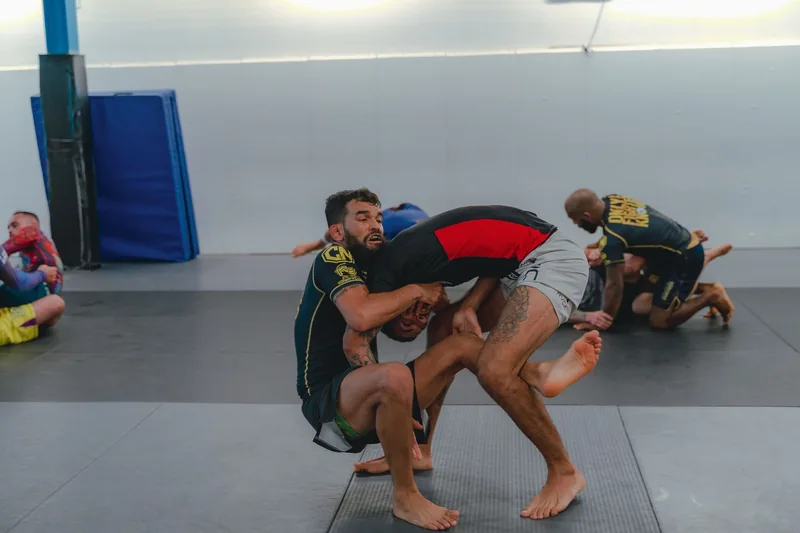
BJJ is a conditioning workout disguised as a chess match. A live round drives your heart rate near the top of its range, drops it during a reset, then drives it back up — the same interval structure as sprint training, except you’re too busy solving a problem to notice you’re doing cardio. Estimates for a moderate class land somewhere around 500 to 600 calories an hour for an average-sized adult, with hard sparring rounds pushing higher. Those numbers vary with your weight and how hard the room is going that night, but the shape of the demand is consistent.
The strength you build is a different kind than a barbell gives you. Grip, hips, neck, core — the muscles that hold a position under a resisting human being. It’s largely isometric work, and it happens whether you plan it or not, because your training partner is a load that fights back. Grapplers as a group tend to carry relatively low body fat, which follows naturally from the combination of high-intensity intervals and the lean mass that grappling builds.
There’s also a mobility benefit nobody advertises: escaping bad positions requires hips, spine, and shoulders that move through ranges most adults abandoned in their twenties. Recovery matters more here than in most sports, and sleep, protein, and hydration will do more for your progress than an extra drilling session — GMA Warrior Supplements exists for exactly that side of it.
What BJJ Does for Your Mind
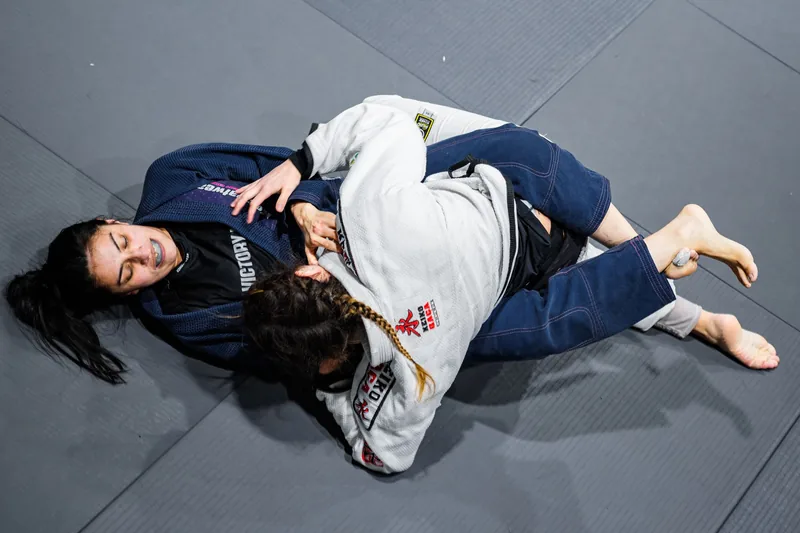
The mental side is where the research has gotten interesting. A scoping review of studies on veterans and first responders found jiu jitsu programs associated with reduced PTSD, anxiety, and depression symptoms, alongside gains in resilience and self-efficacy. Broader work points the same way — better emotional regulation, higher stress tolerance, stronger social connection. That’s emerging research on specific populations, not a prescription, and jiu jitsu isn’t a substitute for treatment. But the pattern is consistent enough to ask why it works.
The mechanism seems to be the combination. Hard physical exertion, forced present-moment attention, and real-time problem solving against a resisting opponent, all at once. You cannot ruminate about work while someone is passing your guard. The mat demands the kind of total attention that meditation asks for and rarely gets.
Then there’s the part that transfers most directly to ordinary life: you get put in bad spots, safely, over and over. Pinned under side control, arm isolated, breathing restricted — and you learn to stay calm and work. Do that a few hundred times and your baseline for what counts as an emergency quietly moves. Difficult conversations and bad news land differently on someone whose nervous system trains under a 200-pound blue belt twice a week.
Self-Defense: The Benefit That Started It All
Jiu jitsu was built to answer one question — what does a smaller person do against a bigger one? The Gracie family’s answer was leverage and technique instead of strength, applied where size matters least: on the ground, in close. That’s the foundation of the whole art and the reason BJJ became the backbone of modern MMA and a fixture in military and law enforcement combatives programs.
The practical case is simple. A large share of real confrontations end up close-range and on the ground — precisely the territory most striking arts spend the least time in. Controlling a position, defending from your back, and ending an exchange without throwing a punch gives you options short of hurting someone, which matters more often than people expect.
The limits are worth stating too: sport jiu jitsu and self-defense jiu jitsu overlap heavily but aren’t identical, and a curriculum built only on competition rules will leave gaps. Our BJJ program includes Gracie self-defense fundamentals for that reason. If you’re still working out what the art actually is, start with our guide to what Brazilian Jiu Jitsu is, then look at the basic techniques every beginner should master.
Benefits for Kids and Families
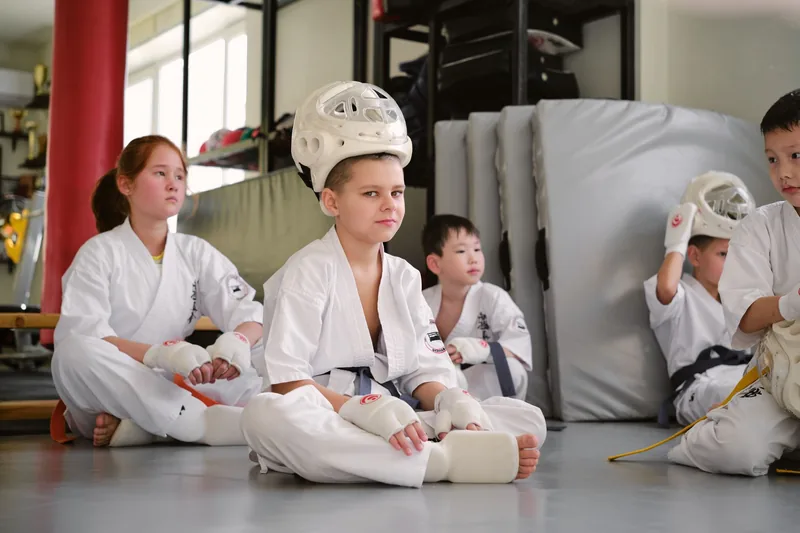
For children, the benefits arrive in a different order. Grappling gives kids a physical vocabulary for handling conflict that doesn’t involve hitting anyone — control, distance, calm. That’s the anti-bullying case, and it’s a real one: most childhood confrontations are shoving and wrestling, not striking, and a kid who knows how to handle contact without panicking rarely has to prove it twice.
Underneath that sits the quieter stuff. Stripes and belts earned across months teach a seven-year-old what sustained effort feels like. Losing a round teaches losing — safely, repeatedly, with a coach right there. Our kids BJJ track runs ages 7 through 12 with supervised, controlled grappling, alongside the rest of our kids martial arts classes in Gallatin. And jiu jitsu is one of the few activities a parent and child can genuinely train together and both get better at.
How Long Before You Actually Feel It
Different benefits show up on different clocks, and knowing the timeline is most of what keeps people from quitting early. Conditioning moves first — two or three weeks in, you’ll notice you’re not as gassed at the end of a round. Stress relief arrives almost immediately. Technical skill is slower and lumpier: expect a few months before the movements stop feeling foreign, and expect plateaus after that. The real confidence — the kind that comes from being tested rather than told — takes six months to a year and builds so gradually you’ll only spot it looking back.
The belts reflect that pace honestly. Blue belt averages around two years of consistent training, and the full BJJ belt ranking system runs on a timescale that makes jiu jitsu unusual among martial arts. That’s a feature — ranks that take years to earn are ranks that mean something.
The one variable that outweighs talent, age, and athleticism is showing up. Two classes a week for a year beats five a week for two months, every time.
Training Jiu Jitsu in Gallatin, TN
Our Brazilian Jiu Jitsu classes at Global Martial Arts USA run under an authentic Gracie lineage — Grandmaster K.O. Spillmann earned his black belt directly under Professor Rocian Gracie Jr., grandson of BJJ founder Carlos Gracie, and holds IBJJF and USBJJF Level 3 black belt certification alongside 50+ years in martial arts. Beginners start in a structured fundamentals track, gi and no-gi are both on the schedule, and kids and adults train separate programs.
GMA has been in Sumner County long enough to have taught two generations of some families, and we’ve been voted the top school in the county. Competitors who want to go deeper train through our dedicated program at GMA Team. If you’re weighing jiu jitsu against something else, look at the full class lineup — eight disciplines under one roof, and plenty of students train more than one.
Ready to Get Started?
Your first class is free. Whether you’re a complete beginner or an experienced martial artist, we’d love to welcome you to the GMA family.
Call us at (731) 324-3847 or book your free trial online.
Frequently Asked Questions
Is jiu jitsu good for weight loss?
It’s one of the better options, mostly because it doesn’t feel like exercise. A moderate class burns roughly 500 to 600 calories an hour for an average-sized adult, and the interval structure of live rolling plus the lean mass grapplers build both work in your favor. The bigger advantage is adherence — people quit treadmills, and they don’t quit jiu jitsu, because every class is a different problem.
Do I need to be in shape before starting BJJ?
No, and waiting until you are is the most common reason people never start. The art was specifically designed so technique beats athleticism, and a fundamentals class is where you build the conditioning rather than where you’re expected to arrive with it. Tell your instructor it’s your first class and pace yourself through the first month.
How long does it take to get good at jiu jitsu?
You’ll be dangerous to an untrained person well before you feel competent against training partners. Expect a few months before the movements stop feeling foreign, around two years of consistent training to reach blue belt, and a genuine shift in confidence somewhere in your first six to twelve months. Consistency beats intensity — two classes a week, every week, outperforms sporadic bursts.