
Start looking at TaeKwonDo schools and you’ll run into two sets of letters almost immediately: ITF and WTF. Some schools list one, some list both, and almost nobody explains what they mean. The ITF vs WTF TaeKwonDo question comes down to two governing bodies that grew out of the same Korean roots, split in the 1960s and 70s, and developed different forms, different sparring rules, and different ideas about what the art is for.
This guide covers where each organization came from, how their forms and sparring differ, what they share, and how to decide which style fits your goals, with notes on how the TaeKwonDo program at Global Martial Arts USA in Gallatin, TN fits into the picture.
What Do ITF and WTF Stand For?
ITF is the International Taekwon-Do Federation, founded on March 22, 1966 in Seoul by General Choi Hong Hi, the Korean army officer who is credited with naming the art. Choi led the ITF until his death in 2002. After he died, the organization divided into several separate federations that each use the ITF name, so “ITF” today describes a style and curriculum as much as a single organization.
WTF was the World Taekwondo Federation, founded in 1973 at the Kukkiwon in Seoul. In June 2017 it rebranded as World Taekwondo (WT), partly to escape the obvious internet meaning of its old initials. You’ll still see “WTF” on older school signs and in search results, but WT is the current name.
One detail trips people up: on the WT side there are really two organizations. World Taekwondo governs competition, including the Olympics. The Kukkiwon, the World TaeKwonDo Headquarters in Seoul, sets the curriculum and issues black belt (Dan) certification. When a school says it teaches “Kukkiwon TaeKwonDo” or “WT style,” it means this branch.
The split itself was political as much as technical. As General Choi fell out with the South Korean government, the art divided into two lineages. Our guide to the history of TaeKwonDo covers that story in detail, from the original kwans through the road to Olympic gold.
ITF vs WTF TaeKwonDo Forms: Patterns vs Poomsae
Forms are the clearest day-to-day difference between the two styles. Both use choreographed sequences of blocks, strikes, kicks, and stances, but the sequences themselves are completely different.
ITF Patterns (Tul)
The ITF trains the Chang Hon patterns, the set General Choi developed. There are 24 of them, a number Choi tied to the 24 hours in a day. They start with Chon-Ji for beginners, and many are named after figures and events from Korean history. ITF patterns are also known for sine wave motion: the body rises and drops through each movement to generate power, which gives ITF forms a distinctive up-and-down rhythm.
Kukkiwon Poomsae
The Kukkiwon branch trains poomsae. Color belts learn the eight Taegeuk forms, and black belts move on to forms such as Koryo, Keumgang, and Taebaek. Kukkiwon movement stays at a more level height, with an emphasis on crisp, balanced technique and strong stances. Poomsae is also a competitive event in its own right at WT championships.
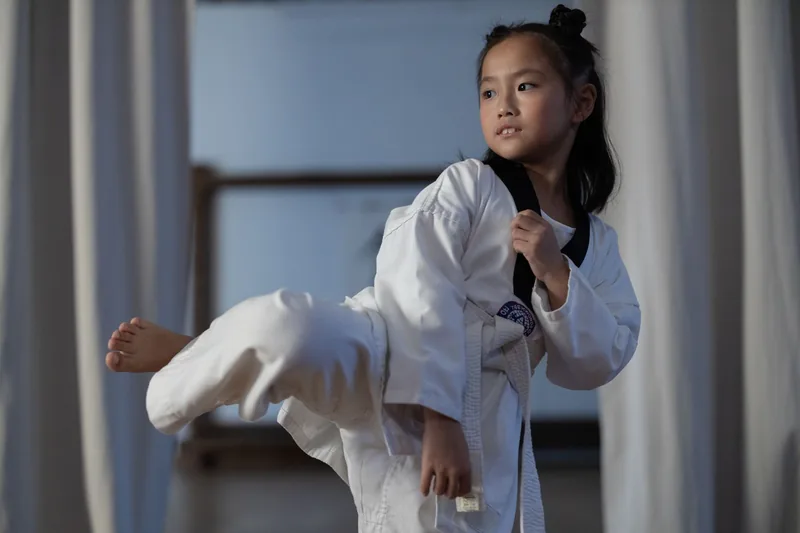
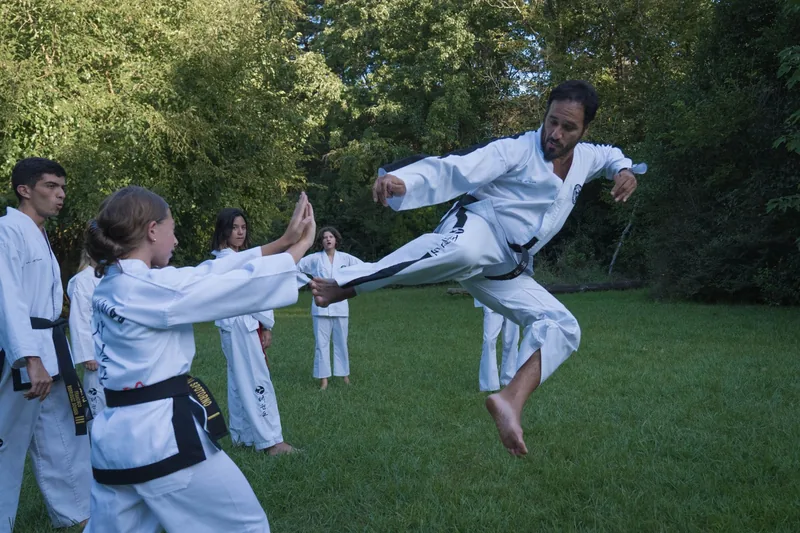
Uniforms differ a little too. Kukkiwon-style doboks are typically pullover jackets with a V-neck, and black belts usually wear a black collar. ITF doboks often open at the front, and black belt uniforms carry black trim along the hem. Small details, but they’re often the fastest way to spot which style a school teaches.
Sparring Rules: Olympic Kyorugi vs ITF Point Sparring
If forms are the clearest difference in class, sparring is the clearest difference in competition.
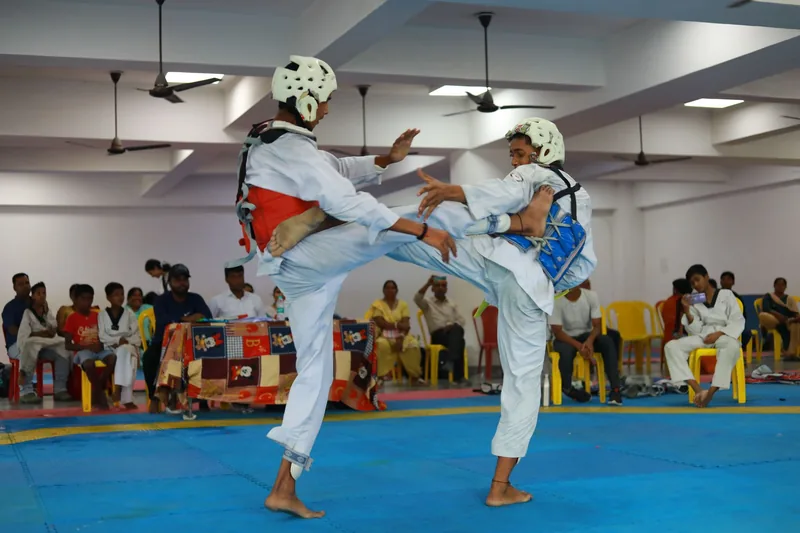
WT sparring (kyorugi) is the Olympic version. Athletes wear electronic chest protectors and head gear with sensors, and the scoring system rewards kicks. Punches count only to the body, while kicks to the head and spinning or turning kicks score the most points. The result is a fast, kicking-heavy sport with athletes who can land techniques at head height from range. TaeKwonDo has been a full Olympic medal sport since the Sydney 2000 Games, and that pathway runs entirely through WT rules.
ITF sparring usually uses padded gloves and foot protectors and is typically light- to semi-contact. Hand techniques play a bigger role. Punches to the head are generally allowed, so hands and kicks blend together more like a traditional stand-up fight. ITF tournaments also include events like patterns, power breaking, and special technique (flying kicks for height or distance).
Neither ruleset is a complete self-defense system. Both are competition formats with safety rules. Point sparring with no head punches doesn’t prepare you for a fist to the face, and light-contact sparring doesn’t prepare you for full force. That’s why good schools on either side layer self-defense training on top of whatever sparring rules they compete under.
What ITF and WT TaeKwonDo Have in Common
For all the arguments online, the overlap is bigger than the differences. Both branches teach the same core kicks: front kick, roundhouse, side kick, back kick, and the spinning and jumping techniques TaeKwonDo is known for. Both use colored belts leading to Dan ranks, both use Korean terminology in class, and both teach the same tenets of courtesy, integrity, perseverance, self-control, and indomitable spirit.
A student who trains seriously in either style ends up flexible, fast, and powerful through the hips and legs, with the discipline to keep showing up. Switching between the two takes some adjustment, mostly in forms and sparring habits, but the foundation carries over. If you want the bigger picture of what the art covers, start with our guide to what TaeKwonDo is.
Which TaeKwonDo Style Is Right for You?
The honest answer: the instructor matters more than the letters. A great ITF school beats a mediocre WT school, and the reverse is just as true. That said, your goals can point you one way.
- You want Olympic-style competition. Look for a Kukkiwon/WT school. That’s the only route to WT-sanctioned tournaments and the Olympic pathway.
- You want more hand techniques in your sparring. ITF-style point sparring gives punches a larger role.
- You want an internationally recognized black belt. Kukkiwon Dan certification is recognized by WT member schools around the world.
- You want a traditional art with self-defense depth. Ask any school, ITF or WT, how much time goes to self-defense, forms, and philosophy versus tournament prep.
At GMA, our TaeKwonDo is rooted in the Jidokwan lineage, one of the original kwans that helped unify modern TaeKwonDo, and our instructor team holds Kukkiwon certification, with ITF credentials on staff as well. The program is led by Grandmaster K.O. Spillmann, a 9th Degree Black Belt with more than 50 years of experience. We balance the athletic side of modern TaeKwonDo with forms, discipline, and practical self-defense, so students get the kicking skill of the sport and the substance of the traditional art. If you’re curious how long that path takes, see how long it takes to earn a black belt in TaeKwonDo.
Many students also cross-train. Our HapKiDo classes add joint locks and throws to the striking base, and grappling fills the gap neither TaeKwonDo ruleset covers. If ground fighting interests you, explore our dedicated BJJ program at GMA Team. Check the class schedule to see when TaeKwonDo meets at our Gallatin school, voted the top martial arts school in Sumner County.
Ready to Get Started?
Your first class is free. Whether you’re a complete beginner or an experienced martial artist, we’d love to welcome you to the GMA family.
Call us at (731) 324-3847 or book your free trial online.
Frequently Asked Questions
Is WTF TaeKwonDo the same as Olympic TaeKwonDo?
Yes. The World Taekwondo Federation, renamed World Taekwondo in 2017, is the governing body for TaeKwonDo at the Olympics. “WTF style,” “WT style,” “Kukkiwon style,” and “Olympic style” all refer to the same branch of the art.
Can I switch from ITF to WT TaeKwonDo?
Yes. The kicks, stances, and fundamentals carry over. You’ll need to learn a new set of forms and adjust your sparring to the other ruleset, and your new school will decide how your existing rank transfers. Most experienced students adapt within a few months.
Is ITF or WT TaeKwonDo better for self defense?
Neither is automatically better. ITF sparring includes more hand techniques and punches to the head, while WT develops exceptional kicking speed and range. What matters most for self defense is whether your school trains realistic self-defense scenarios beyond its competition rules.