

Most advice about self defense for women gets the priority backwards. It leads with the flashy stuff — the knee to the groin, the palm strike to the nose — and skips the part that actually keeps women safe: seeing a situation early, setting a boundary out loud, and knowing how to break a grip that already has hold of you. At Global Martial Arts USA in Gallatin, TN, our instructors have spent more than 50 years teaching women that the physical techniques are the last resort, not the first line.
This guide covers what we teach and why: the awareness habits that prevent most confrontations, the escapes that work regardless of size, why ground defense matters more than almost any other skill, and what the research actually says about whether training works.
Self Defense for Women Starts Long Before Anything Physical
The single most useful thing you can know going in is who the danger usually comes from. According to RAINN’s analysis of Department of Justice National Crime Victimization Survey data from 2010 to 2016, roughly 8 in 10 sexual assaults are committed by someone the victim knows — an acquaintance, a coworker, a partner, a friend of a friend. The stranger in the parking garage is real, but he is the exception.
That changes what training has to prepare you for. A stranger attack is an awareness problem. A known-assailant situation is a boundary problem — the moment where something feels wrong but saying so feels rude. A large part of what we work on in our self defense classes is giving women permission to be the “difficult” one: to leave without explaining, to say “no” without softening it, to make the phone call in front of the person making them uneasy.
The awareness side is trainable too. Keeping your head up, limiting headphones to one ear, scanning for exits when you walk into a room, and acting on the first flicker of unease instead of talking yourself out of it — these habits cost nothing and prevent more than any technique. Our full guide to personal safety and situational awareness breaks the framework down step by step.
The Techniques That Work: Leverage, Not Strength
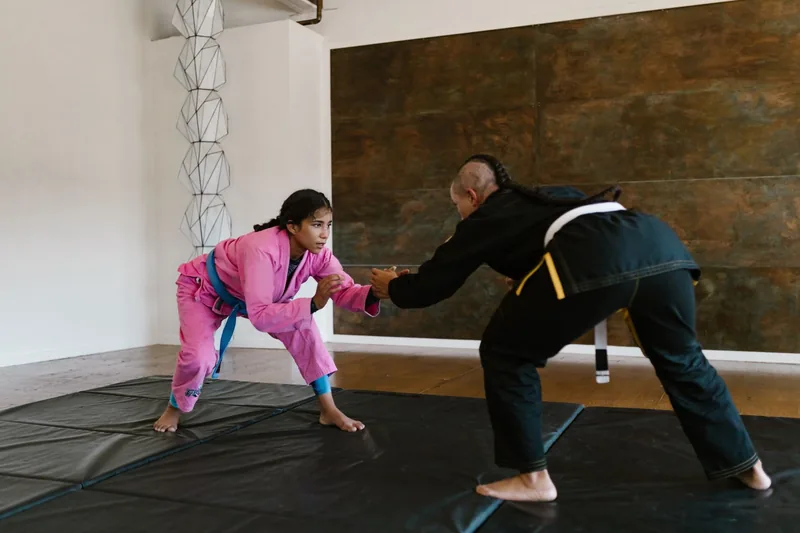
Any self defense system that requires you to be stronger than your attacker has already failed you. Women’s self defense works because it targets structure — thumbs, joints, balance, and vulnerable targets that do not care how much anyone can bench press.
Take the most common attack there is: the wrist grab. The instinct is to yank straight back, which pulls against the four strongest fingers of the grip. The escape is to rotate your wrist sharply toward the attacker’s thumb — the one weak point in any grip — and drive out explosively through that gap. It works the same at 110 pounds as it does at 210. That principle repeats through everything we teach: escape the weak point, don’t overpower the strong one.
The core scenarios worth drilling are the ones that actually happen — wrist grabs, hair pulls, front and rear chokes, bear hugs, and being pinned against a wall or a car. At GMA, the answers come from three directions. HapKiDo supplies the joint locks, escapes, and throws that turn an attacker’s own grip against him. Brazilian Jiu Jitsu supplies ground defense and positional control. Wing Chun supplies close-range striking for the moment someone is already inside your arms — a system whose founding tradition, fittingly, credits a woman with building it precisely so size wouldn’t decide the outcome, as we cover in our guide to what Wing Chun is.
Underneath all of it is the goal: create distance and leave. Self defense is not a fight you win. It is a fight you exit.

Ground Defense: The Skill Most Women’s Programs Skip
A weekend seminar will teach you a dozen standing techniques and almost nothing about what happens after you hit the floor. That is a serious gap, because a size and strength disadvantage is never more decisive than on the ground — and being taken down or pinned is one of the most common ways an assault progresses.
This is where Brazilian Jiu Jitsu earns its reputation. BJJ was built by smaller practitioners to solve exactly this problem: how to survive underneath someone bigger, protect your head and neck, use the guard to control distance, and work back to your feet. Learning to stay calm and structured on your back — instead of panicking and burning every ounce of energy in ten seconds — is one of the highest-value skills any woman can train.
Our head BJJ instruction is led by an IBJJF-certified black belt, and students who want to go deeper in grappling can explore our dedicated BJJ program at GMA Team. For self defense purposes, though, you don’t need years of it. A handful of escapes and the ability to keep breathing under pressure will change your outcome more than any single strike.
Does Self Defense Training for Women Actually Work?
It’s a fair question, and unlike most fitness claims, there is real evidence behind this one. A randomized controlled trial published in the New England Journal of Medicine in 2015 by Senn and colleagues followed 893 first-year university women across three Canadian campuses. Half received a structured resistance-training program covering assessment, boundary-setting, and physical techniques; half received standard safety brochures.
Over the following year, the training group reported 46% fewer completed rapes and 63% fewer attempted rapes than the control group. The researchers estimated that enrolling roughly 22 women in the program prevented one additional rape. Findings from a single trial should be read as encouraging rather than conclusive, and no training makes anyone assault-proof — responsibility always sits with the person committing the assault. But the direction of the evidence is consistent: women who train resist earlier and more effectively than women who don’t.
Worth noting is what that program taught. It wasn’t a technique showcase. It was assessment, acknowledgment, and action — recognizing the situation, naming it as dangerous without hesitating, and responding. That is the same order of operations we teach on the mat.

What Training Looks Like at GMA in Gallatin
Women of every age and background train at our Gallatin school, and most of them walked in with zero martial arts experience. There is no fitness prerequisite and nothing to prove on day one. Classes are taught by certified instructors in a controlled environment — our staff is Safe Sport Certified, led by a 9th Degree TaeKwonDo Black Belt, and GMA has been voted a top school in Sumner County across more than 50 years of teaching families here.
What changes fastest isn’t the technique — it’s the way students carry themselves. Confident posture and steady eye contact end more situations than any escape does, and that shift shows up within a few weeks. If you’re still deciding which discipline suits you, our comparison of the best martial art for self defense lays out the trade-offs, and you can view our class schedule to find a time that works.
Ready to Get Started?
Your first class is free. Whether you’re a complete beginner or an experienced martial artist, we’d love to welcome you to the GMA family.
Call us at (731) 324-3847 or book your free trial online.
Frequently Asked Questions
What is the best self defense technique for a woman?
There isn’t one — but the highest-value skill is the grip escape, because a grab is how most physical assaults begin. Rotating your wrist toward the attacker’s thumb and driving out through that weak point works regardless of size difference. Pair it with the ability to create distance and leave, and you’ve covered the majority of realistic scenarios.
How long does it take to learn self defense as a woman?
The awareness and boundary-setting habits are useful immediately. The core physical escapes — grabs, chokes, bear hugs, and basic ground defense — become reliable under stress after a few months of consistent training, because reliability comes from repetition rather than knowing more moves. Most students feel a meaningful difference in confidence within the first several weeks.
Do I need to be fit or have experience to start?
No. There is no fitness prerequisite and no experience required. Women join our Gallatin classes in their twenties and in their sixties, and the techniques we teach are built specifically so that strength and athleticism are not what decide the outcome. A free trial class is the easiest way to see whether it’s a fit.