

“How long does it take to get a black belt in TaeKwonDo?” is one of the first questions every new student asks. Black belt TaeKwonDo timelines vary from school to school, and how long yours takes depends far more on your consistency than on the calendar. At Global Martial Arts USA in Gallatin, TN, the path from white belt to 1st Dan runs roughly 3.5 to 4 years for an adult who trains regularly.
That number isn’t arbitrary — it’s the sum of ten rank promotions, minimum time-in-grade requirements, curriculum tests, and the class hours it takes to make technique automatic. Here’s where that time goes, what moves it faster, what stretches it out, and why a legitimate black belt can’t be handed out on a schedule.
Why the Path to Black Belt Takes 3.5 to 4 Years
Korean martial arts rank students in two categories. Gup ranks are the color belts, counting down from 10th Gup (white belt) to 1st Gup (black tag). Dan ranks are the black belt degrees, counting up from 1st Dan to 9th Dan. Getting your black belt means climbing all ten Gup ranks, then passing a separate Dan examination. Our complete belt ranking guide breaks down what each individual color means.
The math is simple once you see the structure. At GMA, each Gup rank carries a minimum of three months in grade. Ten promotions at three months apiece is thirty months — two and a half years of time-in-grade requirements before you’re even eligible to test for 1st Dan. Add the curriculum and class-hour requirements attached to the senior color belts, plus preparation for the Dan examination itself, and 3.5 to 4 years is what an honest timeline looks like.
Time in rank is the floor, not the ceiling. Promotions at our TaeKwonDo program are based on curriculum completion, class attendance, and instructor evaluation — not on how many months have passed since your last test. A student who has been a green belt for four months but can’t hold a clean stance under pressure isn’t testing. That standard is the whole reason a GMA black belt carries weight in Sumner County.
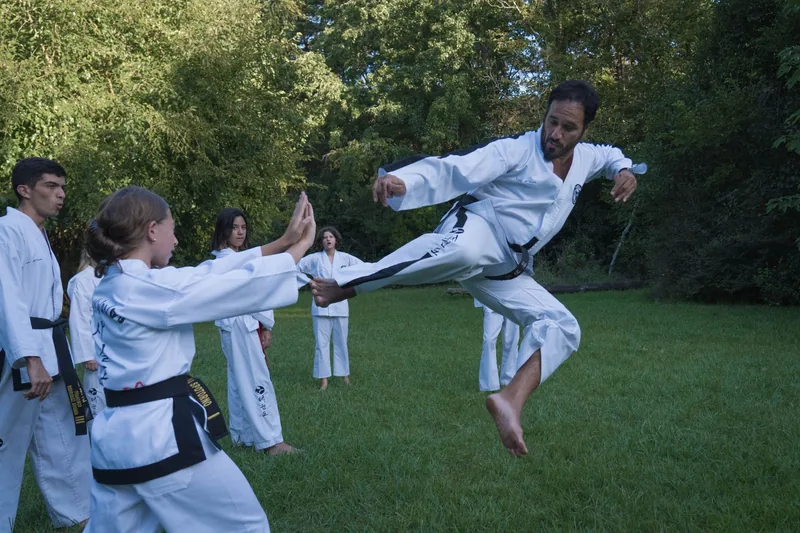
Black Belt TaeKwonDo Timelines: How Long Each Stage Takes
Year one — white belt through green belt. The first twelve months are about building a body that can do TaeKwonDo at all: stances, chambering a kick properly, basic blocks, your first forms, and the dojang etiquette that governs how you train. Most students promote three to four times in this stretch. Progress feels fast here because everything is new.
Year two — green belt through blue belt. The pace slows and the curriculum deepens. Forms get longer, kicking combinations get more complex, and sparring enters the picture with real timing and distance management. This is where most people who quit, quit — and the students who train through it tend to finish.
Year three — blue belt through red belt. Red belt symbolizes both power and the caution that has to come with it. The curriculum expands into advanced forms, self-defense applications, and more demanding sparring. Many students begin leadership training here, assisting with younger classes — which is when their own technique sharpens fastest.
Year 3.5 to 4 — black tag (1st Gup) and the Dan test. The black tag belt is the final color rank, and it functions as a candidacy period rather than a waiting room. Everything gets refined: precision, power, terminology, and the mental composure to perform under examination. The Dan test itself evaluates the entire curriculum at once, and at GMA only Master-level instructors (5th Dan and above) are qualified to test black belt candidates.
What Actually Changes Your Timeline
Training frequency — and consistency. This is the single biggest variable. A student attending twice a week and one attending four times a week are not on the same schedule, even though both meet the three-month minimums on paper. Steady attendance also beats bursts: three years of twice-weekly training outruns eighteen months of five-days-a-week followed by a six-month gap, because skills built on a broken rhythm decay and rank testing exposes that fast. Our class schedule shows what a realistic weekly commitment looks like.
Age and starting point. Adults typically absorb the curriculum and terminology faster; young students often develop cleaner mechanics over time. Neither group has a shortcut, and prior experience in another striking art helps less than people expect — TaeKwonDo mechanics are specific. If you’re still deciding whether the art fits you, our guide to what TaeKwonDo actually is covers what training involves.
Cross-training. Adding a second discipline doesn’t slow your TaeKwonDo progression — GMA students routinely train HapKiDo or grappling alongside it, and many go deeper into ground fighting through our dedicated BJJ program at GMA Team. What matters for your Dan timeline is that your TaeKwonDo class attendance stays consistent while you do it.

Kids, Juniors, and the Poom (Junior Black Belt)
Children follow a different track. In the Kukkiwon system that governs modern TaeKwonDo ranking worldwide, any student who passes a Dan-level examination before their 15th birthday receives a Poom rank rather than a Dan rank — recognized with a half-red, half-black belt. It certifies black belt–level skill while acknowledging that full Dan rank carries responsibilities a twelve-year-old isn’t ready for. When the student turns 15, the Poom converts to the equivalent Dan rank.
At GMA, junior students ages 10 to 15 earn 1st Poom, and the timeline runs anywhere from 3.5 to 8 years depending on how young they start. A seven-year-old who begins today will earn the rank on a longer runway than a twelve-year-old, simply because the minimum age gate exists. That’s a feature, not a delay — the extra years go into kids martial arts curriculum, leadership development, and maturity.
Parents sometimes ask whether they should look for a school with a faster junior track. The schools that promote children to black belt in eighteen months are selling a belt, not a rank. A Poom earned over four or five years means the student has genuinely absorbed the curriculum — and the discipline built during those years is the part that follows them into adulthood.

Black Belt Is the Starting Line, Not the Finish
1st Dan means you’ve absorbed the foundational curriculum and are ready for serious study. At GMA, a 1st Dan can serve as a Training Instructor, assisting certified instructors in class.
The degrees that follow take far longer. 2nd Dan requires a minimum of three years at 1st Dan — six to eight years total — and qualifies a student as a Certified Instructor, which at GMA also means a background check, a yearly Safe Sport exam, and coaching certification. 4th Dan sits around 15 to 17 years and is tested in front of internationally certified Grandmaster-level examiners. 5th Dan, at 18 to 20 years, is the Master threshold — the rank required to test black belt candidates.
The ceiling shows the scale: 9th Dan requires roughly 50 years of training and a minimum age of 60. Our founder, KwanJangNim K.O. Spillmann, holds a 9th Degree TaeKwonDo Black Belt alongside an IBJJF Brazilian Jiu Jitsu Black Belt — 50+ years of continuous practice. Measured against that, four years to 1st Dan is the introduction.
Ready to Get Started?
Your first class is free. Whether you’re a complete beginner or an experienced martial artist, we’d love to welcome you to the GMA family.
Call us at (731) 324-3847 or book your free trial online.
Frequently Asked Questions
How long does it take to get a black belt in TaeKwonDo?
At Global Martial Arts USA, the path from white belt to 1st Dan black belt takes approximately 3.5 to 4 years for an adult training consistently. Each of the ten Gup (color belt) ranks carries a minimum of three months in grade, and promotion also requires curriculum completion, class attendance, and instructor evaluation. Training more often can shorten the timeline somewhat, but the minimum time-in-grade requirements set a floor no student skips.
Can you earn a TaeKwonDo black belt in two years?
Not at a school holding to legitimate standards. Ten color-belt promotions with three-month minimums account for two and a half years of time-in-grade before a student is even eligible to test for 1st Dan. Schools advertising a two-year black belt are compressing the curriculum, the testing standard, or both. The rank is only worth what the training behind it required.
How long does it take a child to earn a black belt in TaeKwonDo?
Junior students at GMA earn 1st Poom — the junior black belt — between roughly 3.5 and 8 years of training, depending on the age they start. Under Kukkiwon rules, students who test at Dan level before their 15th birthday receive Poom rank and wear a half-red, half-black belt; the rank converts to the equivalent Dan when they turn 15. Younger starters have longer timelines because of the age requirement, not because they progress more slowly.