
The hardest part of MMA training for beginners is not the conditioning or the sparring — it’s the assumption that you need to arrive already able to fight. You don’t. Mixed martial arts is a combination of separate disciplines, and every fighter you’ve watched built it one piece at a time, usually starting with a single art and adding the rest over years. At Global Martial Arts USA in Gallatin, TN, we’ve spent more than 50 years teaching adults who walked in with zero experience, and the ones who last are almost never the ones who came in the toughest.
This guide covers what MMA is actually made of, which discipline to start with, what your first month realistically looks like, how to build the conditioning that makes everything else possible, and how to train the MMA skill set here in Gallatin.
What MMA Training Actually Combines
Mixed martial arts isn’t a style. It’s a ruleset that lets different styles meet, and the fighters who succeed in it are the ones who can operate in every phase of a fight. Broadly, that means three domains.
Striking — punches, kicks, knees, and elbows, drawn mostly from boxing, Muay Thai, and kicking arts like TaeKwonDo. This is the phase every fight starts in. Takedowns and clinch work — wrestling and judo, the skills that decide where the fight happens. A fighter who controls that decision controls the fight. Ground fighting — Brazilian Jiu Jitsu, which governs what happens after the takedown: position, control, escapes, and submissions.
Those three domains are why so many people find MMA intimidating. Trying to learn all of them at once is genuinely overwhelming. The good news is that nobody does. You pick a base, get competent in it, and layer the others on top — which is exactly how the multi-discipline path works at GMA, where students commonly train TaeKwonDo for striking alongside Brazilian Jiu Jitsu for the ground game.

Where MMA Training for Beginners Should Actually Start
The most common mistake in MMA training for beginners is spreading yourself across four disciplines in week one and getting mediocre at all of them. Pick one base, train it two to three times a week, and give it a few months before you add anything.
If you’re drawn to striking, start there. Stance, distance, and footwork are the foundation of every strike you’ll ever throw, and they transfer to every other striking art. Our TaeKwonDo program builds the kicking range, balance, and hip mechanics that most beginners are weakest at — and kicking is the skill that takes longest to develop, which is an argument for starting it early.
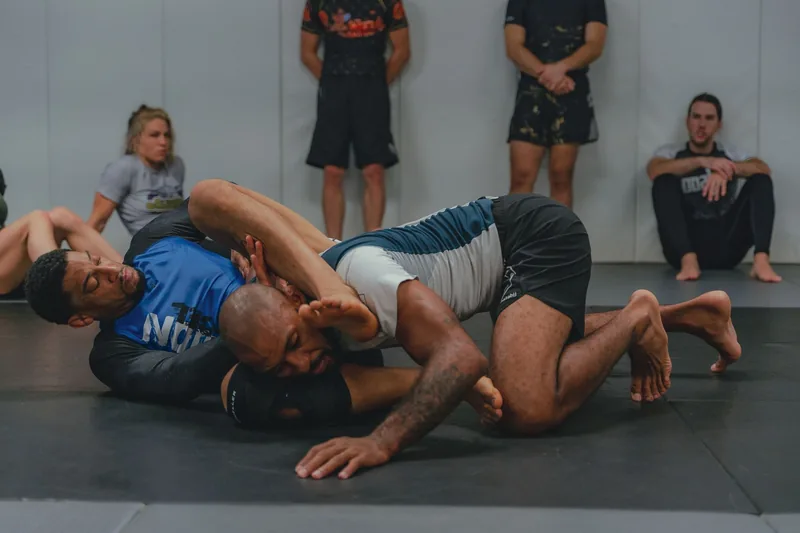
If you’d rather learn the part of a fight most people know least about, start with grappling. Ground fighting is the great equalizer, and it’s the phase where a technically sound smaller person routinely handles a larger untrained one. Basic BJJ techniques — posture, frames, escapes, a handful of submissions — give you something usable faster than almost anything else, and students who want to go deep in grappling can explore our dedicated BJJ program at GMA Team.
There’s also a third path worth naming, because it’s the one most adults actually want. If your goal is protecting yourself rather than competing, HapKiDo and our self defense classes cover joint locks, escapes, throws, and the situational skills that MMA rules deliberately exclude. Plenty of GMA students train the MMA skill set without ever intending to step into a cage.
What Your First Month Really Looks Like
Done properly, MMA training for beginners starts slow. Expect your first class to be a coached introduction, not a test. A good gym asks about your experience, explains the session, teaches one or two ideas, and controls the pace. You should not walk into hard sparring on day one, and if a school throws a beginner into live rounds immediately, that tells you something about the school.
A typical fundamentals class runs a warm-up, a technical demonstration, partner drilling at low intensity, some controlled positional work, and conditioning at the end. You’ll repeat the same movement far more times than feels interesting. That repetition is the entire point — technique becomes reliable under stress through volume, not through knowing more moves.
Realistic month-one goals are unglamorous: follow a drill without constant prompting, move around a crowded mat without colliding with anyone, regulate your own effort, and learn the vocabulary. Soreness in the first two weeks is normal as your body adapts to unfamiliar movement patterns. Two to three sessions a week is the right starting dose — enough for your body to adapt between sessions, and sustainable enough that you’re still training in month six.
What you don’t need on day one: fitness, experience, flexibility, or any understanding of the terminology. Every one of those is an output of training, not a prerequisite for it.

Building the Conditioning That Makes Technique Work
Technique fails when you’re exhausted. That’s the honest reason conditioning matters in MMA — not aesthetics, but the fact that a tired fighter reverts to flailing, drops their hands, and forgets everything they drilled.
MMA conditioning is built around repeated bursts of high effort with short recovery, which is why steady-state jogging alone doesn’t prepare anyone for a round. Prioritize hip and core strength, grip endurance, and the ability to recover between efforts. Bodyweight work handles most of it: squats, lunges, push-ups, planks, hollow holds, burpees, and sprint intervals. Our guide to MMA workout and conditioning lays out the programming in detail, and martial arts training at home covers what you can genuinely develop between classes.
One caution: conditioning supplements mat time, it doesn’t replace it. Beginners who train hard at home and rarely attend class end up strong and unskilled. Two classes a week plus two short conditioning sessions beats five solo workouts, every time.
Training the MMA Skill Set at GMA in Gallatin
GMA doesn’t run a cage-fighting program. What we run is every discipline that MMA is built from, taught properly and separately, which for most adults is the better path anyway — you learn each art from instructors who specialize in it rather than a diluted sampler of all of them.
Striking comes through TaeKwonDo, led by a 9th Degree Black Belt. Ground fighting comes through Brazilian Jiu Jitsu under IBJJF-certified black belt instruction. Joint locks, throws, and weapon defense come through HapKiDo. Close-range striking comes through Wing Chun. Our staff is Safe Sport Certified, and GMA has been voted a top school in Sumner County across more than 50 years teaching families here.
Most beginners start with one class, add a second discipline after a few months, and find within a year that they’ve quietly built a genuine mixed skill set. If you’re not sure which base fits you, come try one — explore our full class lineup or view our class schedule to find a time that works.
Ready to Get Started?
Your first class is free. Whether you’re a complete beginner or an experienced martial artist, we’d love to welcome you to the GMA family.
Call us at (731) 324-3847 or book your free trial online.
Frequently Asked Questions
How long does it take to get good at MMA?
Competence in a single discipline takes roughly one to two years of consistent training two to three times a week. A genuinely mixed skill set across striking and grappling takes longer — most people measure it in years, not months. That said, you’ll be able to use basic escapes and defensive fundamentals within the first few months, which is where most of the practical value lives.
Do I need to be in shape before starting MMA training?
No. Fitness is what training produces, not what it requires. Beginner classes are structured so you can work at your own intensity, and instructors expect new students to need breaks. Showing up out of shape and training consistently beats waiting until you feel ready — that day rarely arrives on its own.
How many days a week should a beginner train MMA?
Two to three sessions a week is the right starting point. It gives your body time to recover and adapt between classes, keeps soreness manageable, and is sustainable long enough to build real skill. Beginners who train five or six days a week early on tend to burn out or pick up an avoidable injury within a couple of months.