
Ask ten martial artists which art is better and you’ll get ten arguments. Ask about TaeKwonDo vs BJJ specifically and the answer gets clearer, because these two arts barely overlap. TaeKwonDo is a striking art built on fast, powerful kicks thrown from distance. Brazilian Jiu Jitsu is a grappling art built on taking the fight to the ground and winning there with control and submissions. They’re less like rival brands and more like two halves of a complete fighter.
This guide breaks down where each art comes from, how they train, how they hold up for self defense and fitness, and how to choose between them. We teach both at Global Martial Arts USA in Gallatin, TN, so we’ll also share what we see when students train one, the other, or both.
Striking vs Grappling: The Core Difference
Every fight moves through ranges: kicking distance, punching distance, the clinch, and the ground. Most martial arts specialize in one or two of them. TaeKwonDo and BJJ specialize in opposite ends.
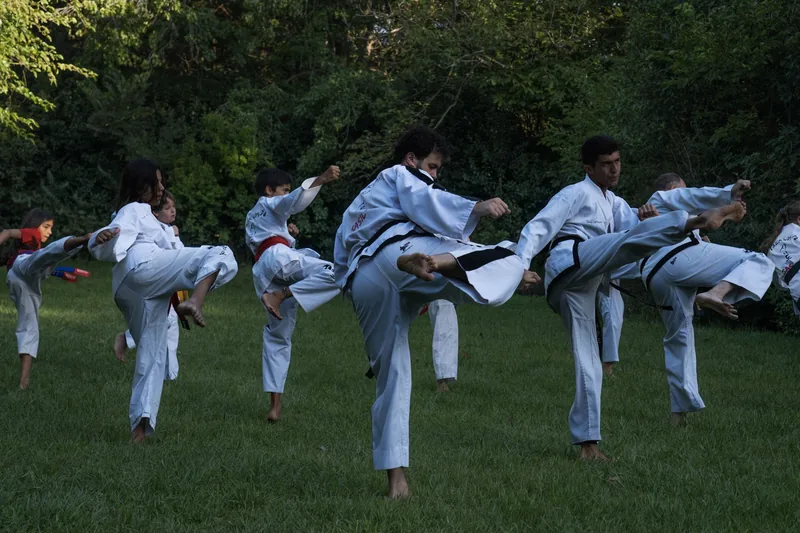
TaeKwonDo owns the outside. The name translates to “the way of the foot and fist,” and the art is famous for the speed, reach, and variety of its kicks: roundhouse, side kick, back kick, plus the spinning and jumping techniques nobody else throws as well. A TaeKwonDo practitioner wants to stay at range, control distance with footwork, and land clean strikes before an opponent can close in.
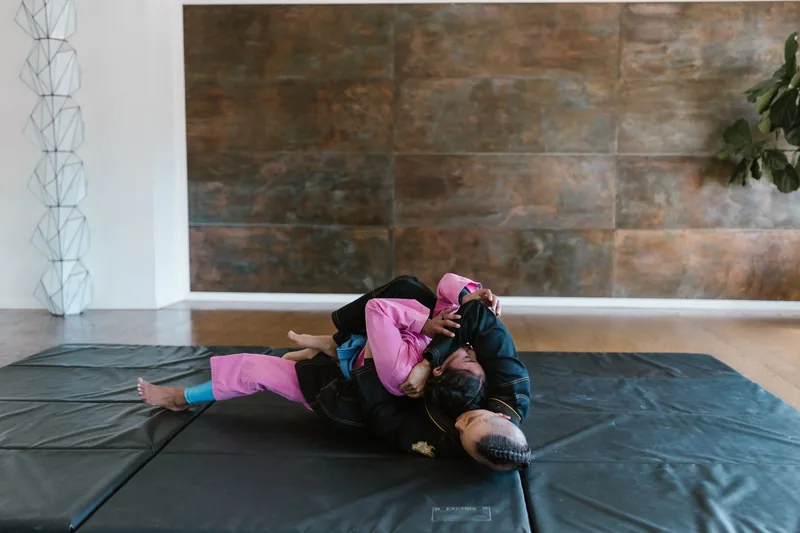
Brazilian Jiu Jitsu owns the inside. BJJ students learn to close the distance, clinch, take an opponent down, and then control them on the ground. From there the goal is a dominant position like mount or back control, and finally a submission such as a choke or joint lock. There’s no punching or kicking in standard BJJ training. It’s leverage, positioning, and timing.
Where Each Art Comes From
TaeKwonDo took shape in Korea in the 1940s and 50s, as Korean masters combined native kicking traditions with influences from Chinese martial arts and Okinawan karate. The early schools, or kwans, eventually unified under the TaeKwonDo name, and the art became an official Olympic sport at the 2000 Sydney Games. Our guide to what TaeKwonDo is covers the full story, including the belt system and training philosophy.
BJJ grew out of Japanese judo and jujutsu, which arrived in Brazil in the early 20th century. The Gracie family refined it into a system where a smaller person could beat a larger one by avoiding a strength contest and fighting from positions where leverage wins. The world took notice in 1993, when Royce Gracie won the first UFC by submitting bigger opponents from striking backgrounds. That result reshaped how martial artists everywhere thought about the ground. Read more in our complete guide to Brazilian Jiu Jitsu.
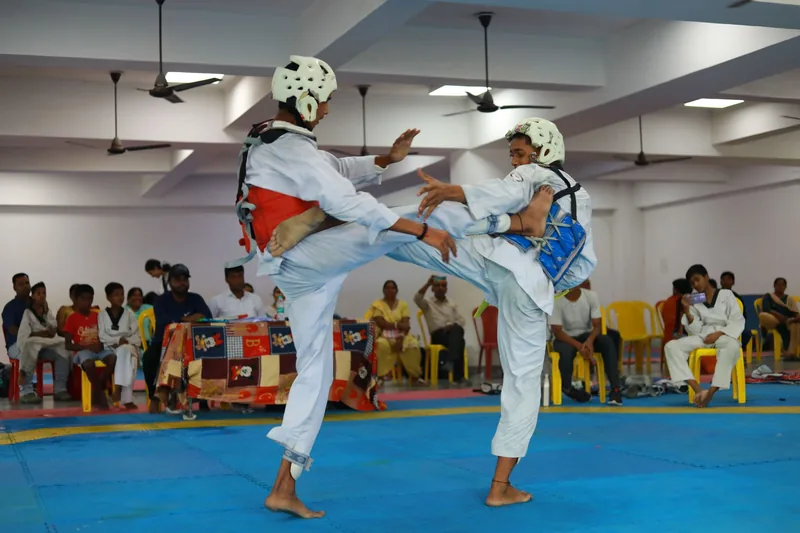
The cultures differ too. TaeKwonDo classes are built on forms (poomsae), Korean terminology, formal etiquette, and board breaking alongside sparring. BJJ classes usually run warm-up, technique drilling, and then live rolling, where you test what you learned against a resisting partner nearly every session.
TaeKwonDo vs BJJ for Self Defense
This is the question most people are really asking, and the honest answer is that each art covers a gap the other leaves open.
TaeKwonDo’s strengths: distance management, fast reactions, and powerful kicks that can end a confrontation before it starts. Kicks are the longest weapons you have, and TaeKwonDo trains you to use them with speed and accuracy. The athleticism carries over too. Students develop balance, flexibility, and the confidence that comes from hard sparring.
BJJ’s strengths: what happens when distance disappears. Real confrontations often end up in a clinch or on the ground, especially against someone bigger who rushes forward. BJJ teaches you to stay calm under pressure, escape bad positions, and control an attacker without needing to out-muscle them. Our breakdown of BJJ self defense covers where it shines and where it falls short.
The gaps: a TaeKwonDo practitioner who has never grappled can struggle once an attacker grabs hold and takes them down. A BJJ player who has never trained striking can struggle to close distance safely against someone throwing hard punches and kicks, and going to the ground is a poor plan when there are multiple attackers. Neither art is a complete answer alone, which is why so many serious martial artists end up training both. For a wider comparison, see our guide to the best martial art for self defense.
Fitness, Training Style, and Who Each Art Suits
Both arts will get you in shape, just differently. TaeKwonDo builds explosive leg power, flexibility, footwork, and cardio through fast-paced drills and sparring. BJJ builds grip strength, core strength, and the kind of full-body endurance that comes from fighting for position against resistance.
- TaeKwonDo may suit you if you enjoy athletic movement, want structured belt goals and forms, like the idea of Olympic-style competition, or want a traditional art with strong character-building at its core.
- BJJ may suit you if you like problem-solving under pressure, want to test technique against a fully resisting partner every class, or are smaller and want a system designed to neutralize size and strength.
Progression feels different as well. At GMA, the path to a 1st Degree Black Belt in TaeKwonDo typically takes 3.5 to 4 years of consistent training. In BJJ, Blue Belt alone usually takes around 2 years, and the full road to black belt runs a decade or more. Both are earned, not handed out.
Why Cross-Training TaeKwonDo and BJJ Works
The best argument in the TaeKwonDo vs BJJ debate is that you don’t have to pick forever. Modern mixed martial arts proved that complete fighters need striking and grappling, and our guide to MMA training for beginners shows how the pieces fit together. A TaeKwonDo student who learns BJJ stops fearing the takedown. A BJJ student who learns TaeKwonDo gains the footwork and timing to manage distance on their feet.
That combination is in GMA’s DNA. Grandmaster K.O. Spillmann holds a 9th Degree Black Belt in TaeKwonDo and received his BJJ Black Belt directly under Professor Rocian Gracie Jr., grandson of Carlos Gracie. Our TaeKwonDo program is rooted in the Jidokwan lineage, and our Brazilian Jiu Jitsu classes follow authentic Gracie lineage with IBJJF-certified instruction in both Gi and No-Gi. Several of our instructors hold rank in both arts, so cross-training here feels like one connected system rather than two separate gyms.
Not sure where to start? Pick the art that excites you most, train it consistently for a few months, then add the other. If you’re also curious how TaeKwonDo stacks up against other striking arts, read TaeKwonDo vs karate. For deep BJJ technique content, explore our dedicated BJJ program at GMA Team. With over 50 years of teaching experience, our Gallatin school was voted the top martial arts school in Sumner County, and you can check the class schedule to see when both programs meet.
Ready to Get Started?
Your first class is free. Whether you’re a complete beginner or an experienced martial artist, we’d love to welcome you to the GMA family.
Call us at (731) 324-3847 or book your free trial online.
Frequently Asked Questions
Is TaeKwonDo or BJJ better for self defense?
Each covers a different range. TaeKwonDo teaches you to control distance and strike from outside, while BJJ teaches you to control and escape once a fight closes to the clinch or the ground. The most complete self defense comes from training both.
Can I train TaeKwonDo and BJJ at the same time?
Yes. The two arts complement each other because they train opposite ranges. Many students start with one and add the other after a few months, once they’re comfortable with the class routine and their recovery between sessions.
Which is easier for beginners, TaeKwonDo or BJJ?
Neither is easy, but they’re hard in different ways. TaeKwonDo asks for flexibility and coordination that build over time. BJJ asks you to get comfortable with close contact and live resistance early. Both welcome complete beginners, and no prior fitness level is required to start.