
For most TaeKwonDo students, the first sparring class is the moment the art gets real. Up to that point, kicks land on pads and forms are performed against imaginary opponents. Now there’s a partner in front of you who moves, blocks, and kicks back. It’s exciting, and it’s normal to feel nervous. Knowing the TaeKwonDo sparring rules before you step on the mat takes most of that nervousness away.
This guide covers how sparring works in a typical class, the basics of Olympic-style competition rules and scoring, the protective gear you’ll wear, and practical tips for your first matches. It’s written from the perspective of the TaeKwonDo program at Global Martial Arts USA in Gallatin, TN, where sparring is trained as controlled partner work with safety first.
What Is TaeKwonDo Sparring (Kyorugi)?
Sparring in TaeKwonDo is called kyorugi, and it’s where students apply their kicks, strikes, footwork, and blocks against a live partner. It doesn’t start with free fighting. Most schools build up to it in stages:
- Step sparring. Pre-arranged drills (one-step, two-step, or three-step sparring) where one partner attacks with a set technique and the other answers with a block and counter. You learn distance and timing with no surprises.
- Drill sparring. Partners trade specific techniques, such as only roundhouse kicks or only counters, at controlled speed.
- Free sparring. Both partners move and attack freely within the class rules, with light, controlled contact and full protective gear.
- Competition sparring. Tournament matches under a formal ruleset, scored by judges or electronic sensors.
Each stage teaches something the next one depends on. Step sparring builds clean technique, drills build reactions, and free sparring teaches you to make fast decisions under a little pressure. Competition is optional. Plenty of students spar for years without ever entering a tournament.
Basic TaeKwonDo Sparring Rules in Class
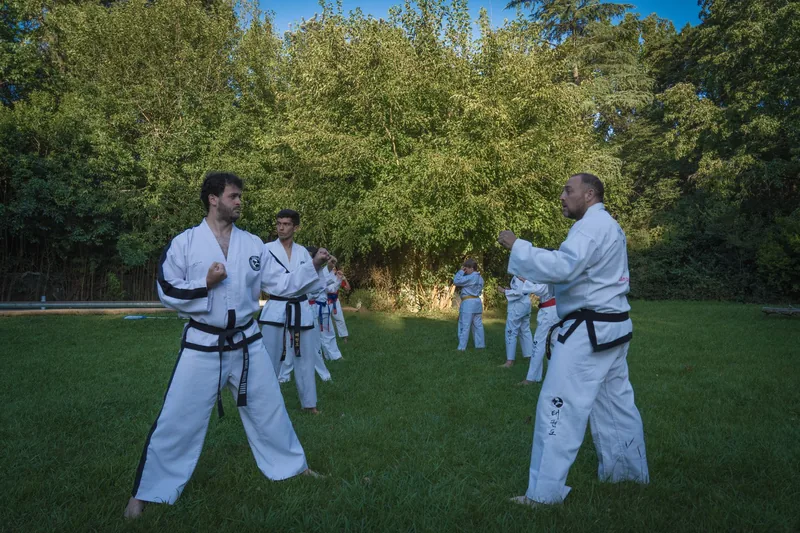
Every school sets its own class rules, but most follow the same core principles. These are the TaeKwonDo sparring rules you can expect almost anywhere:
- Bow in and bow out. Partners bow to each other before and after every round. It’s a sign of respect and a reminder that your partner is helping you learn.
- Full gear, every time. No gear, no sparring. Headgear, mouthguard, chest protector, and pads protect both of you.
- Control your contact. Class sparring is light and controlled. The goal is to touch the target with good technique, not to hurt your partner.
- Legal targets only. Kicks and punches go to the chest protector. Kicks to the head are usually allowed only at controlled contact and often only for higher ranks. No strikes to the back, the back of the head, the joints, or below the belt.
- Listen to the commands. Most schools use the Korean referee commands: shi-jak (begin), kal-yeo (break or separate), and keu-man (stop). When you hear “kal-yeo” or “keu-man,” you stop immediately.
- Match your partner. Spar at the level of the less experienced person. A higher rank who overpowers a beginner isn’t training well.
- Speak up. If something hurts or your gear slips, step back, raise your hand, and stop the round.
If the Korean commands are new to you, our Korean martial arts terminology glossary covers them along with the rest of the language you’ll hear in class.
Olympic TaeKwonDo Sparring Rules and Scoring
Competition sparring under World Taekwondo (WT), the federation that governs the Olympic sport, follows a much more detailed rulebook. Here are the basics a beginner should know.
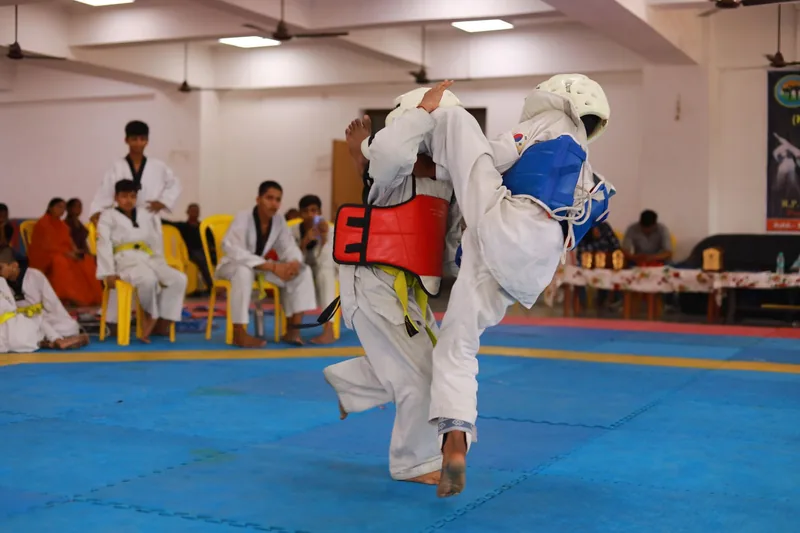
Scoring areas. Points come from techniques that land on the trunk protector (the padded vest, called a hogu) or kicks to the head. Punches score only to the trunk; punching the head is not allowed. Most competitions use electronic sensors in the vest, headgear, and socks to register valid contact.
Point values. A punch to the trunk is worth the least. Kicks score more, kicks to the head more than kicks to the body, and turning or spinning kicks earn extra points because they’re harder to land. World Taekwondo adjusts the exact numbers from time to time, so always check the current rulebook before a tournament.
Rounds. Since 2022, WT matches use a best-of-three-rounds format. Each round is scored separately, the score resets at the start of the next round, and the first athlete to win two rounds wins the match.
Penalties (gam-jeom). A penalty gives your opponent a point. Common penalties include stepping out of the boundary line, falling down, grabbing or pushing, kicking below the waist, attacking after “kal-yeo,” punching to the head, and attacking a fallen opponent.
Not every tournament uses WT rules. Schools in the ITF tradition allow punches to the head and use different scoring, which we break down in ITF vs WTF TaeKwonDo. Local and youth tournaments often use simplified point-sparring rules too, so read the event’s rules before you register.
TaeKwonDo Sparring Gear: What You’ll Need
Sparring gear isn’t optional, and good gear makes sparring far more comfortable. A standard set includes:
- Headgear — padded protection for the head and ears.
- Mouthguard — protects teeth and jaw. Required in nearly every school and tournament.
- Chest protector (hogu) — the main scoring target and your most important protection.
- Forearm and shin guards — absorb the impact of blocks and checked kicks.
- Groin guard — for all students, male and female versions available.
- Sparring gloves and foot protectors — padding for your hands and the tops of your feet.
At GMA, full protective gear is required for every sparring session, and your instructor will tell you exactly what to get before you start.
10 TaeKwonDo Sparring Tips for Beginners
- Keep your hands up. Your guard protects your head even when you’re kicking. Dropping your hands is the most common beginner habit.
- Stay light on your feet. A relaxed bounce lets you move in, out, and sideways in an instant.
- Learn your distance. TaeKwonDo is a long-range art. Most beginner trouble comes from standing too close or too far.
- Watch the chest, not the feet. Your partner’s hips and shoulders move before their kicks do.
- Breathe. Holding your breath burns energy fast. Exhale with every technique.
- Start with simple techniques. A fast front-leg roundhouse kick scores more often than a flashy spinning kick you haven’t mastered.
- Never turn your back. Turning away to avoid an attack is unsafe and, in competition, a penalty risk.
- Warm up and stretch. Loose hips and hamstrings make kicks faster and safer. Our guide to stretches for TaeKwonDo covers the best ones.
- Spar to learn, not to win. Try new combinations. Getting tagged in class is how you find the holes in your game.
- Ask for feedback. After each round, ask your partner or instructor one thing to fix.
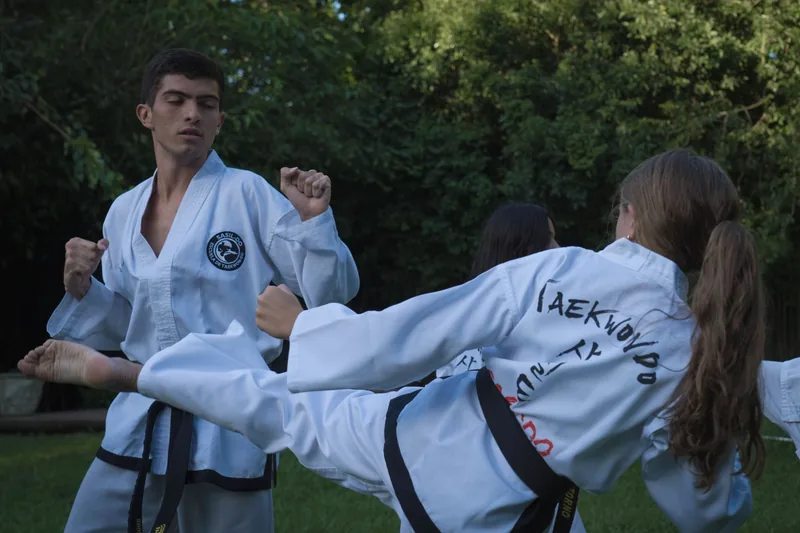
Sparring also takes conditioning. Short rounds feel long at first, so good sleep, hydration, and nutrition help. Fuel your training with GMA Warrior Supplements.
At Global Martial Arts USA, sparring is one part of a complete curriculum that also covers forms, self-defense, and board breaking. Our program is led by Grandmaster K.O. Spillmann, a 9th Degree Black Belt with more than 50 years of experience, our staff is Safe Sport certified, and our Gallatin school was voted the top martial arts school in Sumner County. New to the art? Start with what TaeKwonDo is, see how sparring fits into the path toward earning a black belt in TaeKwonDo, or explore our kids martial arts programs. Check the class schedule to find a class that fits your week.
Ready to Get Started?
Your first class is free. Whether you’re a complete beginner or an experienced martial artist, we’d love to welcome you to the GMA family.
Call us at (731) 324-3847 or book your free trial online.
Frequently Asked Questions
Is TaeKwonDo sparring full contact?
Class sparring is light and controlled. Olympic competition under World Taekwondo rules is full contact to legal targets, but athletes wear headgear, a chest protector, and pads, and punches to the head are not allowed. Beginners always start with controlled contact.
Can you punch to the face in TaeKwonDo sparring?
Not under World Taekwondo (Olympic) rules. Punches score only to the chest protector, and only kicks may target the head. ITF-style sparring does allow controlled punches to the head, so the answer depends on which ruleset your school or tournament uses.
When do beginners start sparring in TaeKwonDo?
It varies by school. Most students begin with pre-arranged step sparring and controlled drills, then move to free sparring once their basic kicks, guard, and control are solid. Your instructor decides when you’re ready, and full protective gear is required from day one.