
Every TaeKwonDo student hits the same wall sooner or later: the kick is fine at waist height, and then the hips lock up. Head-height roundhouse and side kicks don’t come from strength alone. They come from hips, hamstrings, and inner thighs that can open up without fighting you. The right stretches for TaeKwonDo build that range a little at a time, and the wrong ones (or the right ones at the wrong time) can leave you weaker and sorer than when you started.
This guide covers what flexibility your kicks actually need, a dynamic warm-up for before class, the static stretches to do after, how often to stretch, and the mistakes that slow most students down. It’s the same approach our instructors use in the TaeKwonDo program at Global Martial Arts USA in Gallatin, TN.
What Flexibility Do TaeKwonDo Kicks Need?
TaeKwonDo is a kicking art, and kicking high asks a lot of a few specific areas. Knowing which ones lets you spend your stretching time where it pays off.
- Hamstrings. Front kicks, axe kicks, and push kicks all depend on hamstring length. Tight hamstrings pull the kick down and round your lower back.
- Hip adductors (inner thighs). Side kicks and roundhouse kicks open the hip sideways. The adductors set how high that leg can rise before the kick turns into a lean.
- Hip flexors. Hours of sitting shorten the front of the hip. Tight hip flexors limit your back kick and spinning kicks and make it harder to chamber the knee high.
- Glutes and hip rotators. Turning the hip over on a roundhouse or side kick takes rotation. If the hip won’t pivot, the knee and lower back take the strain instead.
- Calves and ankles. Your standing leg pivots on the ball of the foot for nearly every kick. Stiff ankles cost balance and turn.
Flexibility is only half the picture. A kick needs active range, meaning you can lift and control the leg at that height under your own power, not just sink into a split on the floor. That’s why good TaeKwonDo stretching pairs passive holds with kicking drills that train the muscles to work at the end of their range.
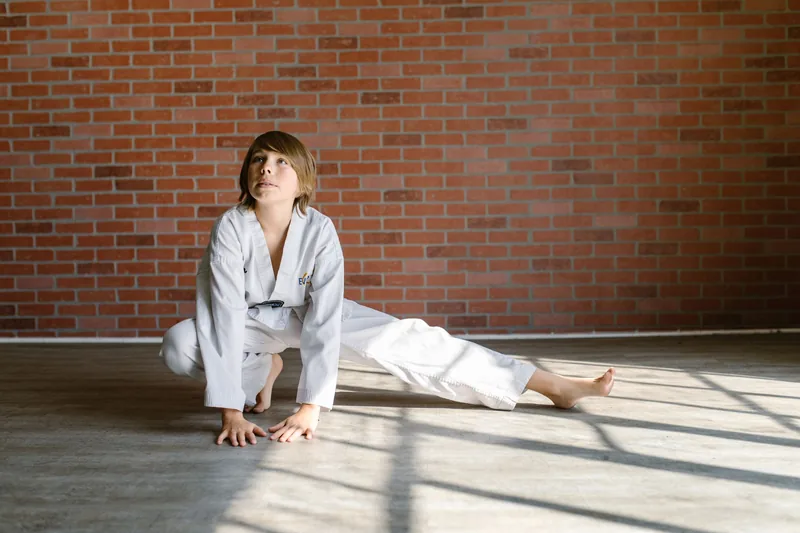
Before Class: A Dynamic Warm-Up for TaeKwonDo
Before you kick, move. A 2016 systematic review by Behm and colleagues in Applied Physiology, Nutrition, and Metabolism found that long static holds right before activity (60 seconds or more per muscle group) tended to reduce strength and power, while short holds had only a trivial effect and dynamic stretching slightly improved performance. For a kicking art built on speed and snap, save the long holds for after class.
Spend five to eight minutes on this sequence, building from small and slow to big and fast:
- Light cardio (1–2 minutes). Jumping jacks, skipping, or light bouncing in fighting stance to raise your body temperature.
- Hip circles and knee circles (30 seconds each). Wake up the joints before you load them.
- Front leg swings (10 per leg). Hold a wall or partner and swing the straight leg forward and back, letting it rise a little higher each rep.
- Side leg swings (10 per leg). Swing across the body and out to the side to open the adductors for side and roundhouse kicks.
- Walking lunges with a twist (8 per side). Opens the hip flexors and warms up rotation.
- Slow chambered kicks (5 per leg, per kick). Lift into the chamber, extend the front, roundhouse, and side kick slowly at medium height, and hold the extension for a beat.
By the end, you should feel warm and loose, not tired.
After Class: The Best Static Stretches for TaeKwonDo
After training, your muscles are warm, and that’s when longer holds do the most good. The American College of Sports Medicine recommends holding a static stretch for 10 to 30 seconds for most adults (30 to 60 seconds can help older adults), repeating each stretch for about 60 total seconds per muscle group, and stretching to mild tightness, never pain.
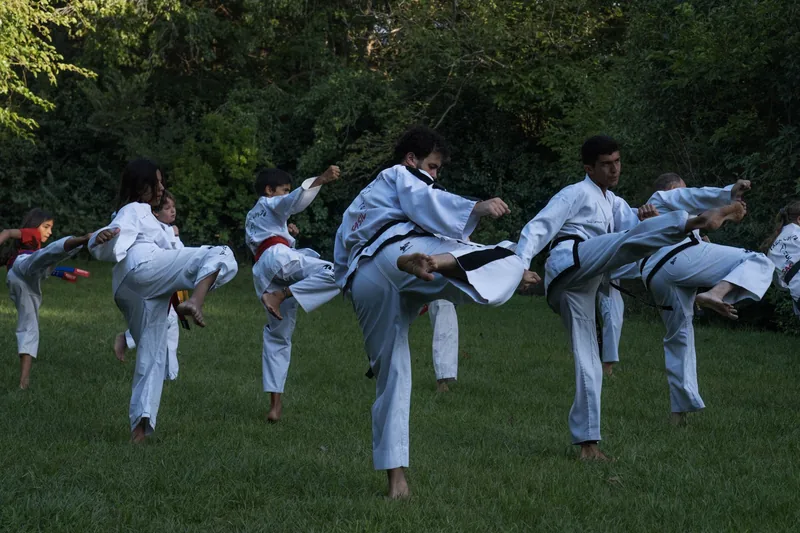
1. Seated Hamstring Stretch
Sit with one leg straight and the other foot against your inner thigh. Hinge forward from the hips with a long back, leading with your chest, and reach toward your foot.
2. Butterfly Stretch
Sit with the soles of your feet together and your knees dropped out to the sides. Hold your ankles and press your knees gently toward the floor with your elbows. This targets the adductors that control side kick height.
3. Wide Straddle Stretch
Sit with your legs spread as wide as is comfortable, toes up. Walk your hands forward, keeping your back flat, then reach toward each foot in turn. This is the foundation of the side split.
4. Low Lunge (Hip Flexor Stretch)
Kneel with one foot forward in a lunge. Tuck your hips under and shift forward until you feel a stretch across the front of the back hip. Essential if you sit at a desk all day.
5. Figure-Four Glute Stretch
Lie on your back, cross one ankle over the opposite knee, and pull the bottom leg toward your chest. It opens the hip rotators that let the roundhouse turn over cleanly.
6. Front Split Progression
From a low lunge, slide the front heel forward and straighten the front leg, supporting your weight on your hands or yoga blocks. Go only as far as you can control. Splits are a long-term goal, not a single-session one.
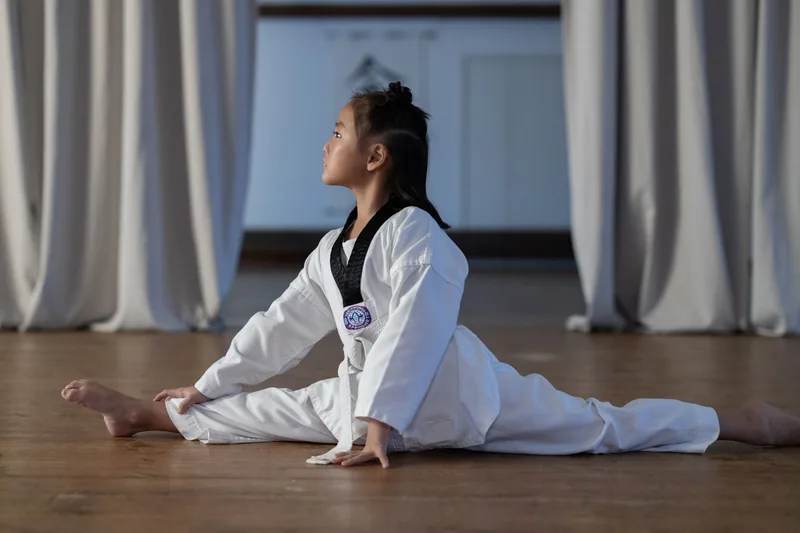
How Often to Stretch for Higher Kicks
Consistency beats intensity. ACSM’s guidance is to stretch at least two to three days a week, and daily stretching works best. A practical plan for most TaeKwonDo students looks like this:
- Every class: the dynamic warm-up before and a 5–10 minute static routine after.
- Two or three non-class days: a slow 10–15 minute session of the static stretches above, ideally after a short walk or some light movement.
- Every week: a few slow, controlled kicks held at the top to build active range at your new height.
Expect gradual progress measured in weeks and months, not days. Younger students gain range faster, but adults improve too with a gentler ramp. Flexibility work is also a big part of why kick height grows steadily from rank to rank, which is one reason the path to a black belt in TaeKwonDo takes years rather than months. Sleep, hydration, and nutrition all affect recovery between sessions. Fuel your training with GMA Warrior Supplements.
Common TaeKwonDo Stretching Mistakes
Stretching cold. Forcing a split before you’ve warmed up is the fastest way to strain a hamstring or groin. Always move first.
Bouncing in static stretches. Ballistic bouncing in a held position can trigger the muscle to tighten up. Dynamic leg swings are controlled movement; bouncing in a split is not.
Pushing into pain. Mild tightness is the target. Sharp, pinching, or joint pain means back off. If pain doesn’t go away, see a doctor or physical therapist before training through it.
Only stretching passively. If you can do a split on the floor but can’t kick above your waist, you need active range. Slow kicks, leg raises, and holding your kick at full extension close that gap.
Stretching for a grappling art looks different, with more emphasis on the hips, neck, and shoulders. If you cross-train, our guide to the best BJJ stretches covers that side. And if you’re new to the art entirely, start with what TaeKwonDo is and how training works.
At GMA, every TaeKwonDo class builds flexibility into the warm-up and cool-down, so you’re never left guessing. Our program is led by Grandmaster K.O. Spillmann, a 9th Degree Black Belt with more than 50 years of experience, and our Gallatin school was voted the top martial arts school in Sumner County. Check the class schedule to find a TaeKwonDo class that fits your week.
Ready to Get Started?
Your first class is free. Whether you’re a complete beginner or an experienced martial artist, we’d love to welcome you to the GMA family.
Call us at (731) 324-3847 or book your free trial online.
Frequently Asked Questions
Should I stretch before or after TaeKwonDo?
Both, in different ways. Before class, do a dynamic warm-up with leg swings, lunges, and slow kicks. After class, when your muscles are warm, hold static stretches. Research suggests long static holds right before training can reduce power, so save these stretches for TaeKwonDo cool-downs.
How long does it take to get flexible enough for high kicks?
It depends on your age, starting point, and consistency. Most students who stretch after every class plus two or three extra days a week notice higher, easier kicks within a couple of months. Full splits can take much longer, and that’s normal.
Do I need to be flexible to start TaeKwonDo?
No. Most students start with very little flexibility. Kicking height develops through regular training and stretching, and instructors adjust techniques to your current range so you can train safely from day one.