

Ask any TaeKwonDo student what they practice at home, and the answer is almost always the same: their form. TaeKwonDo forms, called poomsae in Korean, are set sequences of blocks, strikes, kicks, and stances performed in a fixed pattern. They’re the backbone of rank testing, and each new belt brings a new one to learn. They can also be confusing at first, with Korean names, numbered chapters, and different sets depending on which branch of the art a school follows.
This guide gives you the complete list: the eight color belt forms, the nine black belt forms, what each name means, the older and ITF sets you’ll hear about, and practical tips for learning your forms faster. It’s written from the perspective of the TaeKwonDo program at Global Martial Arts USA in Gallatin, TN, where forms are part of every rank.
What Are TaeKwonDo Forms (Poomsae)?
A poomsae is a choreographed solo routine against imaginary opponents. Each one follows a floor pattern, a line the student travels along while performing techniques in a set order, and each starts and ends on the same spot. Forms teach things that are hard to learn any other way:
- Muscle memory. Repeating the same blocks and strikes hundreds of times makes them automatic.
- Balance and stances. Every transition tests whether your weight is where it belongs.
- Power and timing. Forms teach you to coordinate hips, breath, and hands so a technique lands with the whole body behind it.
- Focus. A form demands total concentration from the first bow to the last. Lose your place and you have to start over.
Forms also carry the art’s philosophy. Most poomsae names point to a natural element, a historical idea, or a moral principle, which is why instructors expect students to know what their form means, not just how it moves. If the Korean words are still new to you, keep our Korean martial arts terminology glossary handy.
The Taegeuk Forms: TaeKwonDo Forms for Color Belts
Most schools affiliated with the Kukkiwon, the world headquarters of TaeKwonDo in Seoul, teach the eight Taegeuk forms to color belts. Taegeuk is the Korean name for the yin-yang symbol at the center of the South Korean flag, and each of the eight forms is tied to one of the eight trigrams from the I Ching. They’re numbered with the Korean word jang, meaning chapter.
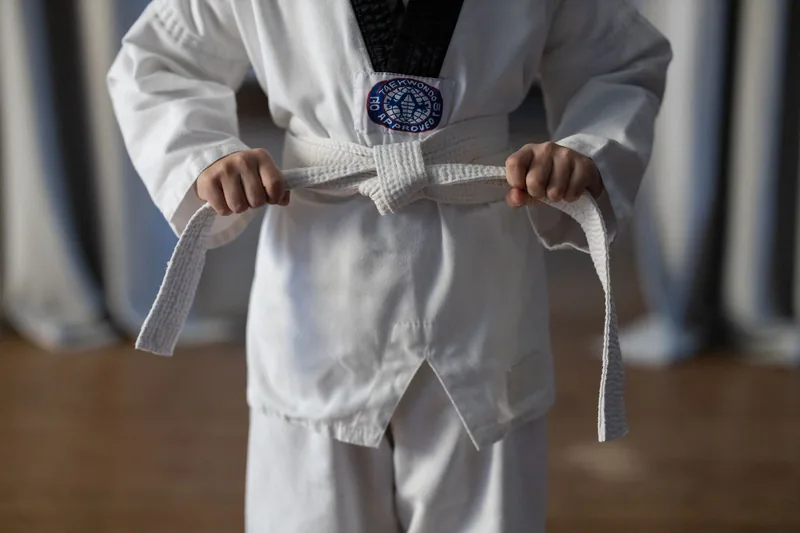
- Taegeuk Il Jang — Keon, heaven and light. The first form, built on walking stance, front stance, low and middle blocks, and front kicks.
- Taegeuk Ee Jang — Tae, joyfulness. Calm on the inside, firm on the outside, with more front kicks and high blocks.
- Taegeuk Sam Jang — Ri, fire and sun. Faster combinations and knife-hand strikes.
- Taegeuk Sa Jang — Jin, thunder. Introduces back stance and side kicks.
- Taegeuk Oh Jang — Seon, wind. Mixes gentle and strong movements, with hammer fists and elbow strikes.
- Taegeuk Yuk Jang — Gam, water. Steady, flowing movement and roundhouse kicks.
- Taegeuk Chil Jang — Gan, mountain. Stillness and stability, with tiger stance and low, rooted postures.
- Taegeuk Pal Jang — Gon, earth. The final color belt form, a review of everything before it plus jumping kicks, in preparation for black belt.
In schools that use this set, students usually add one Taegeuk form with each gup (color belt) rank. Every form still has to be performed cleanly at later tests, so a red belt is expected to know all eight. You can see how those ranks line up in our guide to the martial arts belt ranking system.
Black Belt TaeKwonDo Forms: The Yudanja Poomsae
Once you earn your black belt, the curriculum moves to the nine yudanja (black belt) poomsae. These forms are longer, slower in places, and far more demanding on balance and control. Each is associated with a degree (dan) of black belt:
- Koryo (1st Dan) — named for the Goryeo dynasty, from which Korea takes its English name. It represents the learned, strong-minded person.
- Keumgang (2nd Dan) — “diamond,” for hardness that can’t be broken, and Mount Keumgang. Known for slow, heavy movements and one-legged crane stances.
- Taebaek (3rd Dan) — the bright mountain, linked to Mount Baekdu and the legendary founding of Korea.
- Pyongwon (4th Dan) — a vast plain, representing peace and the source of life.
- Sipjin (5th Dan) — the ten symbols of long life in Korean tradition, emphasizing steady, continuous growth.
- Jitae (6th Dan) — earth, and a person standing on it between heaven and ground.
- Cheonkwon (7th Dan) — heaven and sky, with large circular movements.
- Hansu (8th Dan) — water, adaptable and enduring.
- Ilyeo (9th Dan) — oneness, the unity of body and mind and the culmination of the system.
The time between dan ranks grows with each degree, so the higher forms take years of study. That’s part of why earning a black belt in TaeKwonDo is really the start of a longer journey rather than the finish line.
Palgwe and ITF Patterns: Other Form Sets You’ll See
The Taegeuk set isn’t the only one out there, and you’ll likely run into two others.
Palgwe forms. Before the Taegeuk set, Kukkiwon-style schools used the eight Palgwe forms, created in the late 1960s and based on the same eight trigrams. The Taegeuk forms replaced them for rank testing during the 1970s and 1980s, though some traditional schools still teach Palgwe alongside or instead of Taegeuk.
ITF patterns (tul). Schools in the International Taekwon-Do Federation tradition train the Chang Hon patterns, 24 forms developed by General Choi Hong Hi, starting with Chon-Ji for beginners. ITF patterns use a rising-and-falling “sine wave” motion that looks noticeably different from Kukkiwon poomsae. We break down that split in detail in ITF vs WTF TaeKwonDo.
Which set a school teaches depends on its lineage. GMA’s TaeKwonDo is rooted in the Jidokwan lineage, one of the original kwans that helped unify modern TaeKwonDo, and our instructor team holds Kukkiwon certification. Your instructor will tell you exactly which form is required for your current rank.
How to Learn TaeKwonDo Forms Faster
Forms are one of the most common reasons students feel stuck before a belt test. These habits help:
- Learn the floor pattern first. Walk the shape slowly with just the stances before adding blocks and strikes. Once your feet know where to go, the hands follow.
- Break it into sections. Most forms divide naturally into three or four segments. Master one before linking it to the next.
- Count in Korean. Saying the movement numbers out loud keeps your place and builds the terminology you’ll need for testing.
- Practice a little every day. Five focused minutes daily beats one long session before the test. Many forms fit in a living room.
- Ask about the meaning. Knowing what a movement is for (a block against a punch, a strike to an opening) makes the sequence easier to remember and the technique sharper.
- Film yourself. Compare your stances and chamber positions to what your instructor shows in class.
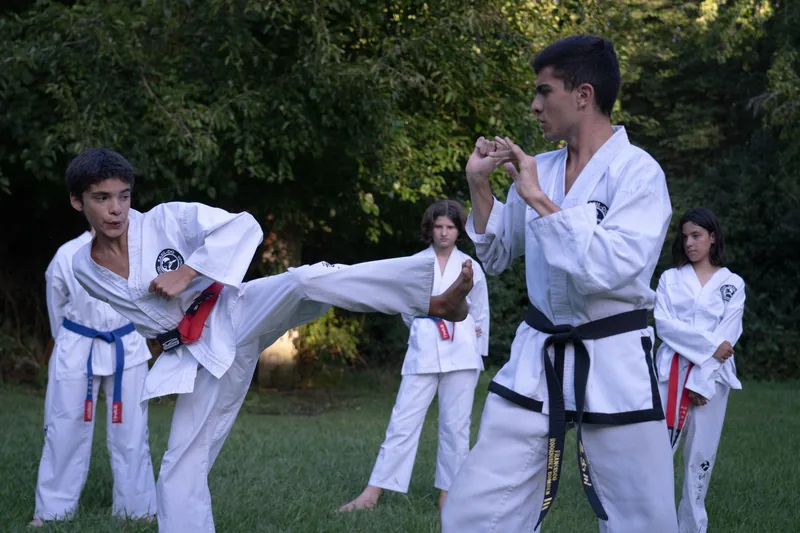
At GMA, each belt rank has its own form to master, and forms are trained in class alongside sparring, self-defense, and board breaking, so you never have to learn them alone. Our program is led by Grandmaster K.O. Spillmann, a 9th Degree Black Belt with more than 50 years of experience, and our Gallatin school was voted the top martial arts school in Sumner County. New to the art? Start with what TaeKwonDo is and how training works. Many students also cross-train: our HapKiDo classes add joint locks and throws, and if grappling interests you, explore our dedicated BJJ program at GMA Team. Check the class schedule to find a TaeKwonDo class that fits your week.
Ready to Get Started?
Your first class is free. Whether you’re a complete beginner or an experienced martial artist, we’d love to welcome you to the GMA family.
Call us at (731) 324-3847 or book your free trial online.
Frequently Asked Questions
How many TaeKwonDo forms are there?
In the Kukkiwon system, there are 17 main forms: eight Taegeuk poomsae for color belts and nine black belt poomsae, from Koryo to Ilyeo. The ITF tradition uses a different set of 24 patterns. Some traditional schools also teach the eight older Palgwe forms.
What is the first TaeKwonDo form?
In Kukkiwon-style schools, the first form is Taegeuk Il Jang, which represents heaven and light. It teaches the basic walking stance, front stance, blocks, punches, and front kick. In ITF schools, the first pattern is Chon-Ji.
How long does it take to learn a TaeKwonDo form?
Most students can learn the sequence of a color belt form in a few weeks of regular classes and home practice. Performing it with the precision, power, and balance required for a belt test usually takes the full time between ranks, which is typically a few months.