
The 24 form tai chi — also called the Simplified Form or the Beijing Form — is the most widely practiced tai chi routine in the world. Created in 1956 by the Chinese Sports Committee to make tai chi accessible to everyone, the 24 Form distills the core principles of Yang Style into a sequence that beginners can learn without years of prior martial arts experience. If you’ve ever wanted to start tai chi and didn’t know where to begin, this is the starting point recommended by instructors everywhere.
This guide walks you through what the 24 Form is, what each section trains, how long it takes to learn, and how to get the most out of your practice — whether you’re starting from scratch or picking it up alongside a class at Global Martial Arts USA in Gallatin, TN.
What Is the Tai Chi 24 Form?
The 24 Form was developed in 1956 when the Chinese Sports Commission standardized a short tai chi sequence for national health promotion. They drew from Yang Style tai chi — the most popular and accessible of the five major styles — and condensed its most essential movements into 24 postures that could be learned in weeks rather than years.
Before 1956, learning tai chi meant committing to hundreds of movements in traditional long forms. The 24 Form changed that. It kept the principles intact — rooted stances, circular movement, coordinated breath, and the concept of qi (internal energy) flowing through the body — while making the practice reachable for ordinary people with ordinary schedules.
At GMA, our Tai Chi program is built on Yang Style, the same tradition the 24 Form comes from. Students who begin with the 24 Form develop the foundational movement vocabulary that longer, more advanced forms build on. It’s a genuine beginning, not a shortcut.
The full form takes approximately 6–8 minutes to complete at normal practice speed. Most practitioners learn the complete sequence in three to six months with regular practice, though developing fluency and depth in the movements takes considerably longer.
The 24 Movements: A Section-by-Section Overview
The 24 Form is typically organized into six natural sections, each building on the movement quality established in the one before it.
Opening and Foundation (Movements 1–3): The form begins with the Commencing Posture — a simple standing movement that establishes grounded posture and coordinated breathing. This is followed by Part Wild Horse’s Mane, which introduces the core footwork pattern used throughout the entire form: the bow stance. White Crane Spreads Its Wings introduces weight shifting and the lifted one-arm guard. These first three movements teach the basics of rooting, shifting, and upper body coordination that every subsequent movement builds on.
Stepping and Arm Work (Movements 4–6): Brush Knee and Push introduces the diagonal step — one of tai chi’s most important footwork patterns — combined with a sweeping arm and forward push. Hand Strums the Lute teaches a narrow stance with precise upper body placement. Step Back and Whirl Arms introduces backward stepping, which beginners typically find significantly more challenging than moving forward. Learning to move backward with control and coordination is a key balance milestone in the form.
Grasping and Single Whip (Movements 7–9): Grasp Sparrow’s Tail — performed on both sides — is often described as tai chi’s core sequence within the sequence. It contains four distinct sub-movements (Ward Off, Roll Back, Press, Push) that represent the fundamental push-pull relationship in tai chi. Single Whip is the most visually distinctive posture in the form — the “hooked” hand position at shoulder height, one arm extended forward in a wide open stance. It appears twice in the 24 Form and is immediately recognizable.
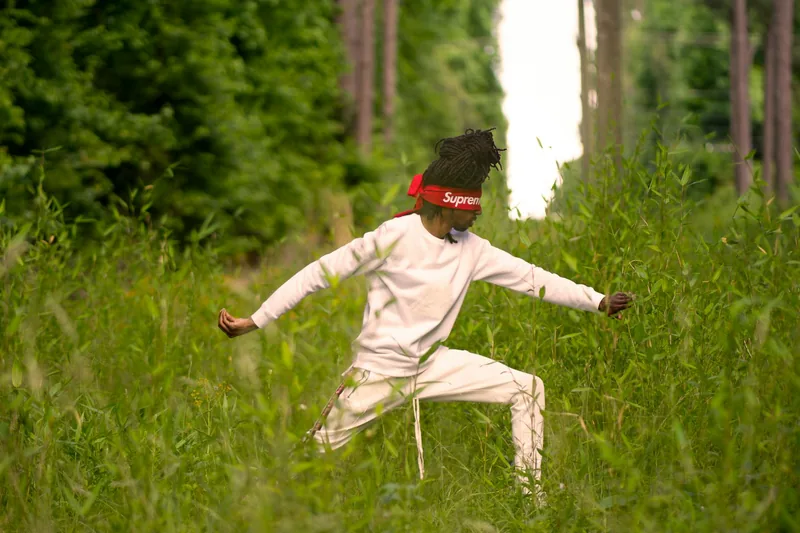
Wave Hands Like Clouds (Movement 10–11): Wave Hands Like Clouds is the most meditative section of the form — a continuous lateral stepping pattern with the arms moving in slow horizontal circles. It’s the closest the 24 Form comes to moving meditation in pure form. Practitioners who find this section difficult often discover they’ve been holding their breath. Single Whip returns again after the Cloud Hands sequence, deepening the repetition that is one of tai chi’s most effective learning tools.
Kicks and Power Movements (Movements 12–21): The middle section of the form is where its martial roots show most clearly. High Pat on Horse, Heel Kicks (right and left), Strike to Ears with Both Fists, Snake Creeps Down, and Golden Rooster Stands on One Leg all require balance, hip strength, and precise weight control. These aren’t decorative — they’re direct self-defense techniques preserved in the form. Jade Girl Works at Shuttles (both sides) introduces diagonal direction changes, Needle at Sea Bottom requires a low forward reach, and Flash the Arm tests shoulder flexibility and power generation from the hip.
Closing Sequence (Movements 22–24): Deflect, Parry, and Punch; Apparent Closing; and Cross Hands into Closing Form bring the sequence to its conclusion. The closing sequence mirrors the precision and grounding of the opening — the form ends as quietly and intentionally as it began.

How Long Does It Take to Learn the Tai Chi 24 Form?
Most beginners with access to qualified instruction and consistent weekly practice can learn the complete sequence — meaning they can move through all 24 postures — in three to five months. “Learning” the sequence and “knowing” the form are different things. Moving through the postures correctly takes months. The subtleties of weight distribution, breath timing, and flowing transitions take years.
A practical learning progression looks like this:
Months 1–2: Learn Sections 1–3 (Movements 1–9). Focus on footwork patterns, the bow stance, and how the arms coordinate with weight shifts. Don’t rush past basic movement quality to accumulate more postures.
Months 2–4: Add Sections 4–5 (Movements 10–17). The kicks and Cloud Hands sequence require more balance work. This is where a good instructor matters most — it’s easy to develop compensations here that limit progress later.
Months 4–6: Complete Sections 5–6 and connect the full form. Run through it as a continuous sequence without stopping. This is the milestone most beginners work toward in their first year.
For beginners who want to understand the broader context of tai chi before diving into a specific form, our tai chi for beginners guide covers what to expect in your first classes, how the learning process works, and the most common beginner mistakes to avoid.

Why the 24 Form Is the Best Starting Point
There are five major styles of tai chi — Yang, Chen, Wu, Sun, and Woo — plus dozens of individual forms within each style. Beginners are often overwhelmed by the range of options. The 24 Form cuts through that noise.
It’s short enough to learn in a reasonable timeframe but complete enough to give you a real practice. The movements are drawn from Yang Style — the same tradition GMA’s program is built on — which means what you learn here transfers directly to more advanced study. The 24 Form teaches rooted stances, coordinated stepping, and the circular, continuous movement quality that defines tai chi across all its forms.
The Yang Style tradition also appears in our post on Yang Style Tai Chi: The Most Popular Form Explained — which covers the broader history and technical principles that the 24 Form is built on. Understanding where the form comes from deepens your practice of it.
Practitioners at GMA in Gallatin — voted the top martial arts school in Sumner County — who begin with the 24 Form regularly progress to longer Yang Style sequences, push hands work, and eventually to the full Yang long form — a 108-movement sequence that takes years to develop. The 24 Form is the beginning of that path, not a substitute for it.
Ready to Get Started?
Your first class is free. Whether you’re a complete beginner or an experienced martial artist, we’d love to welcome you to the GMA family.
Call us at (731) 324-3847 or book your free trial online.
Frequently Asked Questions
Is the 24 Form the same as Yang Style tai chi?
The 24 Form is derived from Yang Style — it uses Yang Style’s movement principles and postures. But it’s a simplified, standardized version created in 1956 by the Chinese Sports Committee, not a traditional Yang Style form. Traditional Yang Style includes much longer sequences (the standard long form has 108 movements). Think of the 24 Form as an introduction to Yang Style tai chi, not the complete system.
Can I learn the 24 Form on my own from videos?
You can learn the sequence from videos, but learning the form correctly is much harder without a qualified instructor. The most common mistakes — locked knees, shallow stances, disconnected arm movement, held breath — are nearly impossible to self-diagnose on video. An instructor catches these errors early, before they become habits. Most practitioners who try to learn entirely from video eventually reach a ceiling and come to class anyway. Starting with qualified instruction from the beginning is faster in the long run.
How often should I practice the 24 Form?
Daily practice, even for 10–15 minutes, is more effective than longer sessions two or three times a week. Tai chi is a motor skill — it’s built through repetition and consistency, not volume on any single day. Practicing the full form once in the morning and once in the evening is a common recommendation for beginners. As you develop fluency, running through the form three to five times in a session is a natural progression.