
If staying steady on your feet has become something you think about — on stairs, on uneven ground, or getting out of a chair — tai chi for balance is one of the most effective practices you can take up. Unlike standing on one leg or doing a few stretches, tai chi systematically retrains the exact skills that keep you upright: shifting your weight under control, sensing where your body is in space, and recovering when something throws you off center. At Global Martial Arts USA in Gallatin, TN, we’ve spent more than 50 years teaching students of every age how to move with confidence again.
This guide explains how tai chi builds balance at a physical level, what the research says about its remarkable record on fall prevention, who benefits most, and the specific movements that make it work — plus how to get started safely.
How Tai Chi Trains Your Balance
Balance isn’t a single ability — it’s a coordinated system. Your body keeps you upright using input from your inner ear, your eyes, and the position sensors in your muscles and joints (a sense called proprioception), then responds with small, fast corrections from the ankles, hips, and core. As we age or recover from injury, those signals get slower and the correcting muscles get weaker. Falls happen in the gap between losing your center and reacting to it.
Tai chi closes that gap. Nearly every movement involves slowly transferring your weight from one foot to the other while staying controlled the entire way — the single best drill for the weight-shifting that walking, turning, and climbing stairs all depend on. Holding postures briefly on one leg strengthens the stabilizing muscles around the ankle and hip. And because the movements are performed slowly and deliberately, your nervous system has time to actually feel each position and refine its corrections, sharpening proprioception in a way fast exercise never does.
The result is balance that holds up in the real world. A misstep on a curb becomes a small wobble you catch instead of a fall you can’t. That carryover from practice to everyday movement is what makes tai chi different from balance “exercises” you do in isolation.
What the Research Says About Tai Chi and Fall Prevention
Few forms of exercise have a fall-prevention record as strong as tai chi. In a 2018 randomized clinical trial published in JAMA Internal Medicine, researchers followed 670 adults aged 70 and older who had a history of falls or impaired mobility. A therapeutic tai chi program reduced falls by 58 percent compared with a stretching program — and by 31 percent compared with a conventional multimodal exercise routine that included aerobic, strength, and balance training. Tai chi didn’t just beat doing nothing; it outperformed standard exercise designed specifically to prevent falls.
Those findings echo a broader body of evidence. A 2017 systematic review, also in JAMA Internal Medicine, concluded that tai chi can reduce fall risk in older adults by up to 50 percent. On the strength of results like these, the CDC and the National Council on Aging now list tai chi among their recommended, evidence-based fall-prevention programs, and a structured curriculum called “Tai Ji Quan: Moving for Better Balance” was developed directly from this research for community fall-prevention use.
The takeaway for anyone weighing where to spend their exercise time: the benefits of tai chi for balance aren’t a wellness trend — they’re some of the best-documented outcomes in the entire field of fall prevention.
Who Benefits Most from Tai Chi for Balance
Older adults have the most to gain, because fall risk climbs with age and the consequences grow more serious. But balance training through tai chi isn’t only for seniors. Anyone recovering from a lower-body injury, managing a neurological condition such as Parkinson’s disease or the after-effects of a stroke, or simply noticing they feel less sure-footed than they used to can rebuild stability with regular practice. Even athletes and active adults use tai chi to refine the control and body awareness that power, speed, and endurance training tend to overlook.
What makes the practice so widely accessible is that it scales to the body you bring to it. Movements can be performed standing for those with solid mobility, or modified and supported for those just starting to rebuild. If you’re an older adult specifically, our dedicated guide to tai chi for seniors covers chair-based options and what a first class looks like in more detail.
Key Tai Chi Movements That Build Balance
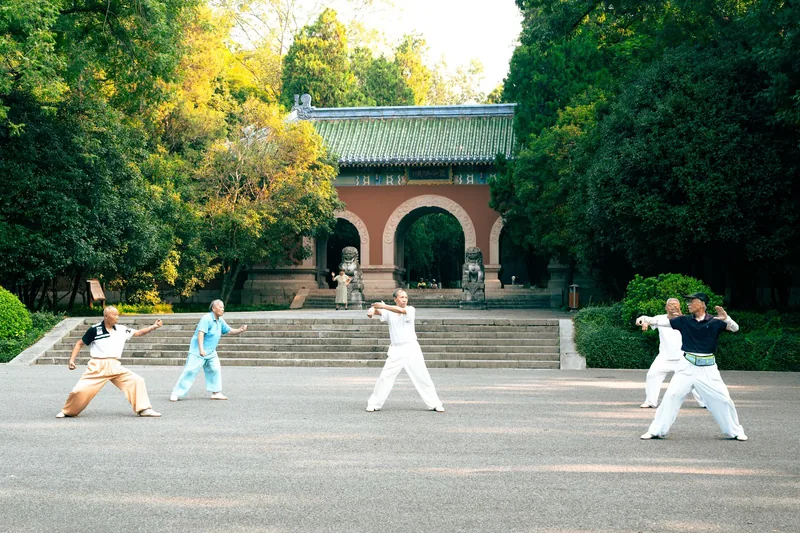
You don’t need the entire form to start improving balance — a handful of foundational movements do most of the work. Controlled weight shifting is the cornerstone: standing with feet shoulder-width apart and slowly transferring your full weight onto one leg, then the other, teaches your body to move its center of gravity without losing control. It looks simple and is surprisingly demanding.
From there, gentle single-leg postures — classic movements like “Golden Rooster Stands on One Leg” — build the ankle and hip strength that catches you when you stumble. Controlled stepping drills, where you place each foot with deliberate precision rather than letting it drop, retrain the careful foot placement that prevents trips. And slow turning movements challenge the inner-ear and visual systems to keep you oriented while your base of support rotates — one of the most common moments people lose their balance in daily life.
In a class setting, an instructor sequences these elements so they reinforce each other and adjusts the difficulty as you progress. That structure, taught as part of the traditional Yang Style forms in our Tai Chi program, is what turns isolated movements into lasting, reflexive balance.
How to Start Building Balance with Tai Chi
If you have a history of falls or any chronic health condition, a quick conversation with your doctor is a sensible first step — tai chi is among the safest forms of exercise available, but a provider who knows your history can flag anything specific to watch. Once you’re cleared, the most valuable thing you can do is practice with a qualified instructor rather than relying on videos alone. Balance training depends on real-time feedback about your posture and weight distribution, and that guidance is exactly what keeps a beginner safe while the skill develops.
Look for a school that teaches tai chi as a complete system — breathing, structure, and martial principles alongside the movements — because understanding why a posture works helps you practice it with intention. GMA has been voted the top martial arts school in Sumner County, and our tai chi classes are taught by instructors with decades of experience in both the health and martial sides of the art. You can view our class schedule and drop in for a free trial whenever you’re ready to take the first step.
Ready to Get Started?
Your first class is free. Whether you’re a complete beginner or an experienced martial artist, we’d love to welcome you to the GMA family.
Call us at (731) 324-3847 or book your free trial online.
Frequently Asked Questions
How long does it take for tai chi to improve balance?
Most people notice they feel steadier within a few weeks of consistent practice, with measurable improvements in balance and fall risk typically documented in studies after about 12 to 24 weeks of training two to three times per week. The key is consistency — short, regular practice builds the reflexive corrections that prevent falls far better than occasional longer sessions.
Is tai chi better than regular balance exercises for preventing falls?
The research suggests it often is. In a 2018 JAMA Internal Medicine trial, a therapeutic tai chi program reduced falls by 31 percent more than a conventional multimodal exercise routine built specifically for fall prevention. Tai chi’s combination of slow weight-shifting, single-leg strengthening, and trained body awareness appears to target the causes of falls unusually well.
Can I do tai chi for balance if I’m afraid of falling during class?
Yes. Movements can be practiced near a wall or sturdy chair for support, and a good instructor scales the difficulty to your current ability so you’re never asked to do more than you can safely manage. Many students who start out anxious about their balance gain confidence quickly as their stability improves.