
The tai chi sword form is where many practitioners discover what their empty-hand practice has actually been building. The movements look familiar — the same rooted stances, the same continuous, circular flow — but now there’s three feet of steel extending from your hand, and every flaw in your posture, timing, and balance shows up at the tip of the blade. It’s demanding, it’s beautiful to watch, and it’s one of the most rewarding stages of tai chi training.
This guide covers what the tai chi sword is, the forms practitioners learn, what sword training develops that empty-hand work doesn’t, how to choose a practice sword, and when you’re ready to pick one up — with notes on how weapon training fits into the Tai Chi program at Global Martial Arts USA in Gallatin, TN.
What Is the Tai Chi Sword?
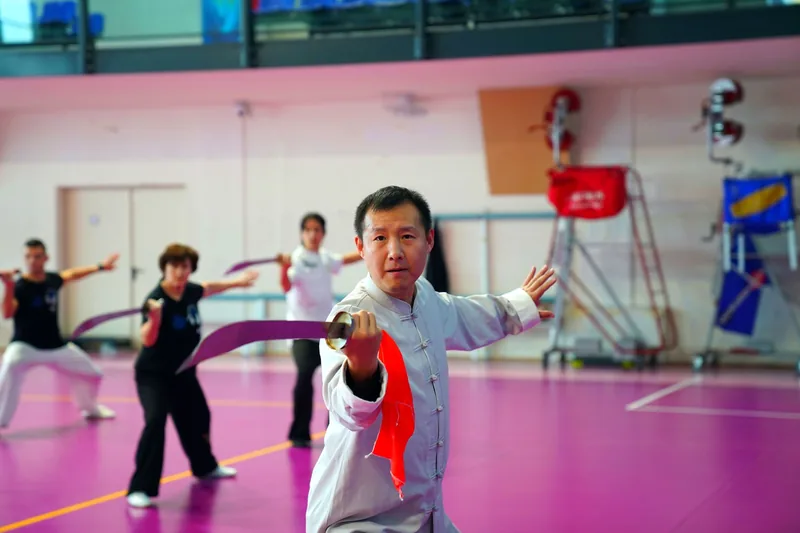
The tai chi sword is the jian — a straight, double-edged Chinese sword. It’s light, balanced toward the hand, and built for precision rather than force. Where the single-edged saber (dao) chops and sweeps with power, the jian cuts, points, and deflects with finesse. That’s why it’s long been called the “gentleman of weapons” in Chinese martial culture: it rewards skill and sensitivity, not muscle.
That character makes the jian a natural match for tai chi. Tai chi teaches you to yield, redirect, and move from the center rather than the arms. The sword asks for exactly the same thing. Grab it too hard and the blade wobbles. Swing it with your shoulder and the movement dies. Move it from your legs and waist, the way the empty-hand form teaches, and the sword comes alive.
A few features stand out the first time you hold one:
- The sword-finger hand. Your free hand forms “sword fingers” — index and middle fingers extended, the others curled. It balances the body and mirrors the blade’s intent.
- Two grips. The handle is symmetrical because the form uses both a forward grip and a reverse grip, where the blade rests flat along your forearm.
- The tassel. Many tai chi swords carry a tassel at the pommel. Today it’s mostly decorative, but it’s also honest feedback — if your movement is jerky or poorly timed, the tassel wraps around your wrist or the blade.
The Main Tai Chi Sword Forms
Just like empty-hand tai chi, the sword has short standardized forms and longer traditional ones. Here are the ones you’ll hear about most often.
The 32 Sword Form
The 32 Sword Form is the most widely practiced tai chi sword form in the world. Adapted from Yang Style sword by Li Tianji, it was approved by China’s national physical education committee in 1957 as the standard introductory sword routine. It’s organized into four sections of eight movements and takes only a few minutes to perform. If you’ve learned the Tai Chi 24 Form, the 32 Sword is its natural companion — same Yang Style roots, same goal of making a deep tradition accessible.
Traditional Yang Style Sword
The traditional Yang family sword form is longer — roughly 50 to 70 movements depending on the lineage — and preserves more of the original sequencing and martial detail. It’s typically studied after a practitioner is comfortable with a short form. If you want the history behind it, our guide to Yang Style Tai Chi covers the tradition both the empty-hand and sword forms come from.
Competition and Other Style Forms
There’s also a standardized 42-movement competition sword form, and the other major styles — including Chen style tai chi — have their own sword routines. Chen sword, like Chen empty-hand, mixes slow movement with sudden bursts of power. The sword itself is the same; the expression changes with the style.
What Tai Chi Sword Form Training Develops
The sword doesn’t replace empty-hand practice — it amplifies it. Here’s what changes when you add a blade.
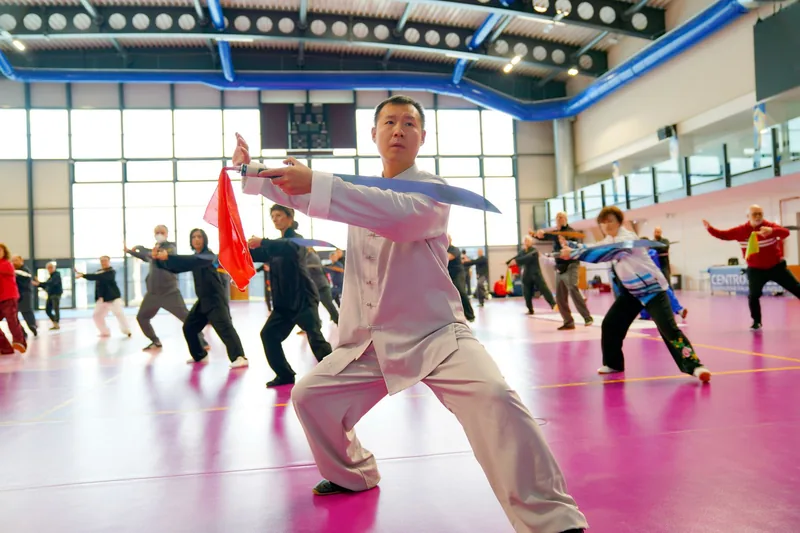
Whole-body connection. A sword exaggerates every disconnect. If your arm moves before your waist turns, the tip tells you. Practitioners often find that sword work fixes timing problems in their empty-hand form that months of correction couldn’t.
Extension and intent. In the empty-hand form, your awareness ends at your fingertips. With a sword, it has to reach the tip of the blade. That habit of projecting focus outward is one of the main reasons teachers introduce weapons at all.
Leg strength and balance. Sword forms include more one-legged postures, deeper stances, and quicker changes of direction than most empty-hand forms. The extra weight held away from your body makes balance harder — and more productive to train.
Grip and wrist control. The jian is held loosely, with the fingers doing fine adjustments. Learning to control a blade without strangling the handle builds a relaxed strength in the hand and forearm that carries over into push hands and self-defense work.
Choosing a Practice Sword
You don’t need a sharp sword — and you shouldn’t start with one. Most practitioners progress through three types:
- Wooden swords — inexpensive, safe for group classes, and ideal for learning the sequence.
- Flexible “wushu” swords — light, thin blades common in demonstrations and competition. They’re easy to handle but don’t feel like a real weapon.
- Rigid practice swords — unsharpened steel with realistic weight and balance. This is where the form starts to feel like swordsmanship.
Sizing matters more than price. The common rule: hold the sword in the reverse grip with your arm relaxed at your side, and the tip should reach about the top of your ear. A sword that’s too long drags your balance forward; one that’s too short throws off the geometry of the form. Before buying, talk to your instructor — they’ll often have loaner swords so you can learn what fits before spending money.
When Are You Ready for the Sword?
Traditionally, weapons come after the empty-hand foundation. You need rooted stances, smooth weight shifts, and a relaxed, connected body before a sword can do anything but expose what’s missing. For most students, that means getting comfortable with a short empty-hand form first and building the habit of regular practice — something our guide to practicing tai chi at home can help with between classes.
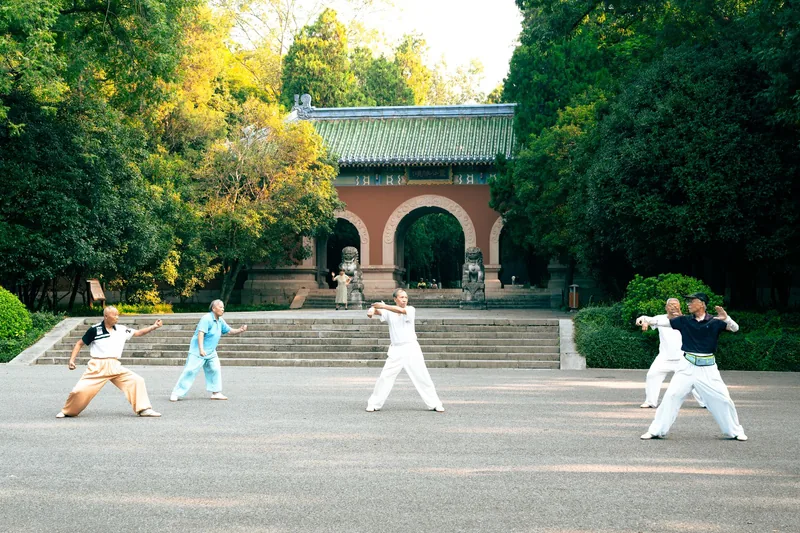
At GMA, Tai Chi is taught under the Golden Talon Kung Fu system led by Grandmaster W. Vardeman, who brings more than 50 years of martial arts experience to the program. The curriculum runs from foundational qigong and empty-hand forms through push hands and self-defense applications to weapon forms — including both the tai chi saber and the double-edged sword. Your instructor will tell you when your foundation is ready to carry a blade.
If weapons training is what draws you in, it’s worth knowing that Golden Talon also includes Wing Chun, whose advanced curriculum features the butterfly swords — covered in our guide to all six Wing Chun forms. Check the class schedule to see when Tai Chi meets at our Gallatin school, voted the top martial arts school in Sumner County.
Ready to Get Started?
Your first class is free. Whether you’re a complete beginner or an experienced martial artist, we’d love to welcome you to the GMA family.
Call us at (731) 324-3847 or book your free trial online.
Frequently Asked Questions
What is the difference between a tai chi sword and a broadsword?
The tai chi sword is the jian, a straight double-edged blade used for precise cuts, thrusts, and deflections. The broadsword, or dao, is a curved single-edged saber used with more powerful chopping and sweeping movements. Many tai chi curriculums, including GMA’s, train both — but they have different characters and different forms.
How long does it take to learn the tai chi sword form?
The 32 Sword Form is short, and many students can learn the sequence in a few months of regular practice once their empty-hand foundation is solid. Performing it well — connected, relaxed, and with the sword moving from the waist — takes much longer. Like the empty-hand form, it’s a practice you refine for years.
Do I need my own sword to start?
No. Beginners usually start with a wooden or loaner sword so they can learn the movements safely and find out what length and weight suit them. Ask your instructor before buying — the right fit matters more than the price.