
Walk past a park early in the morning and you might see two groups moving slowly in the open air. One is flowing through a long sequence that never seems to repeat. The other is standing nearly still, repeating one simple motion with the breath. Both look peaceful, and from a distance they look alike. They are tai chi and chi kung (also spelled qi gong or qigong), and while the two are closely related, they are not the same practice. At Global Martial Arts USA in Gallatin, TN, we teach both, and “what’s the difference?” is one of the first questions new students ask.
This guide explains what each practice is, where they came from, how they differ in structure and purpose, and how to decide which one to start with.
What Is Qi Gong (Chi Kung)?
Qi gong and chi kung are the same word written two ways. “Qigong” is the modern Pinyin spelling; “chi kung” is the older Wade-Giles spelling you will still see on book covers and class flyers. Both are pronounced roughly “chee-gung,” and the name translates to “energy work” or “breath skill” — qi meaning breath or vital energy, gong meaning skill cultivated through steady effort.
Qigong is not one routine. It is a broad family of exercises that coordinate posture, slow movement, breathing, and focused attention. Some sets are done standing still, some seated, and some with gentle repetitive movement. Practices of this kind go back more than two thousand years in China — a silk painting of breathing-and-stretching exercises found in a Han dynasty tomb dates to the second century BC. Well-known sets that are still practiced today include the Eight Pieces of Brocade (Ba Duan Jin) and the Five Animal Frolics (Wu Qin Xi).
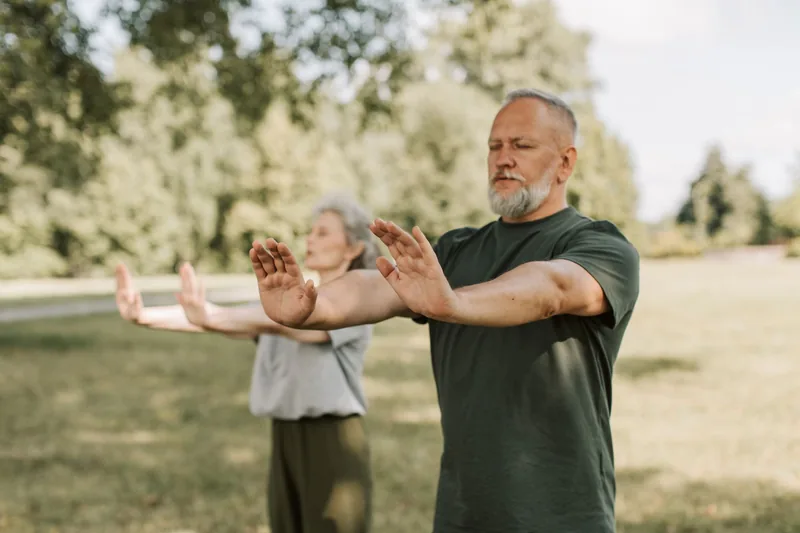
The defining feature of qigong is simplicity. A typical exercise is a single movement or posture repeated several times with the breath. You can learn a basic qigong exercise in one session and practice it in a space the size of a doormat.
What Is Tai Chi?
Tai chi — properly tai chi chuan, or taijiquan — means roughly “supreme ultimate fist.” The word “fist” is the giveaway: tai chi is a martial art. It took shape in China around the 17th century, traditionally traced to the Chen family village, and later branched into several family styles. The most widely practiced today is Yang style, the style we teach at GMA. If you want the background on how it developed, our guide to Yang style tai chi covers its history and character.
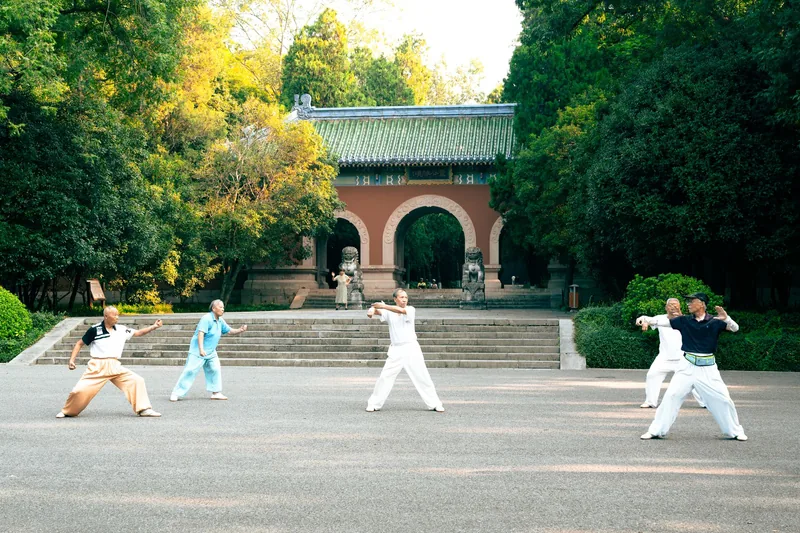
Tai chi is built around forms: long, continuous sequences of connected movements, each with a name and a martial meaning. A “Brush Knee” is a deflection and a push. “Single Whip” is a strike. Practiced slowly, those movements become a moving meditation. Practiced with a partner, they become self-defense. The popular tai chi 24 form, for example, links 24 movements into one unbroken routine that takes several minutes to complete.
Tai Chi and Chi Kung: The Key Differences
Here is the simplest way to understand tai chi and chi kung: qigong is the building blocks, and tai chi is a complete structure built from them. Tai chi uses the same breathing, relaxation, and body awareness that qigong develops, then organizes them into a martial system. That is why many teachers describe tai chi as a form of qigong, but not every qigong practice is tai chi.
The practical differences come down to five things:
- Structure. Qigong exercises are short and repetitive. Tai chi forms are long sequences of different movements that must be memorized.
- Purpose. Qigong is practiced mainly for health, breathing, and calm. Tai chi does all of that and also trains martial applications — balance under pressure, redirecting force, and striking.
- Learning curve. You can do a useful qigong routine after one lesson. A full tai chi form takes months to learn and years to refine.
- Footwork. Much of qigong is done with the feet planted. Tai chi constantly steps, turns, and shifts weight from leg to leg, which is a big reason it is studied for balance.
- Partner work. Qigong is usually solo. Tai chi includes partner drills such as push hands, where you learn to feel and neutralize another person’s force.
What They Have in Common
For all their differences, the two share a lot. Both are low-impact and done slowly. Both pair movement with deep, relaxed breathing. Both ask you to keep your attention on the body instead of drifting through your to-do list, which is why both are often described as moving meditation — a theme we explore further in tai chi and meditation.
The research tends to group them together, too. A widely cited 2010 review in the American Journal of Health Promotion looked at 77 randomized controlled trials of qigong and tai chi and found consistent evidence for benefits including balance, bone health, heart and lung fitness, physical function, and quality of life. Results vary from person to person, and neither practice replaces medical care, but both have a solid track record as gentle, sustainable exercise. Our overview of tai chi benefits goes deeper on what the studies show.
Which Should You Start With?
The honest answer is that you do not have to choose. At GMA, qigong is part of the tai chi curriculum rather than a separate program — students learn qigong breathing and energy-cultivation exercises alongside the Yang style form. Qigong warms up the body and teaches the relaxed breathing that makes the form work; the form gives that breathing somewhere to go.
That said, your goals shape where you put your attention:
- If you want calm and simple daily practice, qigong is the easiest entry point. Ten minutes of standing exercises in the morning is a realistic habit.
- If you want a skill to learn and grow in, tai chi gives you a form to master, partner drills, and a martial art with real depth.
- If balance, mobility, or limited energy is a concern, qigong’s standing exercises let you build confidence before the stepping and turning of a full form.
Either way, both are easy to keep up between classes. Our guide to tai chi at home shows how to build a short daily routine.
Learning Tai Chi and Qigong at GMA
Our tai chi program is led by Grandmaster W. Vardeman, founder of the Golden Talon Kung Fu system, with more than 50 years of martial arts experience. Classes cover Yang style forms, qigong exercises, and the self-defense applications hidden inside the movements. No flexibility, fitness, or experience is required — beginners work at their own pace, and if you are brand new, our tai chi for beginners guide explains what your first class looks like. Recovery and nutrition support any training habit, and some students choose to fuel their training with GMA Warrior Supplements.
Global Martial Arts USA has served families in Sumner County for more than 50 years and has been voted the top martial arts school in the county. You can view the class schedule to find a tai chi class that fits your week.
Ready to Get Started?
Your first class is free. Whether you’re a complete beginner or an experienced martial artist, we’d love to welcome you to the GMA family.
Call us at (731) 324-3847 or book your free trial online.
Frequently Asked Questions
Is tai chi a type of qigong?
Many teachers consider it one. Tai chi uses the same breathing, relaxation, and body awareness that qigong develops, so it is often described as a form of qigong. The difference is that tai chi organizes those principles into long forms with martial applications, while most qigong is short, repetitive, and practiced purely for health.
Are chi kung and qigong the same thing?
Yes. “Chi kung” is the older Wade-Giles spelling and “qigong” is the modern Pinyin spelling of the same Chinese word. Both are pronounced roughly “chee-gung” and refer to the same family of breathing and movement exercises.
Which is easier to learn, tai chi or qigong?
Qigong is easier to start. Most qigong exercises are a single movement repeated with the breath, so you can practice one after a single lesson. Tai chi forms are longer sequences that take months to learn, but many students find that learning a form is a big part of what keeps them coming back.